
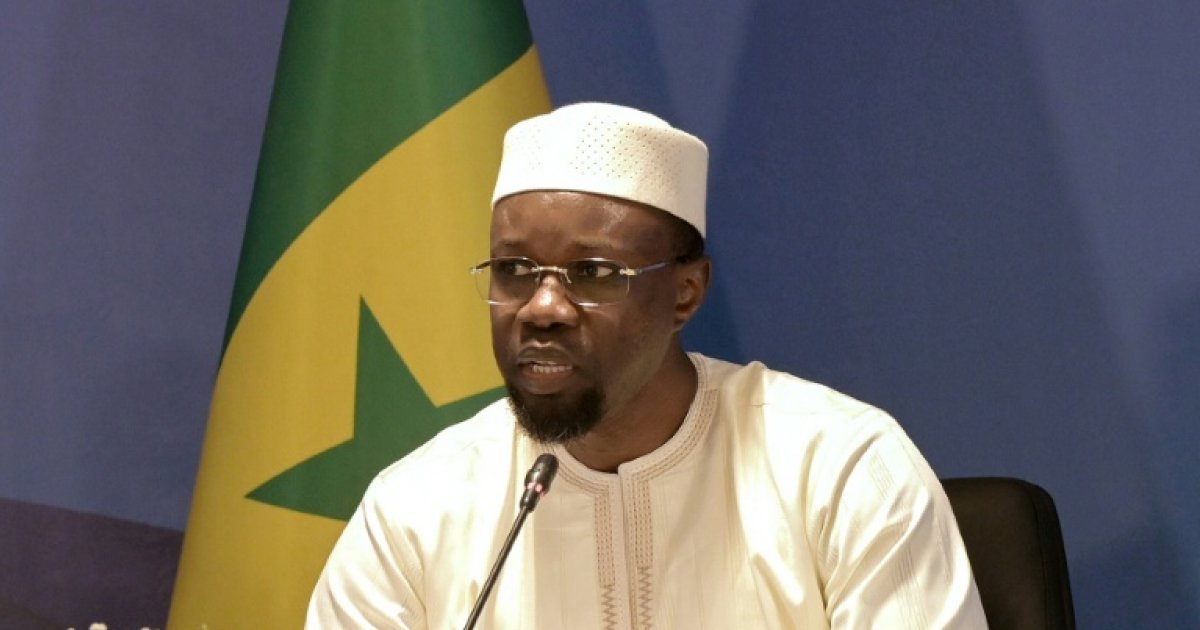
Senegal’s president dismisses Prime Minister Ousmane Sonko
Dakar, Senegal — President Bassirou Diomaye Faye has removed Prime Minister Ousmane Sonko from office, marking a significant shift in Senegal’s political landscape. The announcement, delivered via national television by presidential secretary-general Oumar Samba Ba, stated that Sonko’s dismissal included all government members who will now handle current affairs until further notice.
The president did not indicate whether a new Prime Minister would be named immediately, leaving the nation questioning the next steps in governance.
The end of a tumultuous partnership
Since their rise to power in April 2024 on a wave of popular hope, tensions between President Faye and Prime Minister Sonko had steadily escalated. Once close allies, their relationship deteriorated as Sonko’s growing influence within their party, the PASTEF, began to overshadow the president’s agenda.
Sonko, a vocal critic of former President Macky Sall’s administration (2012–2024), had been barred from running in the 2024 presidential election due to a defamation conviction that stripped him of civil rights. He subsequently endorsed Faye as his replacement in the race, campaigning under the slogan “Diomaye Moy Sonko” (“Diomaye is Sonko” in Wolof), which resonated deeply with Senegal’s disillusioned youth.
The political duo had navigated months of unrest, including violent crackdowns on protests against Sall’s potential third-term bid. Their alliance, forged during a critical amnesty law that freed both from prison, now appears fractured beyond repair.
Sonko’s supporters rally in defiance
Within hours of the announcement, Sonko’s supporters gathered outside his residence in the Dakar neighborhood of Keur Gorgui, chanting and celebrating his dismissal as a victory. Sonko himself took to social media, posting: “Alhamdoulillah. Tonight, I will sleep peacefully in Keur Gorgui.”
The government’s decision has sparked speculation about the future of the PASTEF party, which dominates Senegal’s National Assembly following its landslide victory in the 2024 legislative elections. Critics argue that recent electoral reforms, passed with the president’s approval, were tailored to bolster Sonko’s eligibility for the 2029 presidential race—a move his opponents condemn as political manipulation.
Earlier this year, the Supreme Court upheld Sonko’s 2023 defamation conviction, reigniting debates over his eligibility. However, his party maintains he remains a viable candidate after winning a parliamentary seat in 2024, though he chose to retain his Prime Minister role instead.
Economic strain and political uncertainty
The rift comes at a precarious time for Senegal, which faces severe economic challenges. The outgoing government inherited a debt equivalent to 132% of GDP—the second-highest in Sub-Saharan Africa, according to the International Monetary Fund (IMF). In 2024, the new administration accused the previous government of concealing the true state of public finances, leading to the suspension of a $1.8 billion IMF aid program.
President Faye’s popularity, though strong, has not matched the fervor surrounding Sonko, whose PASTEF movement remains a dominant force in Senegalese politics. With local elections slated for 2027 and the 2029 presidential race looming, the power struggle between the two figures could redefine the country’s trajectory.