
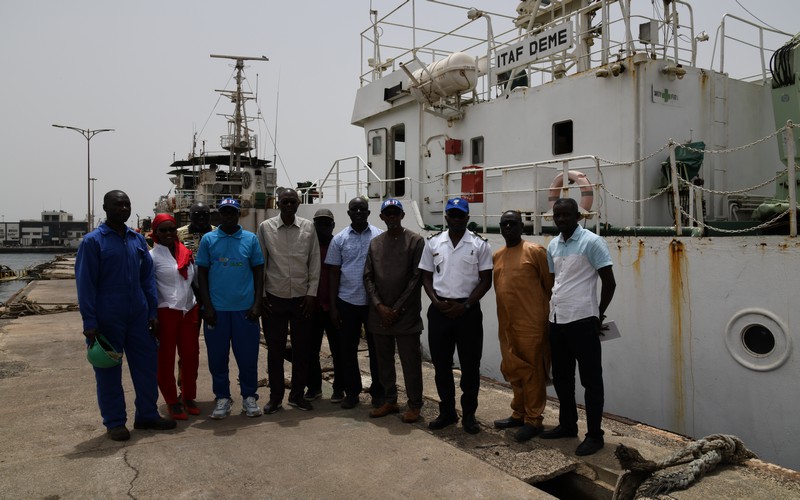
Senegal is taking decisive steps to revitalize its maritime research capabilities by rehabilitating the ITAF Dème, a key oceanographic and fisheries research vessel. The announcement follows an official inspection of the vessel at the Port of Dakar, highlighting the government’s commitment to strengthening national sovereignty in marine resource management.
The ITAF Dème, operated by the Dakar-Thiaroye Oceanographic Research Centre (CRODT) under the Senegalese Institute of Agricultural Research (ISRA), has been out of service since November 2022. Its temporary halt has disrupted critical scientific missions, including fisheries stock assessments, marine ecosystem monitoring, and oceanographic data collection—all vital for sustainable marine resource management.
Why the ITAF Dème matters for Senegal’s blue economy
This research vessel serves as a cornerstone of Senegal’s blue economy strategy. By enabling local scientists to conduct independent marine research, it reduces reliance on foreign expertise while reinforcing the country’s leadership in regional fisheries and oceanographic science. The vessel’s capabilities extend beyond data collection; it also plays a pivotal role in training the next generation of marine scientists and technicians.
Ministerial inspection signals progress in vessel rehabilitation
On May 14, 2026, Dr. Mamadou Abibou Diagne, Secretary-General of the Ministry of Fisheries and Maritime Economy, conducted an on-site evaluation of the ITAF Dème. Joined by ISRA’s Director General, Dr. Moustapha Guèye, Secretary-General Youssoupha Bâ, and CRODT Director Dr. Ismaïla Ndour, the visit aimed to assess the feasibility of restoring the vessel to full operational status.
The vessel’s commander, Seydina Hamza Amar, presented a technical assessment confirming that the ITAF Dème remains structurally and functionally viable. His report outlined a clear path forward for rehabilitation, ensuring the ship can resume its scientific missions without delay.
Government prioritizes fisheries research and sustainable ocean governance
Following the inspection, Dr. Diagne reaffirmed the state’s dedication to expanding Senegal’s maritime research infrastructure. While plans for a new research vessel are underway, the government is equally focused on restoring the ITAF Dème to operational readiness. The vessel’s reactivation is expected to enhance the country’s ability to monitor fish stocks, enforce sustainable fishing quotas, and negotiate favorable fisheries agreements with international partners.
CRODT warns of setbacks from prolonged vessel downtime
Dr. Ndour emphasized the far-reaching consequences of the ITAF Dème’s immobilisation. As Senegal’s sole dedicated fisheries research vessel, its absence has stalled critical activities such as stock assessments, which are essential for setting sustainable fishing limits and securing profitable bilateral fishing agreements. The halt in operations has also weakened Senegal’s regional influence in marine science, where it has long been a leader in West African fisheries research.
Despite these challenges, Dr. Ndour expressed optimism about the government’s renewed commitment to addressing the sector’s bottlenecks, including outdated equipment, operational constraints, and gaps in marine resource monitoring.