

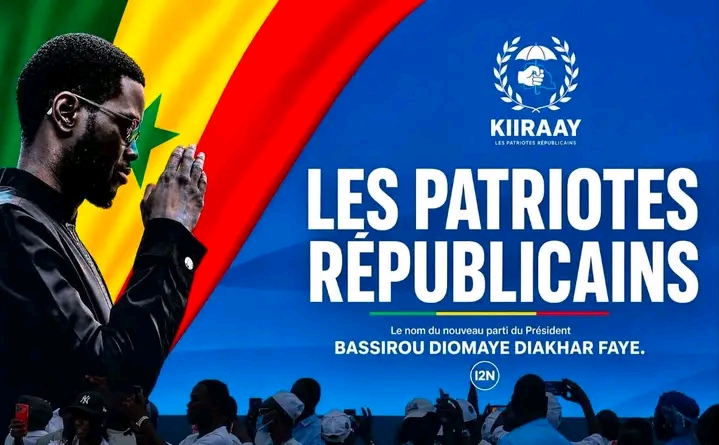
KIIRAAY emerges as a new political force in Senegal’s evolving landscape
Dakar — President Bassirou Diomaye Faye has inaugurated his latest political project, KIIRAAY – Les Patriotes Républicains, in a landmark event held in the capital on Saturday, July 25. The launch signals a pivotal shift in Senegal’s political landscape following his departure from the former PASTEF, once led by his former mentor, Ousmane Sonko.
The new party was formally introduced during a foundational assembly convened at a prominent hotel in Dakar. Its guiding principle, « La Patrie d’abord » (« The Nation First »), underscores a commitment to prioritizing national interests, reinforcing republican institutions, and strengthening the rule of law. The party’s name, derived from Wolof, translates to « what protects, » symbolizing its mission to safeguard Senegal’s future through cohesive governance.
A unifying political project
During the assembly, delegates unanimously elected Bassirou Diomaye Faye as the party’s president, formalizing his transition from his former political affiliation. The creation of KIIRAAY stems from the merger of 437 political parties, movements, and associations, all aligned to support the President’s reform agenda and national development goals.
According to the resolution presented by Aminata Touré, the former coalition’s general supervisor, KIIRAAY represents more than a political shift—it embodies a collective vision to consolidate the progress made under the administration’s governance model. This initiative aims to foster unity among stakeholders committed to Senegal’s Vision 2050 development strategy.
Economic and diplomatic implications
The emergence of KIIRAAY is being closely monitored by international partners, investors, and development stakeholders. In a context where Senegal is advancing its Vision 2050 roadmap, institutional stability and transparent governance remain critical to sustaining market confidence, attracting foreign investment, and deepening international partnerships.
As Senegal prepares for upcoming electoral cycles, the advent of this new political formation could reshape the dynamics within the presidential majority and opposition blocs. It may also influence the trajectory of future economic and institutional reforms, setting the stage for a new phase in the country’s political and developmental journey.