
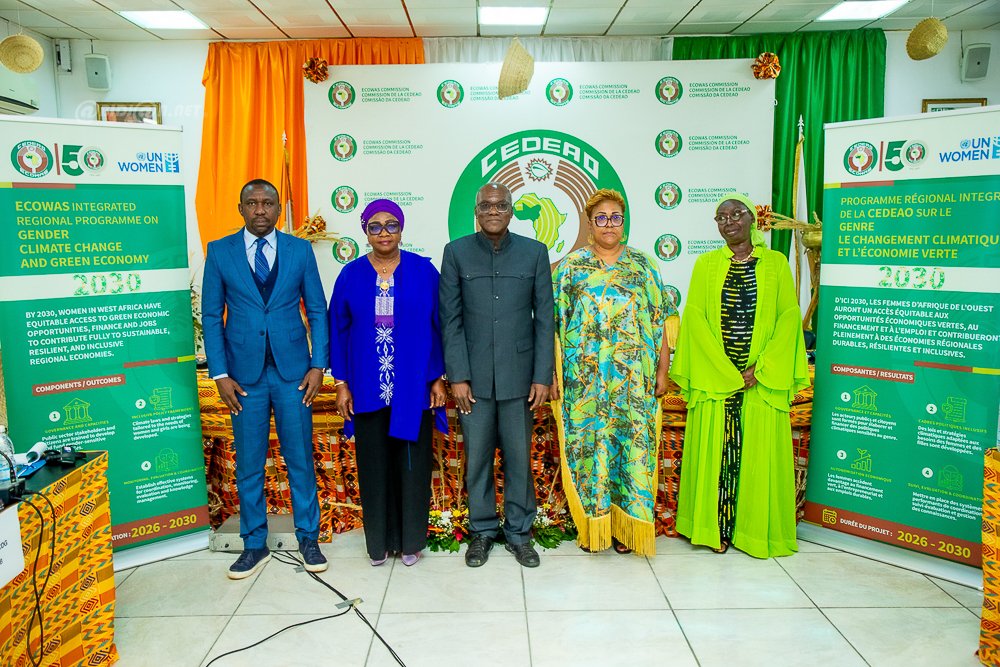
CEDEAO convenes high-level regional dialogue on gender-responsive climate action in Abidjan
Abidjan served as the focal point for a pivotal two-day regional workshop convened by the Economic Community of West African States (ECOWAS), bringing together policymakers, gender experts, and climate stakeholders to chart a gender-sensitive pathway toward a sustainable green economy. Organised by the ECOWAS Centre for Gender Development (ECGD) with support from UN Women, the gathering addressed the intersection of gender equality, climate resilience, and environmental transition across West Africa.
Inclusive climate strategies take center stage
The workshop, held under the theme “Gender-responsive climate action and green transitions in West Africa”, aims to lay the groundwork for a comprehensive regional program designed to amplify women’s leadership in environmental policy-making and green economic opportunities. At the opening session, Sandra Oulaté, Director of the ECGD, underscored the critical need for inclusive climate strategies, noting that women in the region—particularly in agricultural and rural communities—are disproportionately affected by climate-induced challenges such as droughts, erratic rainfall, and land degradation.
Under the proposed 2030 regional initiative, efforts will focus on expanding women’s access to green financing, sustainable employment, and decision-making roles in environmental governance. The program seeks to bridge gaps in resource allocation, ensuring that women-led initiatives in renewable energy, sustainable agriculture, and climate adaptation receive equitable support.
Côte d’Ivoire commended for gender and climate leadership
Louis-Philippe Boni, speaking on behalf of Côte d’Ivoire’s Minister Delegate for African Integration, praised the country’s progressive strides in gender mainstreaming and environmental stewardship. He highlighted initiatives such as reforestation campaigns, energy transition policies, and efforts to enhance women’s representation in leadership roles as exemplary models for the subregion.
Boni also called for strengthened collaboration among ECOWAS member states to streamline women’s access to green financing mechanisms and deepen their participation in regional climate initiatives. His remarks reflected a growing consensus that gender equality is not only a social imperative but a strategic lever for building climate-resilient economies.
Rural women face mounting climate pressures
Dr. Namizata Binaté, representing Côte d’Ivoire’s Ministry of Women, Family, and Children, drew attention to the severe impacts of climate change on rural women, who bear the brunt of environmental degradation. She emphasized the urgent need for women to be integrated into climate decision-making processes, ensuring their voices shape policies that directly affect their livelihoods and communities.
Echoing this sentiment, Dr. Kalilou Sylla, ECOWAS Commissioner for Economic Affairs and Agriculture, stressed that women are the backbone of West Africa’s agricultural sector yet continue to face systemic barriers in accessing productive resources, land ownership, and financial services. Sylla argued that advancing gender equality is essential to fostering economic resilience and accelerating the region’s transition to a low-carbon future.
Roadmap for a gender-inclusive green economy
By the conclusion of the workshop, participants are expected to finalise key deliverables, including a regional action plan with defined budgets, operational mechanisms, and a clear implementation timeline. The outcomes will guide ECOWAS member states in aligning national climate policies with gender-responsive frameworks, ensuring that no woman is left behind in the push for sustainable development.