
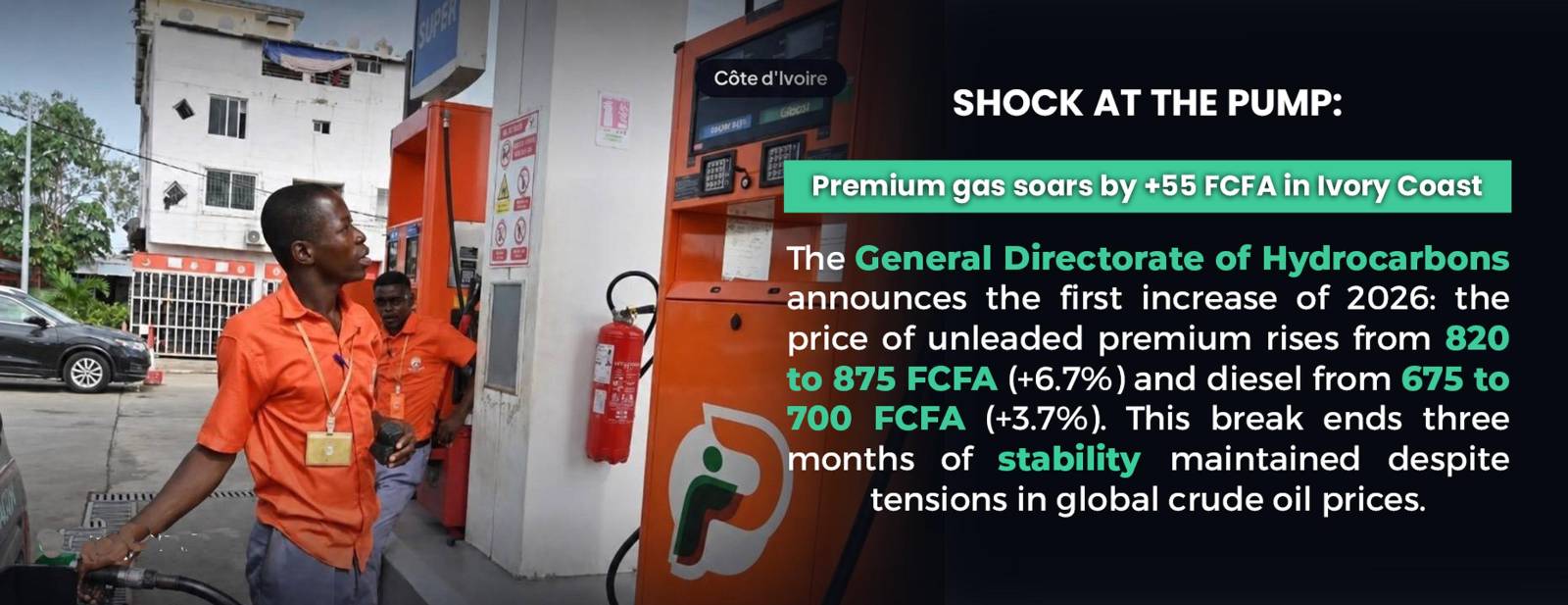
The delicate balance of purchasing power across West Africa has been significantly impacted in May 2026. As households strive to safeguard their savings amidst ongoing inflationary pressures, a striking disparity in fuel costs has emerged at the pumps, contrasting the rates in Côte d’Ivoire with those in Bénin.
Côte d’Ivoire: The Paradox of a Producing Nation
Following a quarter of comparative stability, the Directorate-General for Hydrocarbons in Côte d’Ivoire officially announced the initial price increase for the current year. This adjustment has been met with considerable concern by consumers: the price of Super unleaded gasoline has risen from 820 to 875 FCFA per liter, representing a 6.7% increment, while diesel has surpassed the 700 FCFA per liter threshold.
This revised pricing structure has understandably generated widespread public bewilderment. A fundamental question arises: how can a nation endowed with petroleum reserves, which ought to serve as a natural economic buffer, exhibit higher fuel costs than its neighboring states? Beyond the numerical values, this situation initiates an undeniable ripple effect: every additional franc on a liter of diesel invariably translates into elevated transportation expenses, subsequently driving up the cost of essential commodities.
Bénin’s Strategic Approach: Pragmatism in Policy
In stark contrast, Bénin appears to have prioritized social resilience through its economic policies. Despite not yet possessing significant domestic oil production, the government in Cotonou has implemented an inflation containment strategy. Even with global geopolitical tensions in the Middle East pushing international crude prices upwards, the fuel tariffs established on May 1, 2026, remain remarkably competitive:
- Gasoline: 725 FCFA/L
- Diesel: 750 FCFA/L
The disparity is unequivocally clear: gasoline is priced 150 FCFA lower per liter in Bénin compared to Côte d’Ivoire.
“Our lack of domestic production necessitates stringent fiscal management, yet the paramount objective remains the safeguarding of household purchasing power,” affirmed an individual closely associated with the Béninese executive branch.
By strategically utilizing adjusted taxation or precisely targeted subsidies, Bénin successfully stimulates its local economy, a stark contrast to situations where similar economies appear to be constrained.
Petroleum Wealth: Whose Interests Does It Serve?
This significant pricing discrepancy precipitates a profound discussion concerning resource allocation within the sub-region. For the Ivorian populace, this increase is perceived as an “invisible tax,” directly diminishing their disposable income and impacting both their daily lives and future aspirations.
While Côte d’Ivoire possesses the strategic advantage of oil extraction, it struggles to translate this inherent wealth into tangible benefits for its end consumers. Conversely, Bénin illustrates that a proactive and deliberate policy framework can effectively compensate for the absence of significant natural resources.
A critical and persistent question arises from this scenario: what is the true value of energy sovereignty if it fails to shield its citizens amidst economic turbulence?