

Mali recently observed a state funeral for its former defense minister, Sadio Camara, an event that signified profound national mourning while also highlighting a critical juncture in Malian politics and the broader security situation across the Sahel.
General Sadio Camara tragically lost his life during a significant, coordinated offensive executed by jihadist groups and their Tuareg allies. This assault targeted military installations throughout Mali over the past weekend, marking the most intense attack the nation has experienced in over ten years.
After a two-day period of national mourning, the solemn funeral ceremony was broadcast on state television. It saw the attendance of junta leader Assimi Goïta, accompanied by numerous high-ranking military officers.
During the state funeral, Camara’s coffin was reverently draped in the national flag, showcasing Mali’s green, yellow, and red colors. Large images of the late minister were conspicuously displayed, contributing to the ceremonial, military parade-like ambiance of the event.
Camara stood out as one of the most influential personalities within Mali’s military hierarchy. His pivotal role was instrumental in establishing Russia as the nation’s primary security ally, a strategic shift that occurred following the coup d’état which brought the armed forces to power.
Mali’s Security Landscape and Political Implications
The passing of Sadio Camara represents more than just a national tragedy for Mali; it constitutes a profound strategic disruption. This event has the potential to significantly alter the internal dynamics of the ruling junta, redefine its international partnerships, and impact the overall security framework across the Sahel region.
Historically, the demise of such a highly influential figure as Sadio Camara often destabilizes the internal equilibrium of governing powers in transitional states. Experts are now evaluating that his death, coupled with the significant military setbacks experienced by the Malian army and its Russian-affiliated forces on the battlefield, could precipitate several key outcomes:
- Deepening fractures within the junta
- Reassessment of ties with Moscow
- Reassessment of ties with the Russian Armed Forces
- Reassessment of ties with the Alliance of Sahel States
The implications of these developments extend far beyond Bamako. Regionally, Mali’s strategic pivot from France towards Russia has significantly influenced security policies throughout the Sahel. This shift has particularly impacted discussions in critical areas where insurgency, separatist movements, and governmental fragility converge:
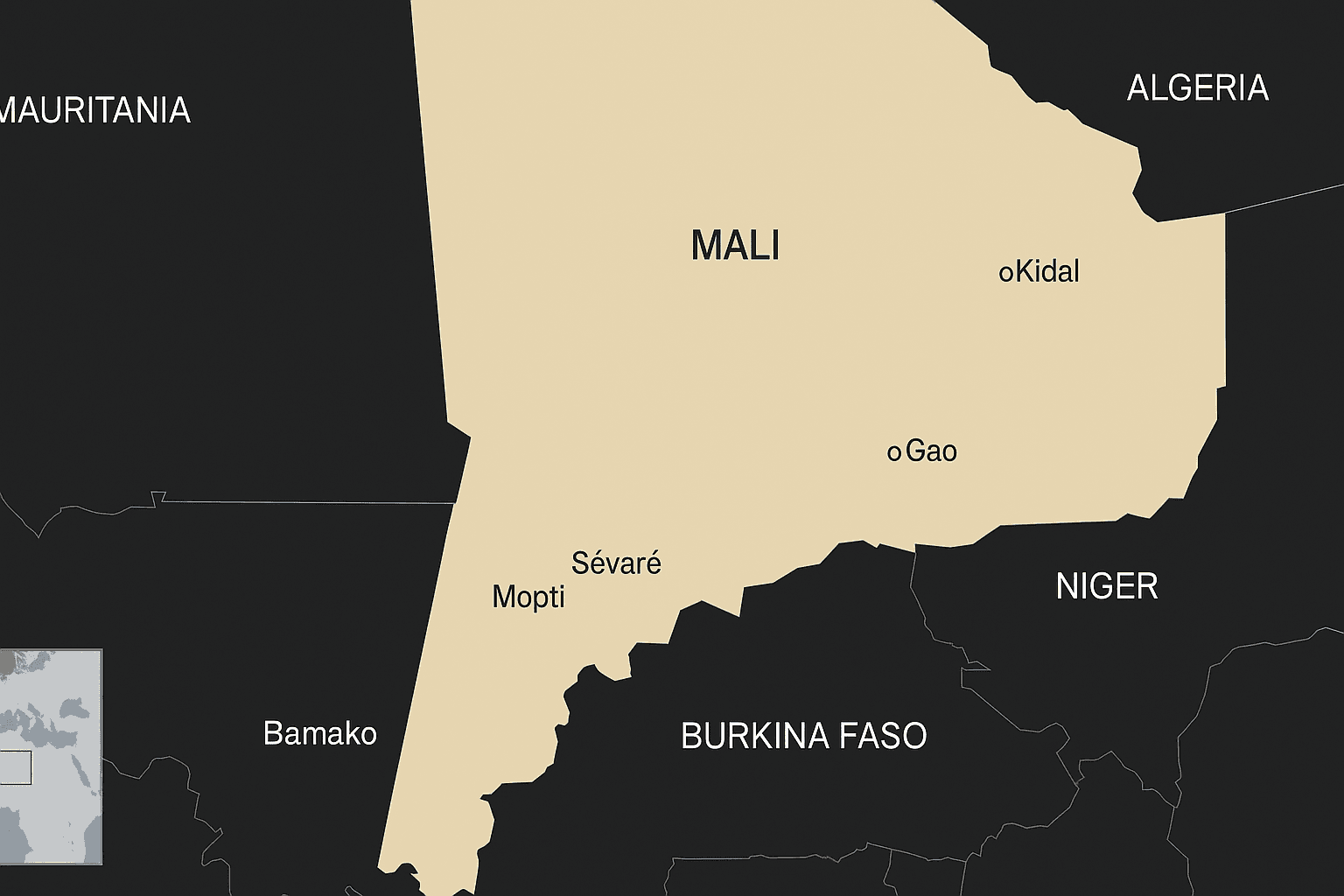
- Gao
- Mopti
- Sévaré
- Kidal
- Other strategic zones
Furthermore, the recent surge in violence underscores the persistent capacity of Jama’at Nasr al-Islam wal-Muslimin and various armed groups linked to Azawad to exert concerted pressure. The continued activity of the Azawad Liberation Front and other separatist factions has reignited worries regarding secessionist ambitions in northern Mali, especially concerning Kidal and the overarching Azawad issue.
The Ascent of Sadio Camara in Mali’s Military
Born in 1979 in Kati, a garrison town near Bamako, Mali, Camara’s life ended in the same location when a car bomb detonated outside his home on Saturday. This explosive attack, involving a vehicle laden with explosives, added significant symbolic resonance, given Kati’s historical importance as a center of military authority in Mali.
Kati transcends being merely a birthplace in Camara’s narrative; it stands as one of Mali’s most politically crucial military hubs. Historically, it has served as a foundational power base for officers who exert considerable influence over events in Bamako. The fact that significant changes in military leadership have frequently originated from Kati underlines both Camara’s profound impact and the broader symbolic weight of his demise in that very location.
During the late 2000s, as a field officer, Camara was deployed in northern Mali. This period coincided with a surge in insurgent activities, with certain factions demonstrating connections to Al-Qaeda-inspired jihadist ideologies.
Following his military academy education, he participated in various international training programs, notably receiving instruction in Russia. This early exposure is believed to have fostered his later strategic inclination towards Moscow as a defense collaborator.
Many citizens of Mali first became aware of Camara in August 2020. He gained public recognition as a colonel, appearing on national television among the five officers responsible for the overthrow of then-President Ibrahim Boubacar Keita.
The officers justified their actions by asserting that Keita’s administration was overly reliant on France and had proven ineffective in curbing the escalating militant violence across the nation. Their declared objective was clear: to enhance national security.
Mali’s Geopolitical Shift: From Coup to Russian Alliance
Subsequent to the coup d’état, the newly established military leadership shifted its focus, embracing Russia as its favored security partner. Concurrently, French military forces and United Nations peacekeepers were compelled to withdraw. Such strategic realignments are common in developing nations, where political leaders often leverage foreign alliances to bolster domestic legitimacy, irrespective of the predictability of operational results.
Camara was central to this significant geopolitical repositioning. He earned widespread recognition as the principal architect behind Mali’s recent outreach and closer ties with Russia, a policy alteration that fundamentally reshaped the nation’s international standing and influenced dynamics throughout the Sahel.
His tenure included serving as defense minister during both consecutive military governments in Mali: initially following the 2020 power seizure, and subsequently after the second coup in May 2021, which saw Assimi Goïta assume leadership.
Camara’s death occurs at a critical juncture, with the ruling junta facing intensifying pressure from various directions. These include a worsening security situation, challenges to internal command unity, ongoing disputes over northern territories like Azawad and Kidal, and increasing questions regarding Russia’s ability to deliver the promised stability. While ceremonial displays, such as a military parade, can convey an image of continuity, the underlying circumstances are considerably intricate. In the realm of governance, while symbolism holds significance, concrete outcomes are paramount. Consequently, the demise of Sadio Camara could prove to be a pivotal event for Mali, impacting Bamako’s security strategies and influencing the future equilibrium among Russia, France, regional stakeholders, and armed factions operating from Gao to Mopti and Sévaré. Even historical allusions to past military coalitions, such as the Allies of World War II, do not alter the contemporary struggle in Mali, which fundamentally revolves around legitimacy, national sovereignty, and survival.