
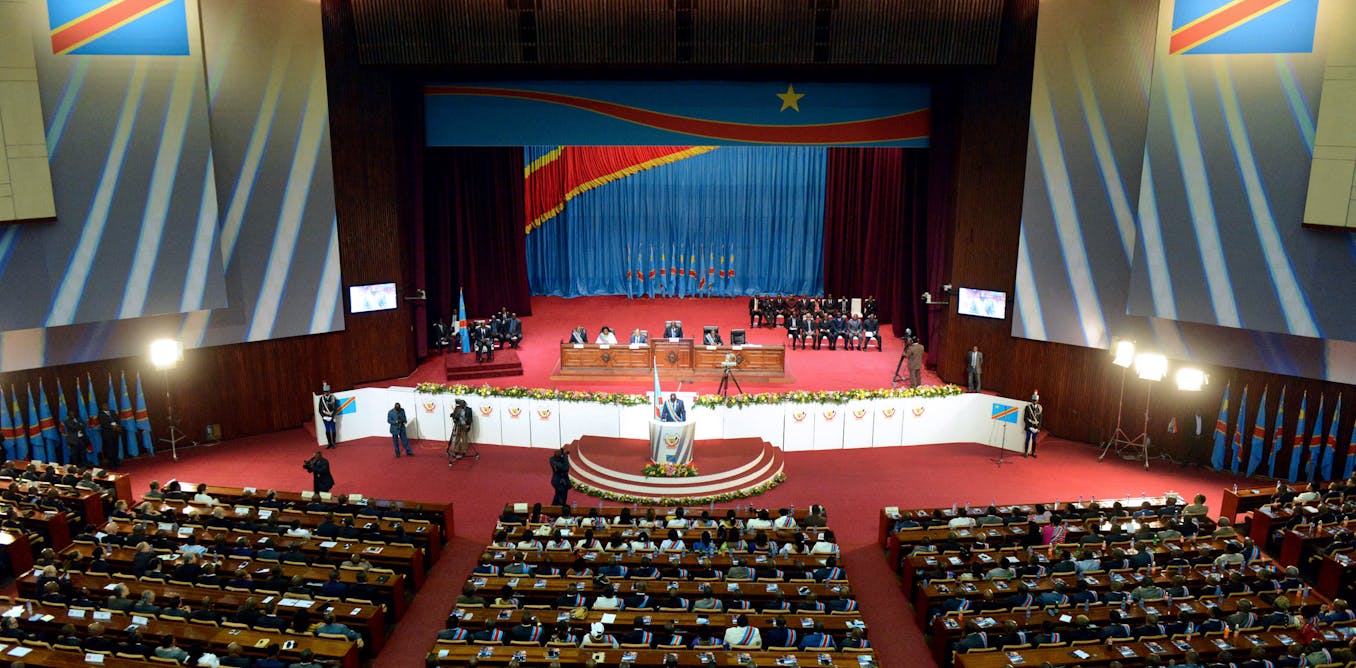
The atmosphere inside the National Assembly turned toxic on May 15, 2026, when misogynistic remarks were broadcast from the very top of the legislative body. During a plenary session, Micheline Mpundu, a national deputy, was concluding a motion of information. As she prepared to step down from the rostrum, Christophe Mboso, the second vice-president who was presiding over the session, chose to publicly comment on her physical appearance. “Thank you, colleague, she is very beautiful… isn’t she?” he remarked from his seat of authority.
The situation escalated as he continued in Lingala, urging the assembly to “observe her for yourselves.” With a laugh, he used his hands to mimic the curves of the deputy’s body, adding that “God created her” and describing her as “the property of another.” These comments were met with loud laughter and applause from the chamber. Remarkably, the session proceeded without interruption, as if such an objective degradation of a colleague was a standard occurrence.
It was only after a wave of outrage from political figures, civil society, and human rights defenders—combined with internal pressure—that Mboso offered an apology several days later. However, no formal sanctions were ever issued against him.
This recent display of verbal violence forces a critical examination of a recurring issue: when will African legislative bodies, particularly in the RDC, stop being hostile environments for the women they are meant to represent?
My political science research into masculinity within Congolese legislative structures suggests that this video is not merely an isolated lapse in judgment. Instead, it reveals a deep-seated structural problem. There is a profound disconnect between the gender equality the RDC authorities have committed to on paper and the daily reality faced by female elected officials.
A structural crisis beyond isolated incidents
Parliamentary violence is a specific branch of the broader abuse women face in the political arena, both in the RDC and globally. Long before the footage of Mboso began circulating in Kinshasa, other instances of sexism had been recorded, highlighting a phenomenon that actively blocks women from fully participating in decision-making processes.
While the early 1990s brought a wave of democratization that tripled the number of women in African parliaments by 2010, the hope that increased numbers would automatically shift institutional culture has proven to be an illusion. In reality, the presence of women is often viewed as a challenge to the established order, triggering structural resistance from male colleagues across the political spectrum. Some still openly argue that politics is a male sanctuary where women do not belong.
Data from the Inter-Parliamentary Union supports this. A 2016 global survey of female MPs across 39 countries found that over 65.5% had been subjected to repeated verbal aggression and insults during their terms. These statistics reflect a grim reality where male colleagues are often the primary aggressors. Furthermore, society often evaluates these women not on their legislative record, but on their appearance, marital status, or how well they fit traditional maternal roles.
Sexism does not stop at the doors of the Parliament; it is brought in by the members and sometimes flaunted from the speaker’s chair. A 2021 study on African parliaments confirmed that progress toward effective political inclusion remains painfully slow.
The applause heard in the RDC chamber is telling. It suggests that the issue isn’t just one individual, but a system that tolerates such behavior. This functions as a control mechanism to keep women in a subordinate position. This “semiotic violence”—expressed through gestures, laughter, and words—serves to remind female deputies that they are viewed as bodies before they are viewed as lawmakers. This naturalization of gender hierarchy often reduces women to something other than equal legislators, regardless of what the constitution says.
Patterns of aggression across the continent
The incident involving Mboso echoes similar events in other African nations. In 2022, Amy Ndiaye, a pregnant deputy in Sénégal, was physically assaulted in the middle of a session. In 2025, Nigerian Senator Natasha Akpoti-Uduagha faced suspension after she dared to speak out against sexual harassment from the Senate President. These cases involving Ndiaye, Akpoti-Uduagha, and Mpundu demonstrate that while African parliaments may tolerate the presence of women, they do not yet fully respect their dignity.
A history of verbal aggression in Kinshasa
The RDC has a documented history of such behavior. On April 30, 2020, then-Senate President Thambwe Mwamba publicly humiliated Senator Bijoux Ngoya during a televised session, making unsubstantiated claims about her personal conduct to undermine her professional aspirations. The session ended in chaos but with little accountability.
Later, on July 15, 2021, Deputy Christelle Vuanga was interrupted during a constitutional debate by Nsingi Pululu, who simply told her, “You are a woman,” in Lingala. It was a blatant attempt to dismiss her expertise based solely on her gender.
The Mboso affair is therefore part of a long-standing pattern. Despite ratifying international conventions and adopting domestic laws, the RDC sees little change within the halls of power. The gap between legal theory and legislative practice remains wide.
Moving beyond symbolic legislation
Decades ago, it was observed that women are often defined as “the other.” In 2026, this status persists in the Congolese Parliament, where female deputies are still reduced to their physical forms rather than their political contributions. This systemic patriarchy undermines democracy itself. As long as sexist behavior remains unpunished, the Parliament remains a misogynistic space.
Currently, women hold only 65 out of 477 seats in the RDC—just 13%—even though they make up nearly 51% of the population. This lack of representation does not excuse the mistreatment they face. While other regions have implemented campaigns like #NotTheCost to protect victims and enforce sanctions, the RDC has yet to turn its legislative promises into action. The failure to sanction Mboso sends a discouraging message to every Congolese woman considering a career in public service. Silence is no longer a viable path forward.