
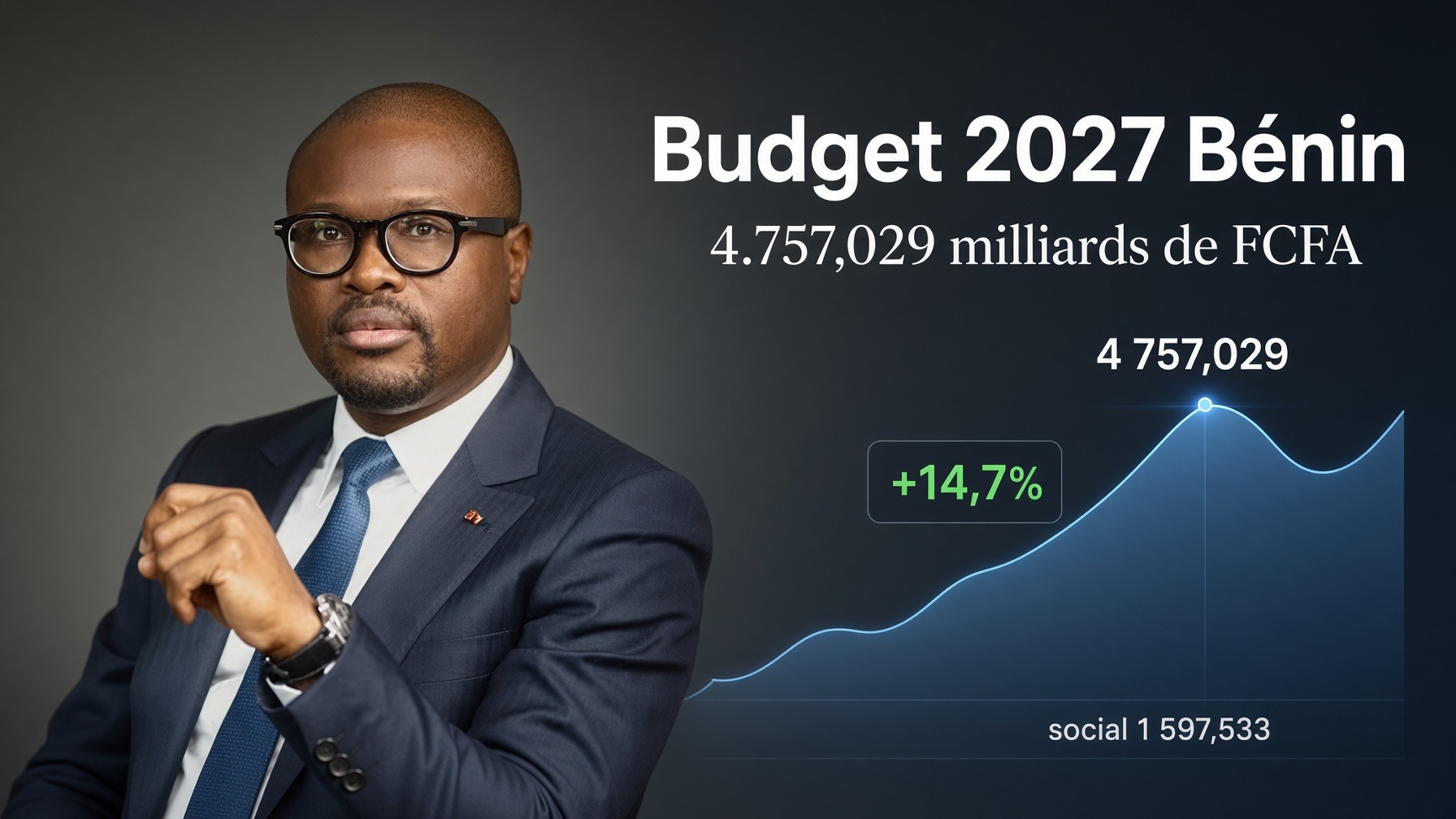
Benin’s government has submitted its 2027 draft budget to the National Assembly, proposing a historic 4,757.03 billion FCFA allocation — a 14.7% surge from 2026’s adjusted budget. The bold move raises a critical question: will this unprecedented investment truly catalyze lasting economic growth, social uplift, and structural transformation across key sectors?
Why a 14.7% budget hike for 2027, and what risks remain
The 2027 budget proposal represents a strategic gamble. It bets on sustaining a 7.5% GDP growth rate while keeping the fiscal deficit at 2.8% of GDP—within the West African Economic and Monetary Union (WAEMU) convergence threshold—and maintaining inflation at a controlled 2.0%. But behind these ambitious macroeconomic targets lies a pressing challenge: translating billions into tangible results for businesses, families, and communities.
Despite the surge in resources—an increase of 608.67 billion FCFA—the government faces a delicate balancing act. Can it invest wisely in critical sectors like agriculture, industry, and technology without compromising fiscal stability or inflating social inequalities?
Five strategic pillars driving the economic vision
The budget’s architecture rests on five core pillars designed to modernize Benin’s economy and improve resilience:
- Agricultural modernization: Boosting productivity, deepening value chains, and promoting local processing to reduce import dependency and raise rural incomes.
- Industrial acceleration: Strengthening local value creation, fostering SME competitiveness, and creating high-quality jobs through targeted incentives and infrastructure.
- Tourism and culture development: Leveraging Benin’s rich cultural heritage and coastal appeal to diversify the economy and generate foreign exchange through sustainable tourism.
- Innovation and digital transformation: Accelerating adoption of digital tools in public administration, agriculture, and education to improve service delivery and reduce inefficiencies.
- Human capital investment: Prioritizing education, vocational training, and social protection to build a skilled, resilient workforce ready for the jobs of tomorrow.
Where will the money go: infrastructure and social priorities
The 2027 budget is not just about spending more—it’s about spending smarter. Public investment will focus intensely on:
- Education infrastructure: building and rehabilitating secondary schools and university facilities, expanding digital learning, and improving access to textbooks and teaching materials.
- Healthcare expansion: constructing five new regional hospitals, upgrading existing district hospitals, and strengthening emergency response systems to reduce maternal and child mortality.
- Energy and water: scaling up rural electrification, improving water supply networks, and integrating renewable energy solutions to support industrial and agricultural zones.
- Digital inclusion: rolling out broadband infrastructure, digital public services, and SMART city projects to enhance connectivity and economic participation.
The government has earmarked 1,597.53 billion FCFA for social-sensitive programs—a 24% increase from 2026—to protect the most vulnerable and expand access to opportunity.
The social safety net: from protection to empowerment
A core feature of the 2027 plan is the deepening of social protection mechanisms designed to break cycles of poverty and exclusion:
- Universal free secondary education for girls: Continuing and expanding the policy to keep adolescent girls in school, reduce early marriages, and improve gender equity in education.
- School feeding programs: Scaling up the national school lunch initiative to enhance learning outcomes and reduce absenteeism, especially among children from low-income households.
- Conditional cash transfers: Expanding the GBESSOKE program to reach more households in extreme poverty, linking support to livelihood development and entrepreneurship training.
- Social emergency response platform: Launching a unified digital portal for social benefits and emergency aid, streamlining access and reducing leakages in welfare delivery.
Healthcare transformation: five new regional hospitals and universal vaccination
The health sector receives a transformative boost with plans for five new regional hospitals and full rehabilitation of existing facilities. Coupled with intensified malaria control, expanded maternal health services, and fortified vaccine campaigns, the budget aims to bring quality healthcare closer to rural communities—critical in a country where geographic access remains a major barrier to care.
Education reform: classrooms, careers, and digital classrooms
The education budget prioritizes three fronts:
- Physical infrastructure: completing ongoing school construction, rehabilitating university laboratories, and upgrading technical training centers.
- Digital learning: scaling tele-teaching platforms to reach underserved regions and integrating ICT into curricula to prepare students for a digital economy.
- Teacher recruitment and career reform: fast-tracking qualified educators into the public system and modernizing career progression to reward merit and reduce brain drain.
The introduction of a new scholarship framework, tied to priority sectors like STEM and agriculture, aims to align education outputs with market demands and reduce youth unemployment.
Local empowerment: communes get a funding boost
In a move toward decentralization, the 2027 budget strengthens financing for municipalities through the new Fonds d’Investissement Communal (FIC) and territorial economic zoning tools. This shift empowers local governments to attract investment, design bottom-up development projects, and ensure resources reach communities equitably.
The goal is to reduce reliance on central transfers, improve transparency in fund allocation, and accelerate delivery of local infrastructure—from roads and markets to health centers and digital hubs.
Can Benin turn ambition into reality? The ultimate test awaits
The 2027 budget is more than a financial document; it is a statement of intent. With a 4.7 trillion FCFA war chest and a suite of targeted reforms, Benin is betting on synergy between public investment, social equity, and economic diversification to propel it toward upper-middle-income status.
But the real verdict will come in the years ahead. Will the schools open on time? Will the hospitals function at full capacity? Will rural farmers see higher incomes? Will young people find jobs in the new factories and tech labs?
The path from billions to better lives is long. Success hinges not only on allocating funds but on execution, accountability, and sustained political will. As the National Assembly debates the budget, the nation watches: Can this unprecedented investment truly transform Benin’s tomorrow?