

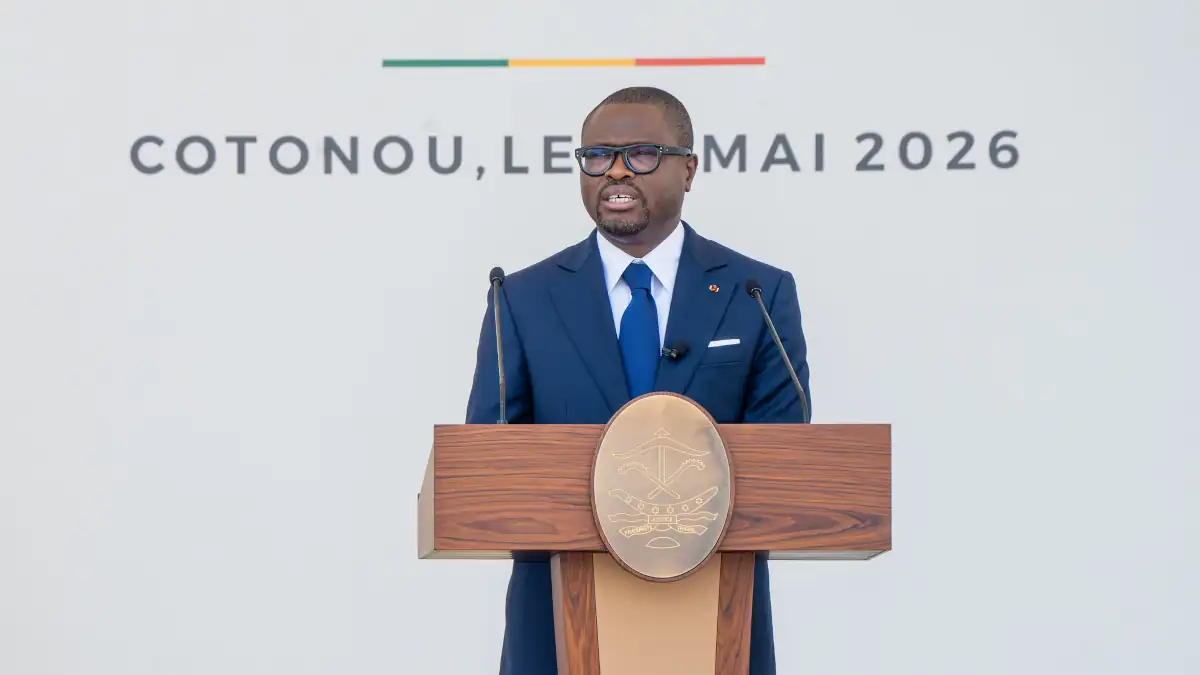
President Wadagni outlines vision for inclusive and secure development
The newly elected President of the Republic of Bénin, Romuald Wadagni, convened the first Council of Ministers of his seven-year term on Thursday, May 28, 2026, at the Palais de la Marina in Cotonou. Just days after his official inauguration, the government gathered to receive the State’s guiding principles and operational framework for the 2026–2033 mandate.
Leadership with a public service mission
In his opening address, President Wadagni extended his congratulations to the newly appointed ministers, emphasizing that their appointment was not a personal favor but a national responsibility. He called on them to embody sobriety, unwavering integrity, and unwavering solidarity in their duties, while rejecting any partisan or self-serving motives in public decision-making.
The Head of State underscored the importance of ethical governance, urging his cabinet to prioritize the public good in every action. His message was clear: public service is a duty, not a privilege, and must be carried out with the utmost transparency and accountability.
Equitable development and territorial cohesion
One of the central themes of the inaugural session was the urgent need to bridge development gaps across Bénin’s municipalities. President Wadagni tasked the government with accelerating policies aimed at reducing disparities between regions through targeted infrastructure investments, improved access to essential public services, and increased budgetary allocations for local governments.
This commitment to territorial equity reflects a broader strategy to ensure that progress reaches every corner of the country, fostering balanced growth and social cohesion.
Strengthening national security as a top priority
The recent surge in armed incidents in northern Bénin has kept security concerns at the forefront of national discourse. During the Council of Ministers, the President reinforced the government’s obligation to maintain robust defense efforts and safeguard national sovereignty. He called for sustained vigilance from defense and security forces to protect communities and restore stability in affected areas.
Streamlined governance for greater efficiency
To enhance operational efficiency, the government announced a restructuring of its institutional calendar. Moving forward, the Council of Ministers will convene on the first Wednesday of each month, with extraordinary sessions scheduled as needed. The Interministerial Committee will meet twice monthly—on the first and third Mondays—to ensure continuous coordination among ministries.
Additionally, joint sessions will be organized, bringing together the Interministerial Committee, the Council of Ministers, and sectoral ministers to address complex policy challenges in a collaborative manner. These changes aim to foster faster decision-making and stronger inter-ministerial collaboration.
This inaugural session marks the formal launch of institutional operations for the new seven-year term, following President Wadagni’s swearing-in ceremony on May 24, 2026.