

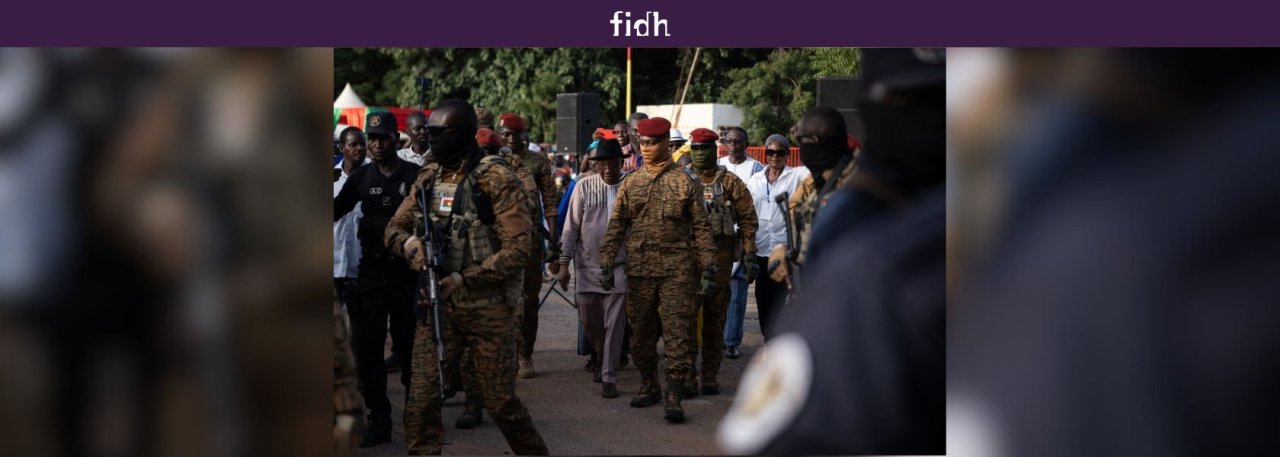
In Burkina Faso, the transitional regime is faltering, with a return to constitutional governance appearing increasingly distant. Two years after seizing power in a coup, the authorities have reneged on their initial commitments by systematically shutting down civic and democratic spaces. This move aims to silence critical voices and curtail fundamental freedoms. The International Federation for Human Rights (FIDH) denounces these widespread human rights abuses and urgently calls for the restoration of the rule of law.
The Burkinabè authorities, who came to power through the military coup of September 30, 2022, have steadily built a system of repression targeting any form of criticism or reporting on human rights violations. Journalists, human rights defenders, and political opponents face daily threats, including attacks, arrests, abductions, unlawful detentions, forced disappearances, and compulsory military service. Their families are also subjected to intimidation. This pervasive climate of fear is intensified by hate speech and calls for violence spread on social media by activists with ties to the regime.
Consequently, the FIDH urges the authorities in Burkina Faso to halt these attacks immediately and release all individuals who have been arbitrarily detained. The Federation also calls on them to uphold their national, regional, and international human rights obligations.
“The muzzling of civil society and the repression of human rights defenders, journalists, and opponents is unacceptable, especially during a transitional period that claims to be rebuilding the state and promoting better governance,” stated Me Drissa Traoré, FIDH Secretary General. “Civil society must be protected. It is essential to free up public discourse by safeguarding the rights to freedom of expression, opinion, association, assembly, and the press.”
Although the regime declared that resolving the country’s armed conflict was its top priority, the FIDH has observed an escalation in violence and abuses against civilian populations by all parties to the conflict. On August 24, 2024, an attack claimed by the Jama’at Nusrat al-Islam wal-Muslimin (JNIM) targeted civilians, defense and security forces, and the Volunteers for the Defense of the Homeland (VDP), resulting in dozens of casualties. These grave crimes were condemned by both the FIDH and the Sahel People’s Coalition.
Forced Conscription of Defenders, Journalists, and Opponents
Since late November 2023, authorities have systematically used forced enlistment as army auxiliaries to target human rights defenders, journalists, and political opponents. Under an April 2023 decree on “general mobilization and warning,” about a dozen individuals have been abducted and sent to the front lines as a punitive measure for their criticism or reporting on human rights abuses. Notable figures subjected to this include human rights defender Dr Daouda Diallo and political figure Ablassé Ouédraogo.
This practice of conscription has also been extended to members of the judiciary, undermining the principles of separation of powers and judicial independence. In August 2024, at least five magistrates, including prosecutors, were forcibly requisitioned and enrolled. This action followed their involvement in judicial investigations or proceedings concerning individuals believed to have close ties to the regime. The conscripted officials include prosecutors from the High Courts of Ouagadougou 1, Boromo, Bobo-Dioulasso, and Gaoua, as well as the senior investigating judge of the Ziniaré High Court and a deputy prosecutor from Bobo-Dioulasso, all requisitioned from August 14 to November 13, 2024.
“Sending magistrates and law enforcement officials to the front lines as retaliation for judicial decisions unfavorable to regime allies is unacceptable. The authorities of Burkina Faso are confirming a disturbing trend: the obstruction of fundamental freedoms, which has been repeatedly condemned by the United Nations, the African Commission on Human and Peoples’ Rights (ACHPR), and our human rights organizations,” said Alice Mogwe, FIDH President. “The Burkinabè state is violating its own Constitution as well as its obligations under the African Charter on Human and Peoples’ Rights and all international instruments and conventions it has signed, particularly those protecting human rights defenders.”
The End of Press Freedom
The authorities in Burkina Faso have systematically curtailed the right to information and press freedom. Local media outlets are under tight control, and major international news organizations have been banned. Journalists are coerced into adopting a “patriotic treatment” of information, meaning coverage that is favorable to the government. They face constant attacks and threats, leading to widespread self-censorship. Investigative journalist Mr. Atiana Serge Oulon, publication director of the well-regarded bi-monthly l’Événement, was abducted from his home by the National Intelligence Agency (ANR) on June 24, 2024. His family has had no contact with him since. His newspaper had been suspended for a month on June 20. On June 19 and 28, 2024, Kalifara Séré and Adama Bayala, a commentator and columnist for BF1 respectively, were abducted following the suspension of the “7 Infos” show on the private television channel. The ACHPR expressed its “deep concern about this situation, which constitutes a serious threat to the physical and moral integrity of journalists, is likely to remove them from the protection of the law, and infringes upon their freedom of expression and opinion.”
Relatives of Exiled Opponents Targeted
In recent weeks, family members of former officials have been subjected to harassment, violence, and abductions. Between September 11 and 16, 2024, at least two relatives of Djibril Bassolé, a former Minister of Foreign Affairs under Blaise Compaoré, were assaulted and kidnapped in Ouagadougou. These abductions are a direct result of incitement to violence by activists aligned with the regime.
“We call on the African Union and the United Nations to coordinate their efforts to urge the authorities in Burkina Faso to end this climate of violence, release the abducted individuals, and respect their physical and moral integrity,” declared Professor Mabassa Fall, FIDH Representative to the African Union.