
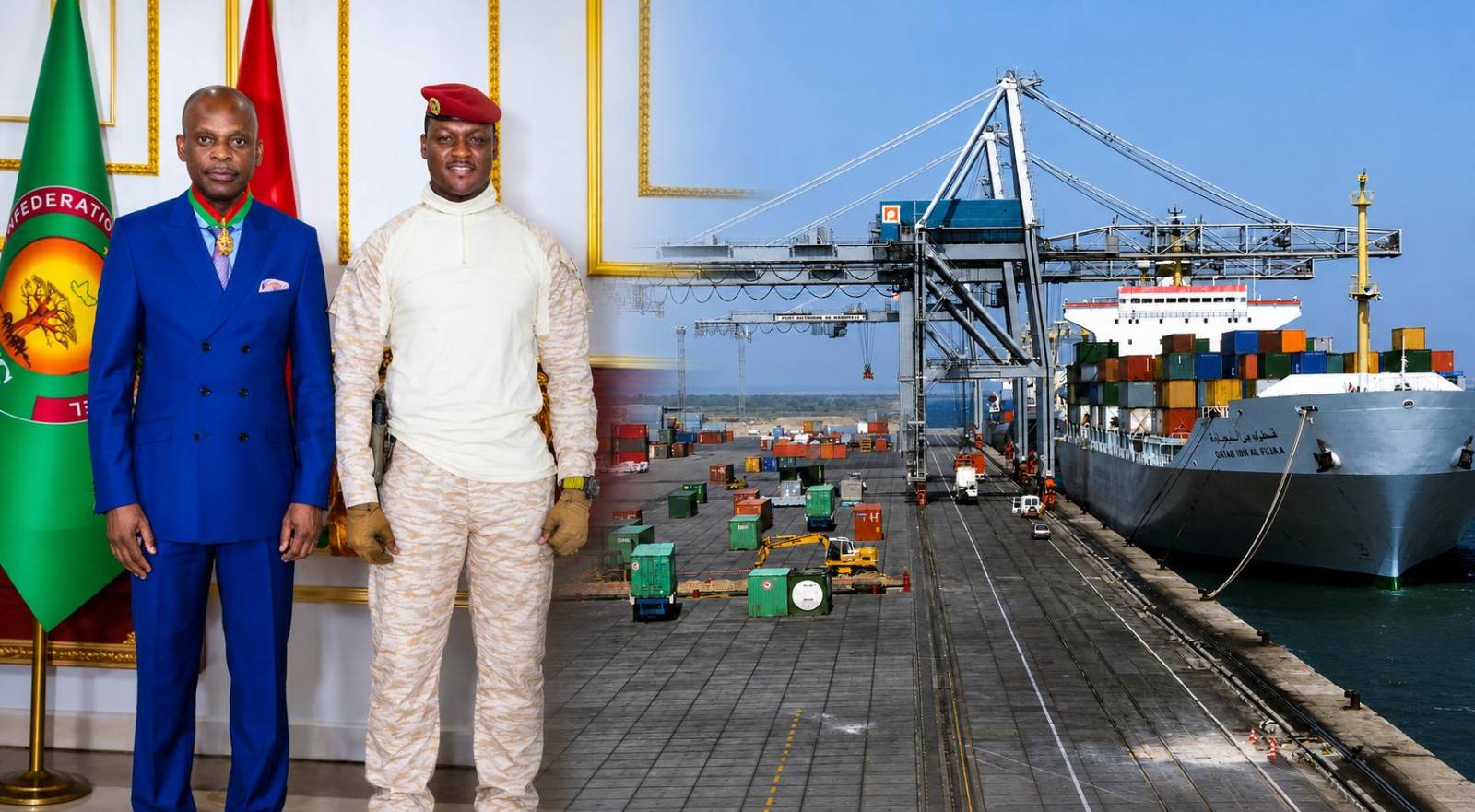
The recent elevation of Togo’s Foreign Minister to the rank of Commander of the Order of the Stallion—the highest honorific distinction in Burkina Faso—has been heralded by official channels as a hallmark of Lomé’s so-called « diplomacy of openness, solidarity, and proximity » toward its neighbors. Yet beneath the veneer of celebration lies a far more nuanced—and less flattering—political reality.
Diplomacy driven by interests, not ideals
The symbolic weight of this honor inevitably raises a critical question: what precisely does this distinction reward? Exemplary diplomatic conduct, or a convergence of interests between two regimes navigating shared political and economic challenges? In international relations, such honors often serve to reinforce alliances, but they can also function as veiled political messages to regional partners.
Behind the scenes, many interpret this accolade as the culmination of a geopolitical charade. The timing of this diplomatic thaw is particularly noteworthy, arriving as it does in the wake of a contentious political betrayal that left a lasting impression. The Togolese government, under President Faure Gnassingbé, had extended asylum to former Burkina Faso President Roch Marc Christian Kaboré—a decision that proved short-lived. Lomé’s swift abandonment of Kaboré in favor of closer ties with Ouagadougou’s new leadership underscores a starkly pragmatic approach to regional alliances.
The primacy of economic pragmatism
For Togo’s leadership, regional solidarity appears to wane when economic interests come into play. By sidelining Kaboré, Faure Gnassingbé prioritized strategic trade agreements with Burkina Faso’s current administration. The primary objective? To ensure the seamless transit of Burkinabé goods and merchandise through the Autonomous Port of Lomé (PAL), thereby securing lucrative logistical contracts.
This strategy is rooted in a shared economic dependency. As a landlocked nation, Burkina Faso relies heavily on maritime corridors for its imports and exports. The PAL represents a vital artery for its trade flows, making the preservation of favorable relations with Lomé a mutual priority. For Togo, the transit of Burkinabé goods constitutes a significant revenue stream, further cementing the economic interdependence between the two capitals. In this context, the dramatic rapprochement between Lomé and Ouagadougou reflects a calculated alignment of interests rather than an ideological kinship.
By trading the fate of a political exile for assurances of logistical dominance, Lomé has laid bare the transactional nature of its so-called « diplomacy of proximity. »
A shifting paradigm in regional diplomacy
The timing of this honor coincides with lingering concerns over governance, political freedoms, and human rights across the subregion. Critics argue that this distinction serves less as a recognition of democratic values or principled cooperation and more as an endorsement of a strategic partnership. The episode exemplifies a broader trend in West African diplomacy, where economic and security imperatives increasingly overshadow traditional commitments to democracy and human dignity.
Alliances are now forged and dissolved in response to commercial interests, logistical necessities, and security imperatives, relegating once-sacrosanct principles to the periphery of diplomatic discourse. The disconnect between official rhetoric and ground-level realities has eroded public trust, particularly among those who once viewed regional solidarity as a moral imperative rather than a transactional convenience.
The chasm between rhetoric and reality
While authorities celebrate this distinction as proof of an exemplary bilateral relationship, the narrative clashes sharply with the underlying pragmatism that defines it. When diplomatic gestures are so transparently tied to economic self-interest, the lofty ideals of African solidarity lose their resonance in the eyes of an increasingly skeptical public.
At its core, this honor reflects a relationship governed by political realism, where raison d’état supersedes ideological consistency. States prioritize strategic interests, trade exchanges, and political stability—even at the expense of ethical coherence. The gulf between diplomatic pronouncements and on-the-ground actions has fueled criticism, highlighting the extent to which pragmatic calculations now dictate the terms of engagement between Lomé and Ouagadougou.
Beneath the veneer of diplomatic cordiality and the gleam of medals adorning official attire lies a cold, unyielding pragmatism. This distinction, far from symbolizing selfless fraternity, appears instead as a reward for a commercial partnership secured at the expense of ethical principles and asylum rights. It is this glaring discrepancy that continues to fuel debate over the true nature of the ties binding Burkina Faso and Togo.