
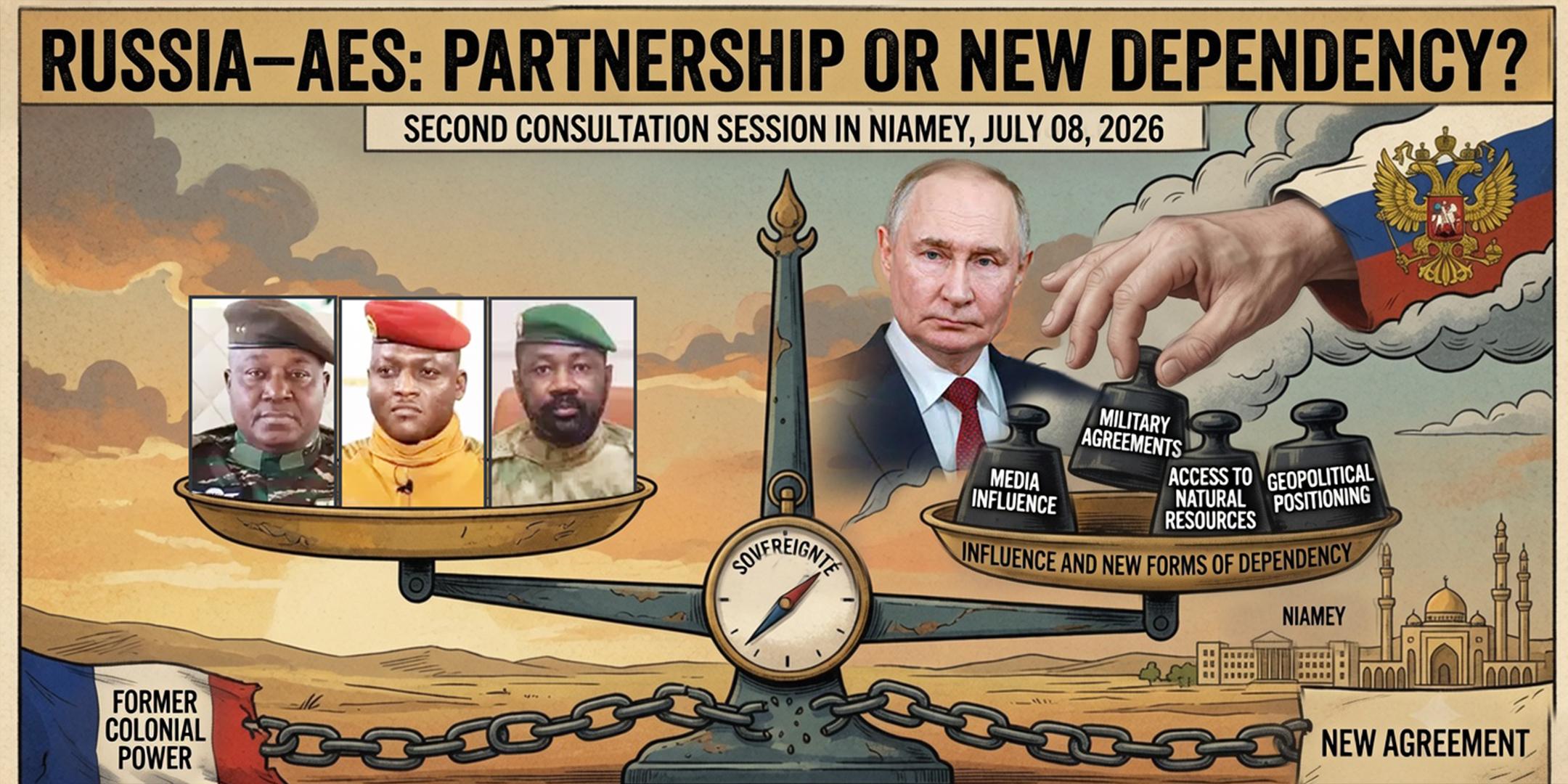
The second session of high-level consultations between the foreign ministers of the Alliance of Sahel States (AES) and their Russian counterpart, Sergey Lavrov, convened in Niamey on July 8, 2026, has been framed by regional authorities as a landmark moment in forging a partnership grounded in sovereignty and mutual respect. However, beneath the official rhetoric, a pressing question emerges: could this alignment inadvertently pave the way for a new reliance on Moscow?
A shift in alliances under the banner of independence
For years, the governments of the AES have criticized the entrenched influence of historical colonial powers, particularly France, in the name of reclaiming national autonomy. Yet, replacing one foreign power with another does not inherently secure greater freedom. Historical precedent demonstrates that state relations are frequently shaped by geopolitical, economic, and strategic imperatives rather than altruism.
Expanding russian influence across the Sahel
The Kremlin has steadily deepened its footprint in the Sahel through a multifaceted approach. Military cooperation, diplomatic agreements, economic exchanges, and cultural and media outreach have all intensified. While AES leaders champion this diversification as an exercise of sovereign choice, critics argue that it raises a critical concern: at what point does this engagement transition from partnership to dependence?
Major powers rarely extend their reach into a region without calculating the potential returns. Whether securing access to natural resources, expanding diplomatic leverage, or solidifying strategic positioning on the African continent, each collaboration serves national interests. Russia’s engagement in the Sahel is no exception to this pattern.
The geopolitical tightrope: autonomy versus alignment
This evolving dynamic has sparked apprehension over its political ramifications. A close alliance with a single dominant power risks constraining the diplomatic maneuverability of Sahelian states, narrowing their capacity to diversify partnerships, and exposing them to the volatilities of international rivalries. In an era defined by great-power competition, there is a tangible danger that the Sahel could become a battleground for external agendas rather than an autonomous player on the global stage.
True sovereignty, as many analysts emphasize, is not merely about selecting a new ally but about preserving the freedom to make independent decisions, maintaining balanced relationships, and defending national interests without succumbing to rigid alignment.
Measuring progress beyond rhetoric
The AES authorities characterize their collaboration with Russia as a “mutually beneficial” endeavor. Yet, this claim must be judged against tangible outcomes: enduring security improvements, sustainable economic growth, job creation, skill transfers, and the strengthening of national institutions. Without demonstrable progress in these areas, declarations of sovereignty may ring hollow to the very citizens they are meant to inspire.
The trajectory of this partnership remains uncertain. Will it empower Sahelian states to assert greater autonomy, or will it merely represent a transition from one sphere of influence to another? For observers, the path to genuine independence lies not in replacing a dominant partner but in cultivating a diplomacy that engages with all parties—without becoming ensnared by any one.