
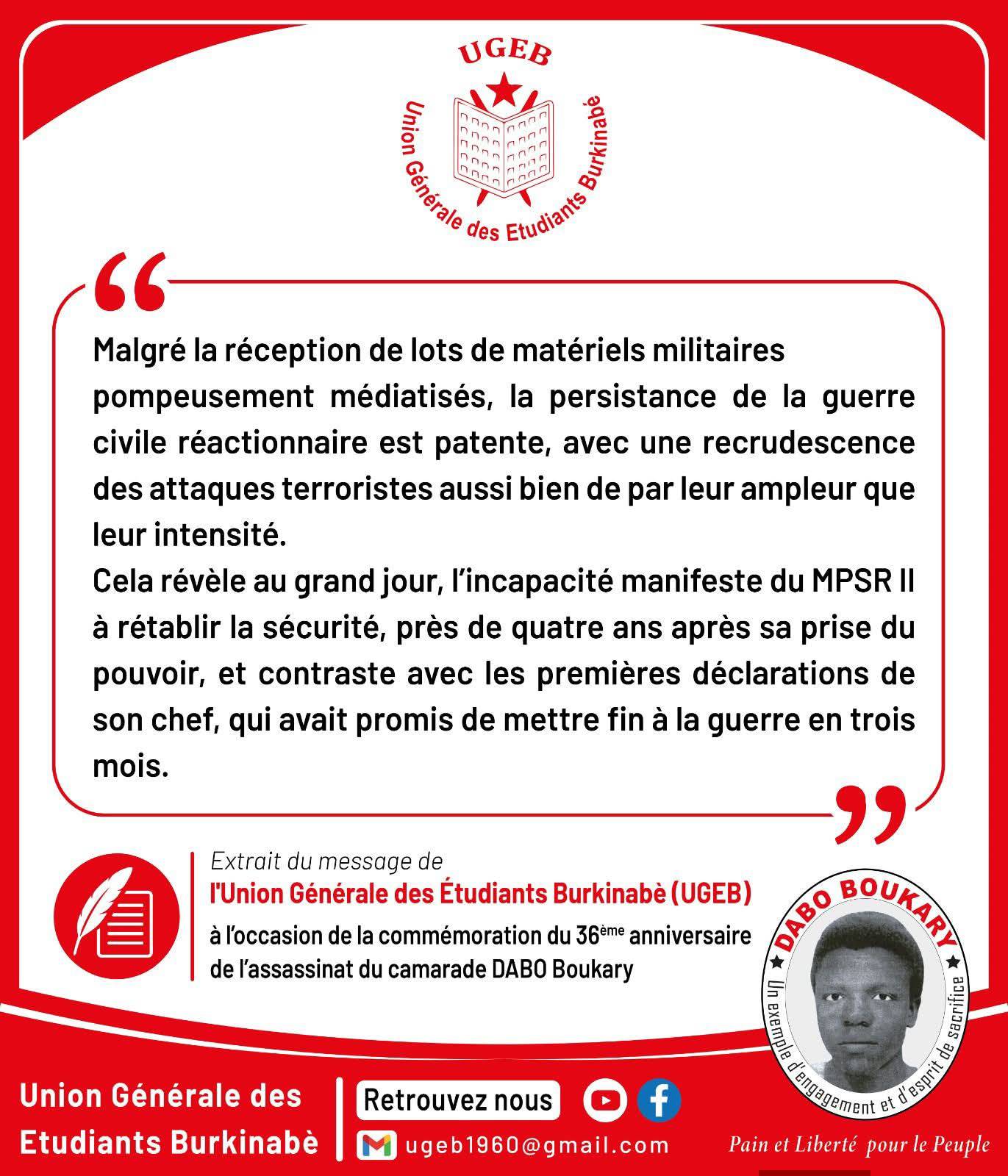
The security situation in Burkina Faso remains alarmingly precarious nearly four years after the MPSR II took power. In a scathing public statement, the Union générale des étudiants burkinabè (UGEB) has openly challenged the outcomes of the transition led by Captain Ibrahim Traoré. From relentless militant strikes to a deepening humanitarian crisis and soaring living costs, the student union has delivered a damning assessment, highlighting the stark inadequacies of Ouagadougou’s current strategies.
From hopeful beginnings to stark reality
When Captain Traoré seized control in September 2022, he inspired cautious optimism in a nation battered by conflict. He hinted at a swift resolution to the security crisis, suggesting a three-month window to turn the tide. Yet, nearly four years later, the UGEB’s verdict is unforgiving: the strategy has fallen far short of expectations.
The student union underscores how the authorities’ early pledges have failed to align with ground-level realities. Far from diminishing, militant attacks have surged in both frequency and intensity. The once-promised swift victory has dissolved into a grinding conflict, leaving a weary public disillusioned by the absence of tangible progress.
Military hardware vs. ground-level effectiveness
The UGEB draws a stark contrast between the government’s glowing military communications and the daily struggles of ordinary Burkinabè. State media has prominently featured the arrival of advanced weaponry—drones, fighter jets, armored vehicles, and heavy weaponry—portrayed as a turning point in the fight against insurgents. Yet, the student union dismisses this as mere spectacle.
Despite the military buildup, militant groups continue to overrun vast swathes of territory. The UGEB argues that the government’s reliance on flashy acquisitions cannot compensate for a lack of cohesive, on-the-ground strategy. Meanwhile, civilians remain trapped in a cycle of fear, with armed incursions disrupting lives across the country.
The twin crises of displacement and inflation
The failure to restore security has triggered a humanitarian and economic meltdown in Burkina Faso. Mass displacement remains one of the most glaring scars of the conflict, with millions of Burkinabè abandoning their homes and livelihoods for the relative safety of urban centers. This exodus has left rural communities devastated, their fields and markets abandoned in the wake of militant advances.
The economic fallout has been equally devastating. Runaway inflation has crippled household budgets, hitting students and low-income families hardest. Basic goods have become scarce in some regions, where militant blockades have choked supply chains. The cost of living has skyrocketed, eroding purchasing power and deepening vulnerability in a population already scarred by years of conflict.
New alliances, same unresolved challenges
Under the MPSR II transition, Burkina Faso has dramatically shifted its military partnerships, severing long-standing defense ties—particularly with France—and forging new alliances, most notably with Russia and the Alliance des États du Sahel (AES). While these changes were framed as a push for greater sovereignty, the UGEB questions their real-world impact.
Despite the arrival of foreign trainers and reinforcements for the Forces de défense et de sécurité (FDS) and Volontaires pour la défense de la patrie (VDP), the peace dividend has yet to materialize. The UGEB contends that these strategic pivots have delivered neither the promised security nor the much-touted gains in territorial control.
A call for honest reckoning
The UGEB’s critique serves as a urgent wake-up call in a political landscape where dissent is increasingly stifled. By exposing the yawning gap between government rhetoric and the reality of unrelenting violence, the union underscores the need for a sober reassessment of the MPSR II’s strategies. With millions displaced and inflation ravaging household incomes, rhetorical victories no longer suffice. For Burkina Faso, the path forward demands more than announcements—it requires tangible, everyday security for all its people.