
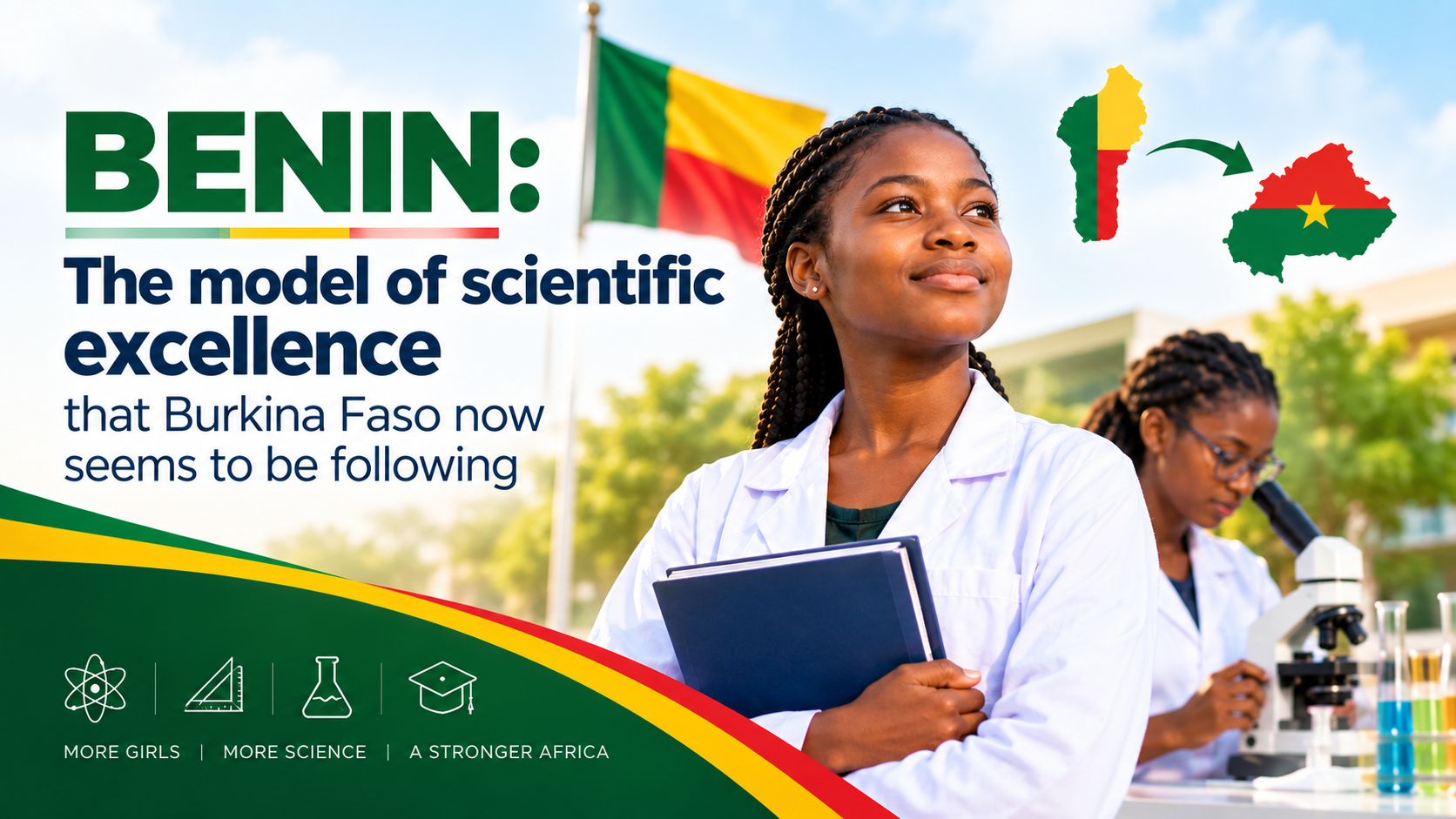
From regional inspiration to national momentum
In West Africa, education systems are increasingly aligning around a shared priority: nurturing the next generation of female scientists. While Benin has long led this charge with its robust academic competitions and inclusive policies, Burkina Faso has now introduced a decisive initiative of its own one that signals a marked shift in its approach to fostering scientific talent among young women.
Benin’s proven pathway to scientific achievement
For years, Benin has positioned academic excellence as a cornerstone of its educational strategy. In 2026, the country reinforced this commitment with the third edition of its General Competition in Mathematics and Physical Sciences, held in Djougou. This event went beyond mere competition: it was paired with an excellence camp designed to identify, mentor, and inspire the nation’s brightest young scientists. The ceremony on August 29, 2026, celebrated not only top performers but also the educators behind their success, underscoring a holistic vision of scientific development.
Benin’s approach is comprehensive. Recognizing that true progress requires more than accolades, the government has taken bold steps to remove financial barriers. As of the 2026-2027 academic year, all girls in public secondary and technical schools benefit from free tuition a measure aimed at dismantling economic obstacles and ensuring equitable access to education. The logic is clear: before girls can aspire to become scientists, they must first have the opportunity to learn.
Burkina Faso’s HAKILI Mousso: a breakthrough in talent detection
In September 2026, Burkina Faso launched HAKILI Mousso, a groundbreaking national initiative dedicated exclusively to identifying and celebrating female scientific talent. The program’s inaugural edition drew 84 high school graduates with science backgrounds, who competed in rigorous assessments covering mathematics, physics, and chemistry. On September 19, the top performers in each discipline were awarded prizes ranging from cash incentives and laptops to scholarships and motorcycles each recognition designed to fuel further academic and professional pursuit.
HAKILI Mousso’s significance lies not only in its format but in its mission. By spotlighting the intellectual capabilities of young women, the initiative challenges entrenched stereotypes about gender and academic potential. Where some programs once prioritized appearances, HAKILI Mousso redefines success by measuring competence, reasoning, and innovation.
The convergence of two nations’ educational visions
Though distinct in execution, Benin’s and Burkina Faso’s strategies share a common objective: to transform the landscape of scientific education. Benin focuses on creating an enabling ecosystem—through competitions, excellence camps, and policy measures like free tuition for girls. Burkina Faso, by contrast, has introduced a targeted national platform to unearth and reward female scientific talent.
The similarities, however, are striking. Both countries are dismantling gendered barriers in STEM fields, encouraging girls to pursue scientific disciplines, and positioning academic excellence as a driver of national development. Where Benin leads with institutionalized reforms, Burkina Faso follows with a bold and visible statement: talent knows no gender, and neither should opportunity.
Beyond competitions: building the workforce of tomorrow
The ultimate goal of these initiatives transcends awards and ceremonies. Africa’s growing economies demand skilled scientists, engineers, and technologists capable of addressing challenges in energy, healthcare, agriculture, and digital innovation. By investing in girls’ education and scientific potential, both Benin and Burkina Faso are laying the groundwork for a more competitive, innovative future.
HAKILI Mousso and Benin’s academic competitions are not isolated events they are part of a broader regional movement. As Burkina Faso reorients its educational priorities, the country is not merely adopting a new program; it is embracing a philosophy that values merit, hard work, and intellectual achievement. In doing so, it joins Benin as a regional leader in fostering a new generation of female scientists poised to shape Africa’s scientific landscape.
Redefining success: the cultural turning point
The timing of HAKILI Mousso’s launch is also symbolic. In June 2026, Burkina Faso suspended local beauty pageants to rethink its models of youth recognition. This pause opened a dialogue about what kinds of achievement deserve public celebration. HAKILI Mousso answers that question directly: it is not beauty, but brilliance, that deserves the spotlight.
This shift reflects a deeper cultural evolution. Both countries are moving away from superficial measures of success and toward a focus on substance intellectual rigor, problem-solving, and innovation. In this transformation, Benin serves as a regional model, while Burkina Faso demonstrates how even established nations can recalibrate their strategies for greater impact.
The ripple effect: what comes next?
The introduction of HAKILI Mousso marks a turning point in Burkina Faso’s educational narrative. But its true value will be measured in the years ahead by the number of young women who pursue advanced studies in science, launch careers in research, and contribute to technological advancement across the continent.
For now, the message is clear: the future belongs to those who prepare for it. Through targeted initiatives and systemic reforms, both Benin and Burkina Faso are ensuring that no talent goes unnoticed and no girl is left behind. As this regional momentum grows, the rest of Africa will be watching.
By Yvette Tchuente — State political analyst