
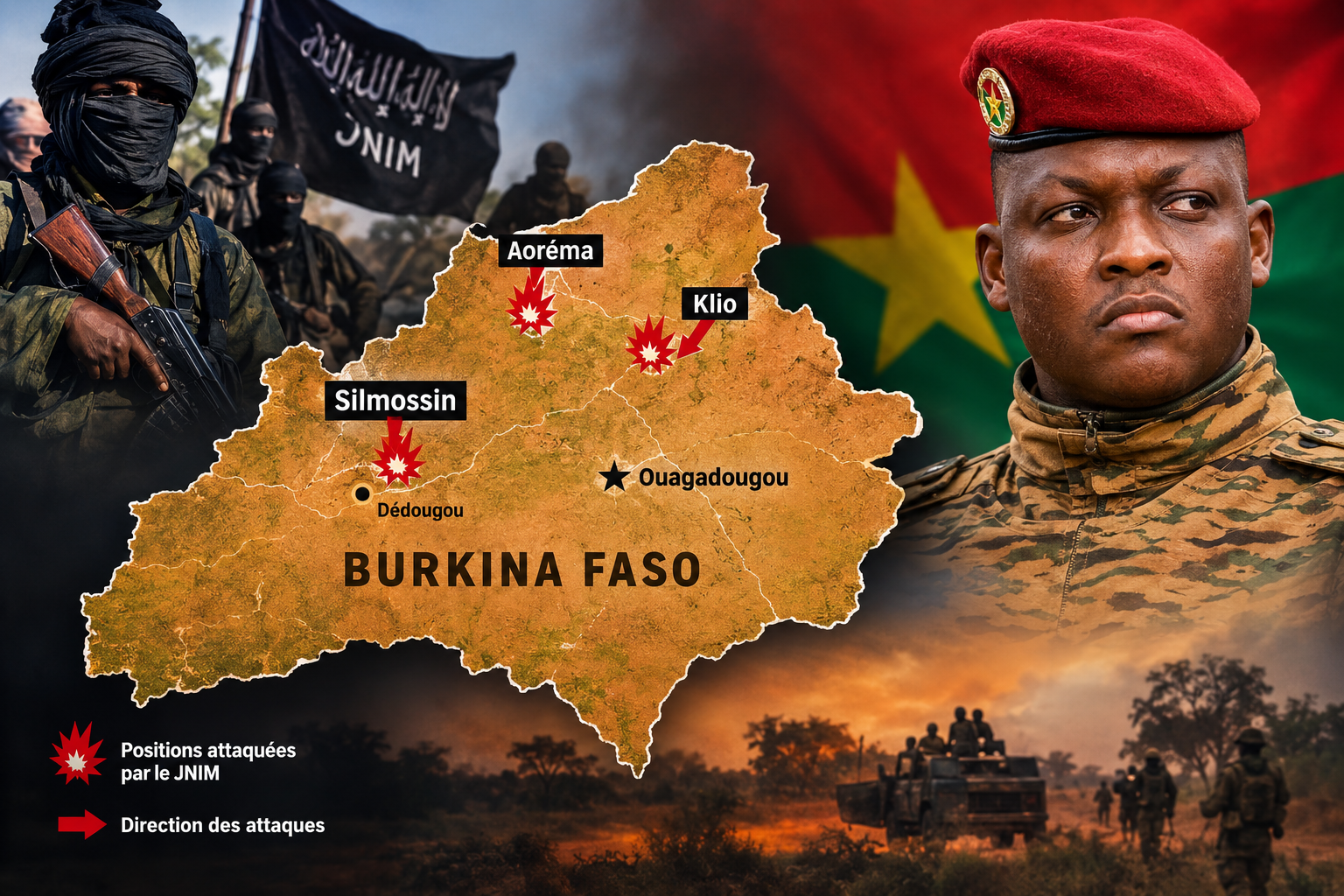
Jihadist group claims control of key military posts in Silmossin
The Group for the Support of Islam and Muslims (JNIM) announced late Friday, September 25, 2026, that it had secured full control over several military outposts operated by Burkina Faso’s militias in Silmossin, close to the city of Dédougou. The same day, the group also claimed responsibility for overrunning two additional positions held by the national army and the Volunteers for the Defense of the Homeland (VDP) in Aoréma and Klio, located in the country’s northern region.
While the authenticity of these claims requires verification, the frequency of such announcements raises a pressing question: How effective is Burkina Faso’s current security strategy under Captain Ibrahim Traoré’s leadership?
From battlefield victories to lasting security: the strategy under scrutiny
Since seizing power in 2022, Traoré’s administration has positioned territorial reconquest, the expansion of national forces, and the mobilization of VDP fighters as the cornerstones of a new security doctrine. However, a military strategy’s success cannot be measured by the number of soldiers deployed, operations announced, or territories reclaimed. True effectiveness lies in the state’s ability to hold ground, safeguard civilians, protect vital infrastructure, and prevent armed groups from re-establishing control in recovered areas.
This sustained capability remains the most glaring challenge.
The double-edged sword of VDP mobilisation
The rapid integration of VDP fighters has broadened the defense footprint, yet it also exposes inadequately trained and equipped volunteers to high-risk positions. Security analysts highlight the JNIM’s adaptability, which relies on superior intelligence, mobility, logistics, and the ability to exploit gaps in surveillance and coordination between units.
Regaining a position does not automatically equate to restoring state authority. For security to be meaningful, it must enable local administrations to function, schools to reopen, markets to operate, farmers to return to their fields, and displaced populations to resettle conditions that continue to elude many areas despite military operations.
Official rhetoric meets battlefield reality
Traoré’s administration has framed sovereignty, mass mobilization, and military reconquest as pillars of its political narrative. State communications frequently underscore national military successes. Yet, when armed groups continue to claim attacks on military or VDP positions, these declarations must be weighed against observable outcomes.
Even official statements acknowledge shortcomings. On September 25, Burkina Faso’s Minister of Foreign Affairs admitted the need to reassess what “has not worked so far,” emphasizing the urgency of preventing youth recruitment by terrorist organizations a clear indication that purely military responses are insufficient.
Jihadist resilience and the evolving threat landscape
The JNIM’s tactics have grown increasingly sophisticated. Reports indicate the group’s enhanced mobility, improved intelligence networks, diversified financing, and the tactical use of drones. These adaptations have intensified pressure on both security forces and civilian populations across the Sahel. The group’s ability to reassert control in previously cleared areas underscores the limitations of traditional counterinsurgency approaches.
For Traoré, the moment of reckoning has arrived. The task is no longer to project an image of progress but to demonstrate through verifiable data and sustained results that the 2022 strategy is genuinely reducing violence and restoring state authority.
A strategy at a crossroads: what comes next?
The JNIM’s latest claims, if substantiated, would signal another critical vulnerability in Burkina Faso’s frontline defenses. Even without full confirmation, the sheer volume of attacks on state-held positions demands examination: Why do certain zones remain so difficult to secure despite increased troop numbers, equipment, and financial resources allocated to counterterrorism efforts?
The answer lies not in short-term victories but in long-term outcomes: permanently secured territories, reduced civilian casualties, stabilized military losses, unhindered movement, the return of displaced communities, operational public services, and the durability of reclaimed positions.
Without transparent, accessible data to validate these indicators, the gap between official narratives and ground-level realities will continue to fuel skepticism. In asymmetric warfare, slogans do not win battles only tangible, lasting results do.
By Yvette Tchuente — State political analyst