
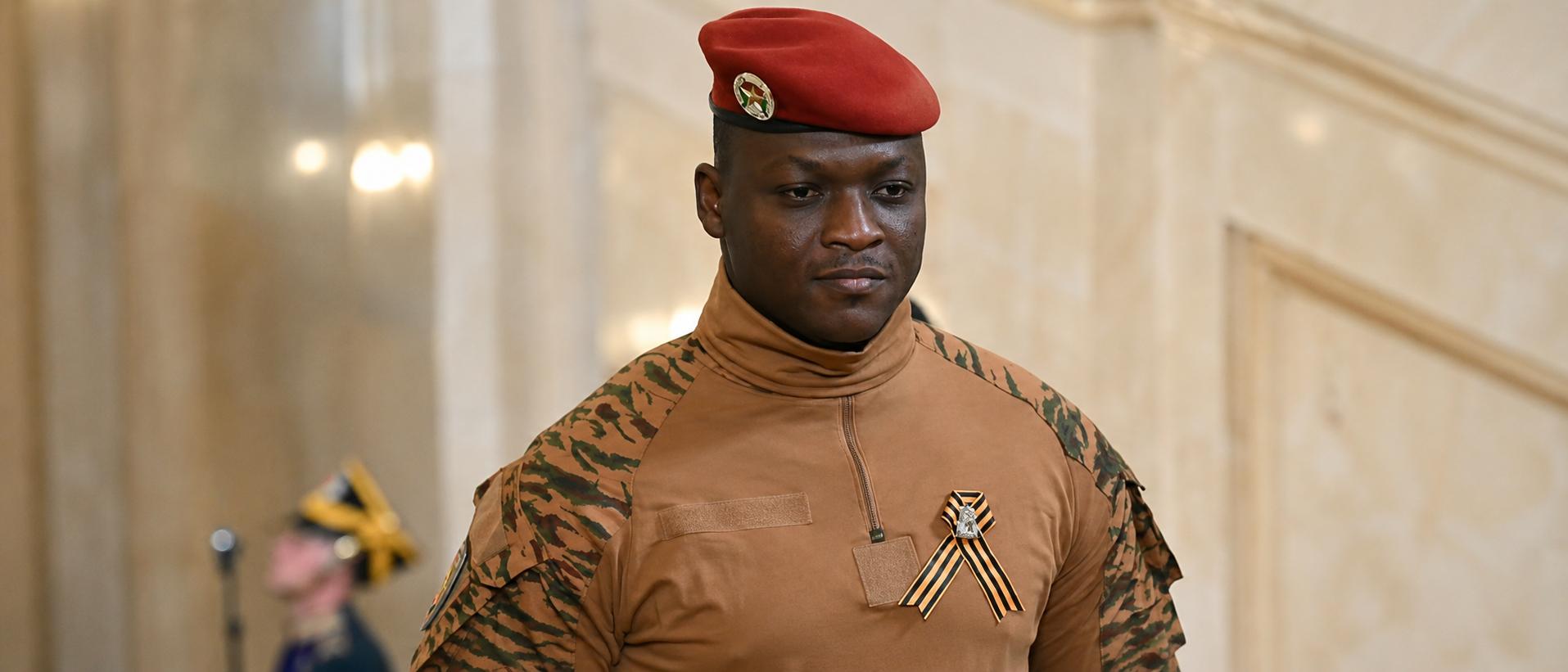
The military junta in Ouagadougou has reached a turning point. Facing the harsh realities of Burkina Faso’s deepening security crisis, and with the once-hyped Russian partnership yielding diminishing returns, the government is making a strategic U-turn—this time, toward Ankara. The shift isn’t one of diplomacy, but of necessity. A high-level delegation, led by Ambassador Hermann Yirigouin Toé, recently traveled to Turkey to plead for concrete military support, signaling more than a policy recalibration—it’s an admission of failure.
From Moscow’s promises to battlefield realities
When Burkina Faso broke ranks with its traditional allies and pivoted toward Russia in 2023, the move was framed as the game-changer needed to reclaim territory and restore stability. Yet despite the influx of Russian military trainers and hardware, the promised surge in security never materialized. Terrorist attacks continue unabated, entire towns remain under siege, and the junta’s ambition to stabilize the Sahel within its borders has stalled under the weight of logistical and operational shortcomings.
The Russian military model—once touted as a path to rapid victory—has shown its limits in the unforgiving terrain of the Sahel. With the African Confederation of States (AES) struggling to demonstrate credible results, Ouagadougou is now forced to confront a difficult truth: Moscow’s support, while significant, is not enough to reverse the tide of insecurity.
Ankara as a last-resort lifeline?
In a rare public display of diplomatic vulnerability, Burkina Faso has turned to Turkey with what can only be described as a plea for assistance. The delegation’s visit to Ankara wasn’t about negotiation—it was about survival. Among the requested deliverables: advanced defense technologies, particularly Turkey’s battle-tested combat drones, which have proven effective in similar African theaters. The underlying message was clear: if Burkina Faso cannot secure its borders alone, and if Moscow cannot deliver, then Ankara must step in.
This is not a partnership of equals. It is a call for help from a government that has exhausted its options. The junta’s overtures to Turkey reflect a deeper crisis: the failure of its own security doctrine, rooted in ideological posturing rather than pragmatic action. With no quick fixes in sight, Ouagadougou is now betting on Ankara’s reputation for pragmatism and robust defense capabilities to fill the widening security vacuum.
Can Ankara’s intervention break the cycle?
The stakes could not be higher. Burkina Faso’s future stability hinges on whether Ankara’s support can translate into tangible battlefield results. Turkey has already demonstrated its willingness to engage in high-stakes security partnerships across Africa, from Libya to Somalia, often with rapid deployment and tangible outcomes. But the Sahel presents unique challenges—deep-rooted insurgencies, porous borders, and a population caught in the crossfire. Success will depend not only on military hardware but on strategic coordination and sustained political will.
For the junta, this shift is not just about survival—it’s about credibility. The Russian partnership promised a rapid return to order; the Turkish overture is a gamble on long-term security cooperation. If Ankara delivers, Ouagadougou may yet regain control. If not, the spiral of insecurity could deepen, leaving Burkina Faso—and its people—trapped in a cycle of violence with no clear exit.
The hidden cost of a failed security doctrine
Burkina Faso’s desperate pivot to Turkey lays bare the consequences of a security strategy built on empty promises and flawed assumptions. The junta’s fixation on symbolic alliances, rather than measurable results, has left the country more exposed than ever. Now, with Ankara as the last hope, Ouagadougou faces a reckoning: the world is watching whether this new partnership can deliver where others have failed. The clock is ticking, and the cost of another miscalculation is unthinkable.