
From financial sovereignty to a mounting debt burden
Ibrahim Traoré has repeatedly championed a vision of Burkina Faso as a nation capable of self-reliance, rejecting the necessity of external borrowing to fund its development. His administration has framed this stance as a decisive break from past economic practices—promoting reduced dependency on foreign partners, heightened economic sovereignty, and a commitment to financing growth through domestic resources.
Yet the latest fiscal data presents a stark contrast to this narrative. While the government insists on limiting its reliance on external debt, the reality of public finances reveals a sharp and sustained increase in total indebtedness.
Debt levels surge past 8.7 trillion FCFA
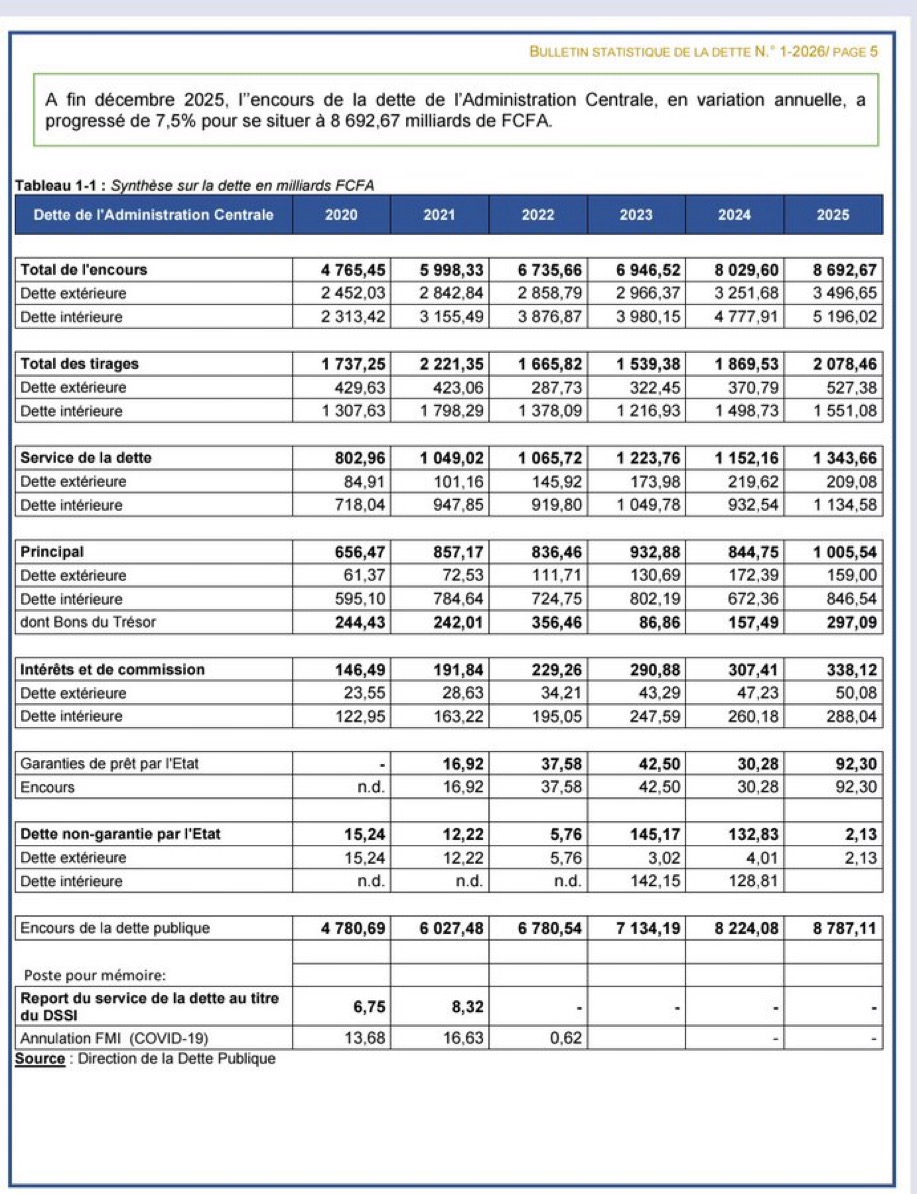
Official statistics from Burkina Faso’s Ministry of Economy and Finance and the Treasury Department reveal a dramatic expansion of public debt over recent years. In December 2020, central government debt stood at 4.77 trillion FCFA. By December 2021, it had risen to approximately 6.11 trillion FCFA. The upward trajectory continued unabated.
As of December 2025, the debt load had reached 8.69 trillion FCFA. By March 2026, it had climbed further to 8.73 trillion FCFA—nearly doubling in just over five years.
This surge in borrowing raises critical questions about the alignment between policy rhetoric and fiscal reality. How has a government committed to financial independence accumulated debt at such a pace? And more importantly, what purpose do these funds serve?
Domestic borrowing dominates the debt structure
One notable feature of Burkina Faso’s rising debt profile is the growing reliance on domestic financing. By the end of 2025, nearly 60% of central government debt—approximately 5.19 trillion FCFA—was sourced internally through Treasury Bonds and Bills.
While domestic borrowing can signal strengthened financial autonomy, it is not without cost. Servicing this debt requires regular payments of both principal and interest. In the first quarter of 2026 alone, debt servicing costs surged to 407.1 billion FCFA—a 31.5% increase year-on-year.
This financial obligation places a direct strain on the national budget, diverting public funds that could otherwise be allocated to social programs, infrastructure, or security.
Can sovereignty be measured in fiscal independence alone?
Proponents of Ibrahim Traoré’s economic strategy argue that reducing exposure to foreign lenders enhances national sovereignty. However, true financial independence extends beyond mere borrowing choices—it requires the capacity to generate sufficient revenue, manage expenditures, and service debt without compromising future stability.
Burkina Faso boasts substantial mineral wealth, particularly gold, which has long been a cornerstone of its export economy. Yet the presence of natural resources does not automatically translate into fiscal strength. The state must channel these assets into productive investments, ensuring that revenue generation aligns with development needs.
Without this alignment, even resource-rich nations risk falling into cycles of borrowing to cover recurring expenditures.
The debt dilemma: growth at what cost?
Over the period from late 2020 to early 2026, Burkina Faso’s central government debt increased by nearly 4 trillion FCFA. While the International Monetary Fund (IMF) has classified the country’s debt as sustainable in the medium term, it has flagged significant vulnerabilities:
- Refinancing risk: A heavy reliance on short-term domestic debt instruments may expose the government to liquidity pressures in future periods.
- Export dependence: Revenue from gold exports remains a key driver of fiscal capacity, yet global price volatility poses a persistent threat.
- Security expenditures: Rising defense spending, while necessary, continues to strain the national budget.
The IMF’s assessment underscores that while Burkina Faso’s debt is not currently unsustainable, its trajectory demands careful management. The question remains: Is the country building a foundation for long-term resilience, or merely postponing financial accountability?
A policy paradox: borrowing under the banner of sovereignty
At the heart of this issue lies a fundamental contradiction. The administration’s insistence on financial sovereignty is juxtaposed with a debt profile that has expanded by billions in recent years. If external borrowing was truly being minimized, how can the surge in total debt be justified?
The government must now provide clear answers: Who are the creditors? What are the interest rates? Which projects are being financed? And crucially, what tangible benefits are being delivered to the Burkinabe people?
Financial sovereignty cannot be proclaimed through rhetoric alone. It must be demonstrated through disciplined fiscal management, transparent accountability, and measurable outcomes. Until then, the debt figures tell a story that challenges the narrative of self-reliance.
For a nation seeking to chart its own economic course, the true test of sovereignty lies not in the absence of debt, but in the purpose and productivity of every franc borrowed.