
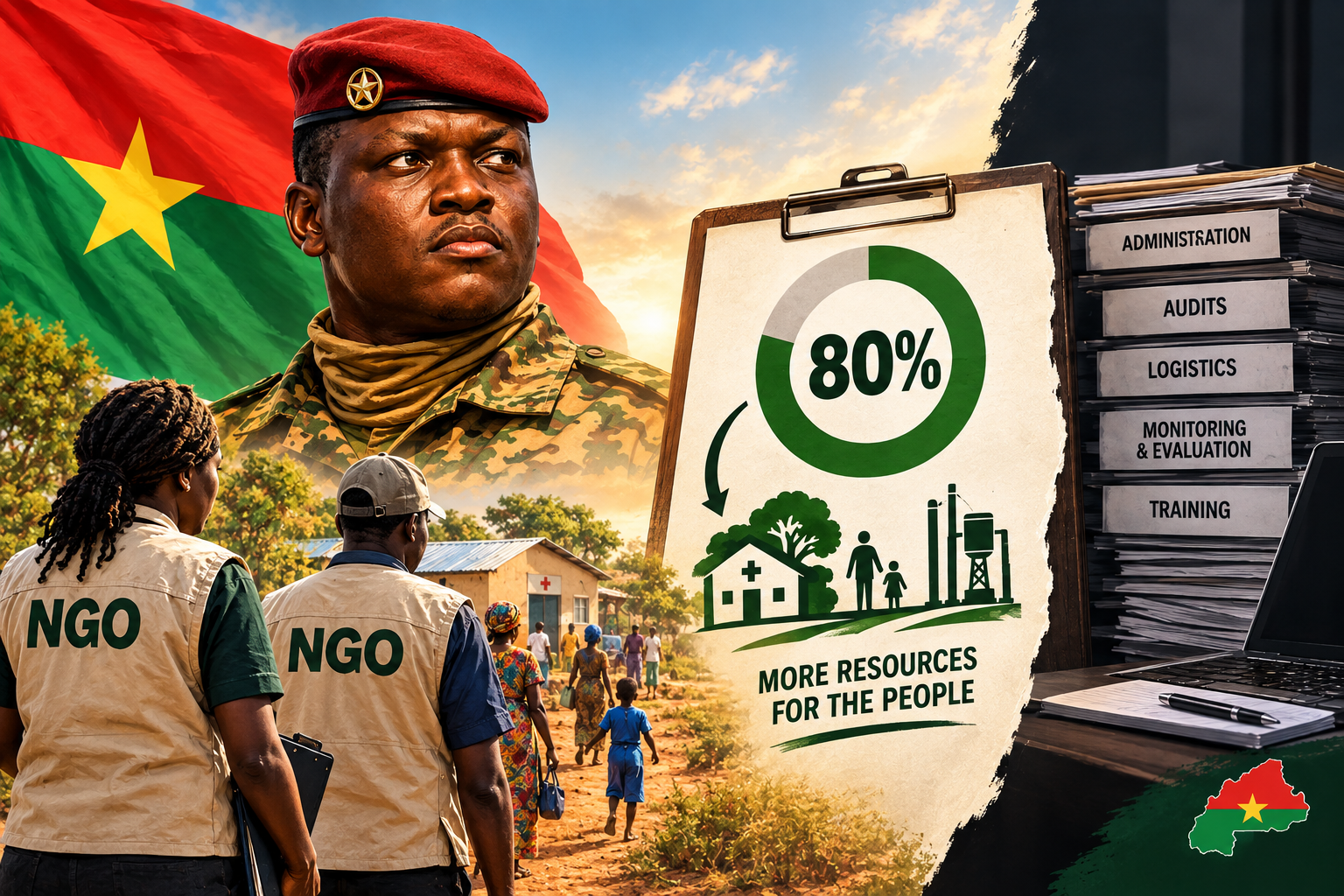
Under the leadership of Captain Ibrahim Traoré, Burkina Faso has rolled out a sweeping regulatory framework for non-governmental organizations (NGOs) that marks a decisive turning point in how humanitarian and development aid is managed across the country. Enacted on September 24, 2026, the new policy requires all NGOs operating in Burkina Faso to allocate a minimum of 80% of their resources toward direct field interventions an ambitious move designed to maximize impact on local populations.
From promise to policy: what the 80% rule really means
The stated goal is clear: redirect more funds from administrative overhead to tangible, on-the-ground outcomes. The principle resonates with public expectations fewer costs tied to offices and paperwork, more resources reaching those in need. Yet beneath the surface, the policy raises critical questions about balance, definition, and unintended consequences.
The rule assumes that every dollar not spent on immediate project delivery is a waste. But NGOs are not logistics companies. They are complex entities managing accountability, training, logistics, audits, and long-term sustainability functions that do not always produce visible results but are vital to ensuring that aid is effective, ethical, and enduring.
What counts as a direct investment? The ambiguity that could undermine the policy
The government’s definition of “direct investment” remains vague, and this ambiguity threatens to distort the policy’s intent. Is a doctor’s salary part of a health center’s construction? Is staff training an investment in infrastructure or human capacity? What about monitoring and evaluation, logistical coordination, or even basic office support in remote areas?
Without precise guidelines, NGOs may struggle to classify expenses correctly, leading to either over-reporting or under-investment in essential support functions. Clear, sector-specific criteria are not just helpful they are necessary to ensure fairness and effectiveness.
One size does not fit all: the danger of uniform thresholds
Not all NGOs are created equal. Some focus on building schools, where material costs dominate. Others prioritize community training, advocacy, or emergency response sectors where human resources and soft skills drive impact. Imposing an identical 80% threshold across all organizations risks penalizing those with high knowledge-based or service-delivery models without proving their work is less valuable.
Diversity in mission demands flexibility in regulation. A rigid ratio may force NGOs to restructure artificially cutting monitoring staff, delaying audits, or relocating operations to meet the threshold, rather than improving their core work.
The illusion of control: why 80% is not the same as accountability
While transparency is a valid objective, the 80% rule operates at the level of input distribution, not output quality. It measures how money is spent, not whether it achieves real change. True accountability lies in impact: how many lives are improved, how sustainably, and at what cost.
Instead of relying on a percentage, the government could enforce stronger systems mandatory independent audits, real-time financial reporting, unannounced site inspections, and transparent beneficiary feedback mechanisms. These tools directly verify whether funds are used appropriately and whether projects deliver results.
The moment of truth: will this policy help or hinder aid?
Captain Traoré’s government has every right to demand greater efficiency and transparency from NGOs. But a blanket percentage cannot replace genuine oversight or measure genuine impact. The real test will be whether this policy, in practice, enhances the quality and reach of humanitarian aid or merely forces organizations to conform to an arbitrary administrative benchmark.
The coming months will reveal whether Burkina Faso has struck a balance between fiscal discipline and operational integrity. For now, the policy stands as a bold statement of intent one that must now prove its worth through action, not just numbers.
By Yvette Tchuente — State political analyst