
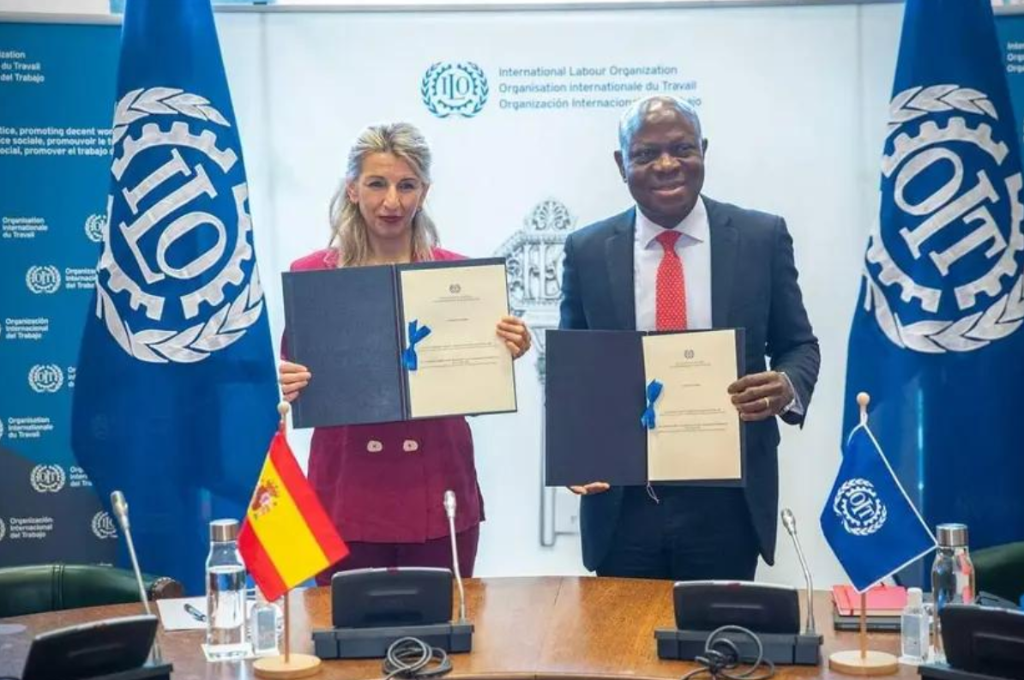
The Uncontested Reelection That Echoed Loudest Criticisms
The International Labour Organization (ILO) has entered a pivotal phase, as Gilbert Houngbo secured a second term as its Director-General without a single challenger on November 16, 2026. The absence of competition, however, did little to silence the dissenting voices that emerged in the final hours of the election. The surprise withdrawal of Spain’s Labour Minister, Yolanda Díaz, transformed what was expected to be a tightly contested race into an uncontested victory—but not one without consequences.
Díaz’s last-minute decision to step aside was framed as a move to preserve unity within the global labour movement. Yet, her parting words painted a far less harmonious picture of the ILO’s current state, accusing its leadership of financial mismanagement and eroding the very social dialogue the organization was built to champion.
Financial Crisis: The Invisible Hand Behind the Ballot Box
The most damning criticism leveled by Díaz centres on the ILO’s deteriorating financial health. She described the organization’s budgetary struggles as one of the most severe in its nearly century-long history, exacerbated by delayed and unpaid contributions from key member states. The United States, a major contributor, has been notably delinquent in its payments, further straining the institution’s ability to function.
The outgoing administration’s response—implementing cost-cutting measures, including staff reductions and restructuring—has drawn sharp rebuke. Díaz argued that these austerity steps disproportionately burdened the workforce, undermining the ILO’s core mission to protect workers’ rights and social justice. The cuts, she contended, were not merely financial necessities but symptomatic of a leadership that prioritized institutional survival over its founding principles.
Behind the Scenes: How Austerity Became a Contested Legacy
The financial strain has forced the ILO to confront uncomfortable truths about its operational efficiency. Staff reductions and hiring freezes have been proposed to align expenses with revenue, but these measures have sparked internal backlash. The ILO’s own staff union has openly contested the restructuring plans, citing inadequate consultation and a failure to uphold the organization’s commitment to social dialogue within its own walls.
This paradox—an institution dedicated to global labour rights grappling with internal dissent over workforce conditions—highlights a governance crisis that transcends its financial woes. The staff’s grievances underscore a fractured relationship between leadership and the very people tasked with advancing the ILO’s goals.
Social Dialogue in Crisis: A Mission at Risk
At the heart of Díaz’s critique lies a fundamental question: can an organization tasked with safeguarding workers’ rights effectively govern itself when its own workforce feels sidelined? Her accusations point to a leadership that has weakened the social dialogue it is mandated to promote. The tensions between the outgoing administration and the ILO’s staff representatives reveal deeper systemic issues—ones that threaten the organization’s credibility on the global stage.
Díaz’s remarks resonate with broader concerns about the ILO’s ability to maintain its relevance in an era of rising inequality and precarious labour conditions. If the organization cannot foster dialogue among its own stakeholders, how can it advocate for social justice worldwide?
The Syndicate Divide: Why Díaz’s Exit Was a Strategic Retreat
The withdrawal of both Díaz and Peru’s candidate, Javier González-Olaechea, left Houngbo as the sole candidate, but their exits were not arbitrary. Díaz’s decision was shaped by the shifting alliances within the labour movement. The International Trade Union Confederation (ITUC) had publicly endorsed Houngbo, a move Díaz characterized as misaligned with the sentiments of a significant faction of the global labour community.
She also questioned the transparency of the endorsement process, suggesting that internal divisions within the ITUC risked further fragmenting the labour movement. By stepping aside, Díaz sought to prevent a prolonged schism—one that could have paralyzed the organization’s ability to advocate for workers’ rights globally. Her withdrawal was, in essence, a calculated gambit to prioritize unity over division, even if it meant conceding the election.
A Second Term, A Pivotal Crossroads
With Houngbo’s reelection secured, the ILO now faces a critical juncture. The uncontested victory, far from being a mandate of confidence, has instead spotlighted the fractures within the organization. The financial crisis, the erosion of social dialogue, and the internal strife among staff and affiliates demand urgent attention. For Houngbo, the challenge ahead is twofold: to stabilize the ILO’s finances and to restore trust among its stakeholders.
Can the ILO emerge from this period of turmoil stronger, or will the unchallenged leadership of its Director-General only deepen the divisions? The coming years will test whether the organization can reconcile its mission with its governance—or risk becoming a cautionary tale of institutional decline.