
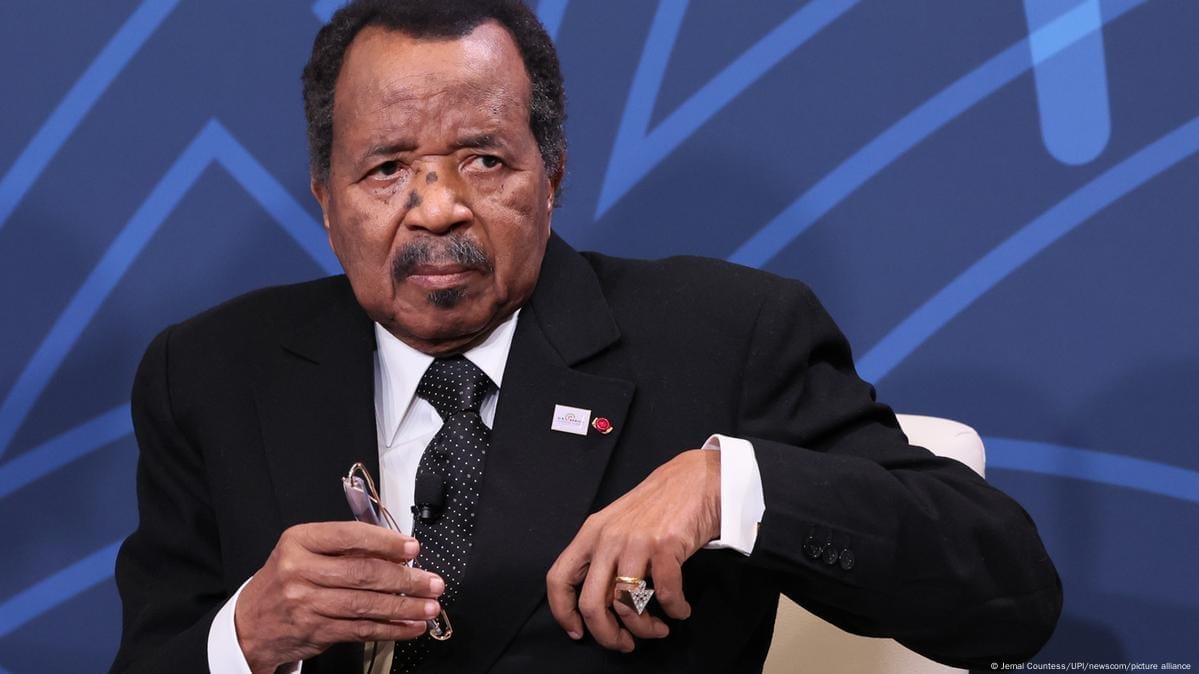
Forty-four days after departing Cameroon under the guise of a private stay in Europe alongside his spouse, President Paul Biya—now 93 years old—has yet to return to the country. His prolonged absence is fueling intense public debate and amplifying speculation about his health across national media and social platforms.
Government insists institutions remain stable
In response to mounting rumors, the ruling Rassemblement démocratique du peuple camerounais (RDPC) has sought to ease concerns. On July 15, Christophe Mien Zok, the party’s director of propaganda, published an editorial in L’Action asserting that all state institutions are functioning normally.
« The power is not vacant. The Lion has not left », he declared, dismissing claims that the country is being governed remotely or left in a state of institutional limbo.
Official presidential channels have continued to release messages attributed to Biya, including congratulatory notes to foreign leaders such as French President Emmanuel Macron on Bastille Day and the President of Montenegro. Despite these communications, no public appearances or detailed updates on the President’s activities have been made public.
Opposition demands clarity on presidential vacancy
The situation has prompted opposition figures to intensify their calls for transparency. Deputy Jean-Michel Nintcheu has filed a petition with the Constitutional Council to examine the possibility of a vacancy in the presidency.
The Union démocratique du Cameroun (UDC) has emphasized that while it does not wish to speculate on Biya’s personal health, the lack of official information raises serious concerns about the continuity of governance. The party argues that prolonged absence from national territory, while not automatically constituting a vacancy, raises critical questions about the effective exercise of presidential powers and the adequacy of existing mechanisms to handle temporary incapacitation.
Constitutional gaps fuel institutional uncertainty
Legal experts point out that once President Biya’s absence exceeds 45 days—a symbolic threshold—it could warrant formal review by the Constitutional Council. However, Cameroonian law currently lacks any explicit limit on how long a head of state may remain outside the country.
The UDC also highlights the absence of a designated vice-president since the constitutional revision of April, calling attention to a structural vulnerability in the country’s governance framework. The party is advocating for the adoption of clear legal provisions to regulate prolonged presidential absences, ensuring continuity of state functions and preventing institutional ambiguity in times of uncertainty.
As the days without Biya continue to accumulate, the divide between official reassurances and public skepticism deepens. While authorities insist that state institutions remain fully operational, critics continue to demand greater transparency regarding the President’s condition and the establishment of a robust legal framework to address scenarios of prolonged absence.