
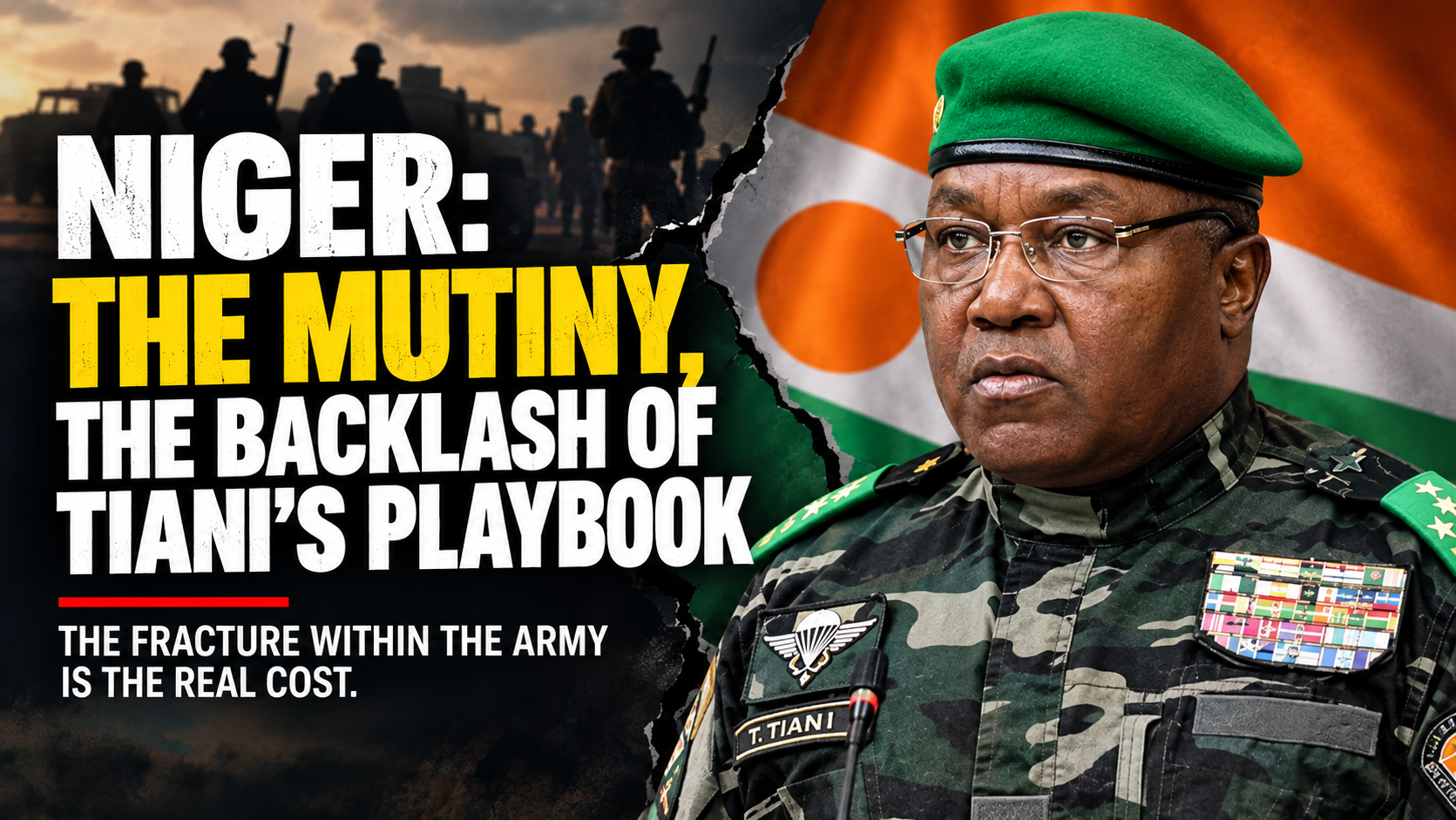
The recent mutiny in Niger raises a troubling question: is the military, once the backbone of the regime, now turning against it? The events of August 28 and 29 cannot be dismissed as a mere disciplinary lapse or the work of a few disgruntled soldiers. Instead, they point to deep-seated issues within the armed forces, issues that have been brewing since General Tiani seized power.
Politicising the ranks
Since taking office, Tiani has steadily transformed the military from a force focused on national defence into a tool for political control. By promoting loyalists, sidelining independent-minded officers, and prioritising personal loyalty over merit, he has disrupted the internal balance that once held the army together. As fealty to the leader outweighs experience and competence, distrust has seeped into the ranks.
This politicisation inevitably breeds consequences. When soldiers believe their advancement hinges on connections rather than performance, a sense of injustice takes root. Frustrations mount, rivalries intensify, and the trust between different levels of command erodes. The mutiny, therefore, is not an isolated incident but a symptom of a deeper malaise, fed by years of tension, discontent, and suspicion inside the military apparatus.
A fragile pillar
The stakes are particularly high because the army is one of the main pillars of stability in a country facing a perpetual security threat. A divided military, wary of its own hierarchy and distracted by internal vendettas, cannot operate as effectively as one united behind a credible chain of command. When soldiers begin to view their comrades with suspicion, operational cohesion starts to crack. In a context where Nigerien forces are battling militant groups on multiple fronts, every additional fracture within the security apparatus is a direct risk to the nation’s defence.
The official silence about the fate of arrested soldiers is telling. This opacity is part of a crisis-management approach that thrives on uncertainty. As long as no one knows who has been detained, where they are held, what charges they face, or how they are being treated, fear can spread effectively through the ranks. Uncertainty becomes a means of control: anyone could be next.
Silence breeds suspicion
This lack of transparency also undermines any chance of reconciliation. Rather than clarifying responsibilities and finding an institutional way out of the crisis, the silence fuels rumours, suspicion, and contradictory narratives. The families of those arrested are left in limbo, their comrades remain distrustful, and the hierarchy loses further credibility. What might have been handled as a purely military affair risks ballooning into a broader crisis of confidence.
By showcasing military vehicles and weapons on state television, the regime is not just communicating; it is crafting a narrative. Displaying equipment as ‘evidence’ of a plot may convince the public that the arrests are justified. But such displays do not answer the real questions: What exactly were the mutineers demanding? Can individual responsibilities be established? What procedures have been initiated? And above all, why did such a crisis erupt within the very forces meant to protect the regime?
This theatrical communication threatens to divert attention from the core issue. Producing arms or vehicles does not prove an organised conspiracy. Facts must be established, evidence verified, and procedures made transparent. Otherwise, official messaging looks more like an attempt to legitimise arrests than a genuine response to the nation’s concerns.
A dangerous paradox
Deeper still, this strategy reveals a fundamental contradiction. The regime claims to bolster the state and restore authority, yet it seems to govern through mistrust within its own military institution. An army cannot remain effective when its members fear that any dissent might be seen as a threat to the leadership. Discipline does rely on obedience, but it also depends on trust in the hierarchy, fairness of procedures, and a sense of belonging to a shared institution serving the nation.
The repeated purges and sidelining of experienced officers carry an operational cost. Each senior officer removed, each command weakened, each unit destabilised by fear represents a loss of skill, experience, and cohesion. In a fight against armed groups that boast networks, local intelligence, and adaptability, Niger cannot afford to weaken its command structures to settle internal political scores.
Herein lies the paradox: the regime’s rhetoric is full of sovereignty, security, and territorial defence, yet much of its energy is spent monitoring, controlling, and neutralising dissent within the security apparatus. This prioritisation of the regime’s political safety is likely to come at the expense of national security itself.
An army that fears internal purges more than external threats will inevitably lose some of its fighting spirit. Soldiers must focus on their primary duty: protecting civilians and defending the territory. If their attention is increasingly diverted by internal power struggles and the fear of being labelled disloyal, the military loses efficiency even as it gains political oversight.
Ultimately, the mutiny of August 28 and 29 raises questions that go far beyond the fate of the arrested soldiers. It challenges how Tiani views power, the military, and loyalty. A national army cannot be turned into a regime’s personal guard without internal tensions erupting.
By concentrating on hunting internal opponents rather than restoring genuine military unity, Tiani risks weakening the very institution on which the country’s security largely depends. A divided armed force may offer short-term political advantages, but it constitutes a long-term strategic threat.
That is the junta leader’s fundamental political responsibility: he has gradually mistaken the regime’s security for the state’s security. In seeking to guarantee his own political survival, he risks undermining military cohesion, eroding trust within the ranks, and thereby leaving Niger even more exposed to the threats it faces. The current crisis appears less as an isolated event than as the culmination of a governance style built on suspicion, concentrated power, and the steady politicisation of the security apparatus.