
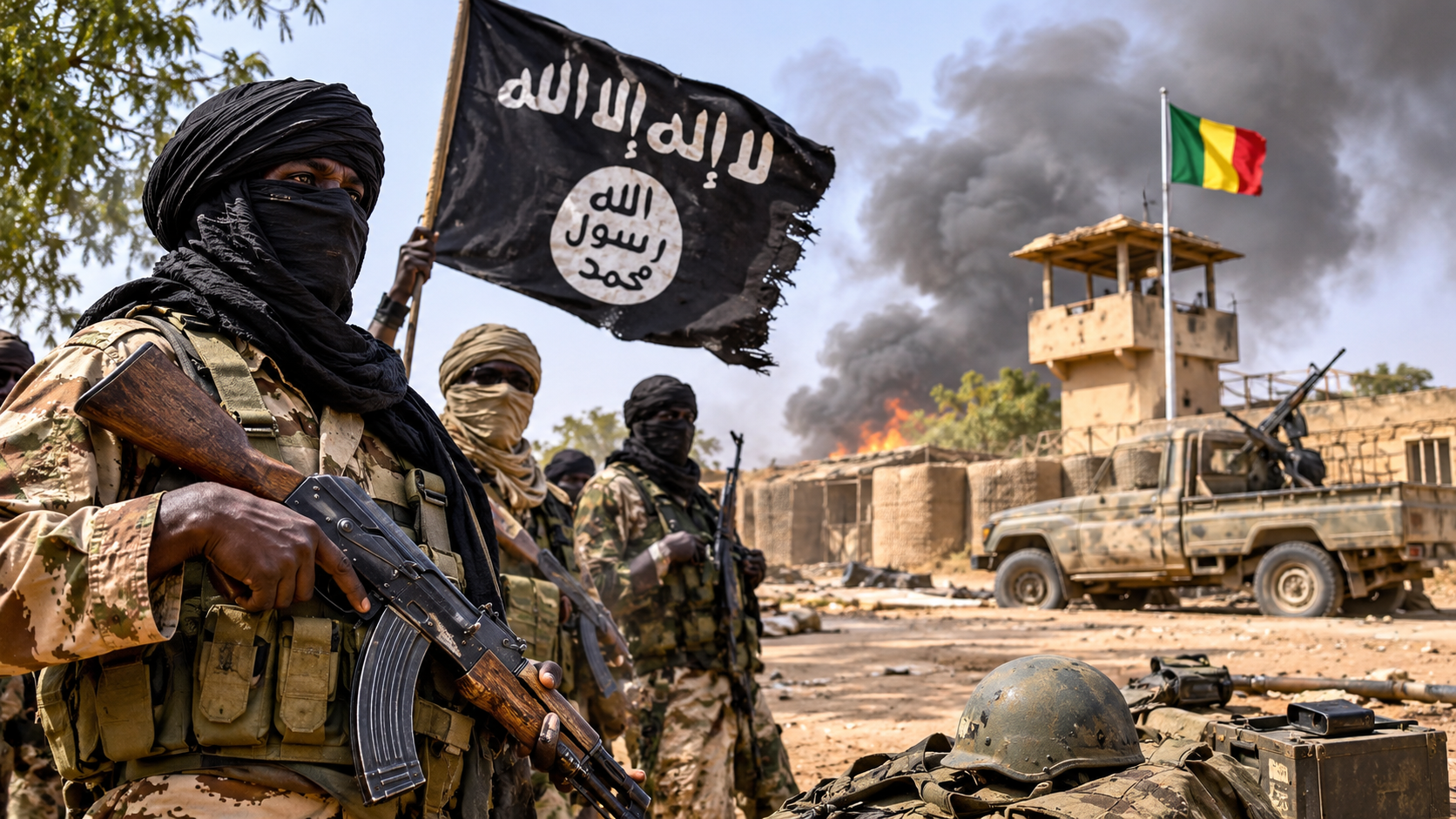
JNIM claims new gains as pro-government forces face mounting pressure in Mopti
The sun rose over Bayman on October 31, 2026, but brought no relief to Mali’s embattled military. In a dawn assault, fighters from the Group for the Support of Islam and Muslims (JNIM) struck a position held by forces loyal to the transitional government. The jihadist coalition, designated as a terrorist organization by Malian authorities, swiftly asserted control over the site, which had been occupied by pro-government militias operating in coordination with Russian military advisors.
The attack marks another ominous turn in a security landscape that has seen repeated setbacks for Malian forces and their allies. While official statements from Bamako continue to highlight large-scale operations and high casualty figures among jihadist ranks, the reality on the ground tells a different story one of contested territory and fragile defenses.
Unconfirmed losses but clear strategic consequences
The JNIM’s statement following the Bayman operation claims the neutralization of multiple pro-government fighters, though no independent verification has been made available. The absence of a definitive casualty count whether dead, wounded, or captured leaves critical questions unanswered. What is certain, however, is that the loss of a strategically positioned site represents a tangible blow to Malian military planning.
The attack follows a recent history of high-profile failures, including the devastating September 10 assault on Dioura, where at least 100 Malian soldiers and five Russian paramilitaries were killed in an ambush claimed by the same jihadist group. The repeated ability of JNIM to breach fortified positions raises serious concerns about the effectiveness of current counterterrorism strategies.
Russian military support under scrutiny
The partnership between Bamako and Moscow has been central to Mali’s counterterrorism narrative, with joint operations, aerial bombardments, and high-profile raids frequently cited as evidence of progress. Yet the persistence of attacks such as the one in Bayman casts doubt on the durability of these claims. Official military communiqués from May 2026 onward report over 4,800 terrorists neutralized and more than 850 airstrikes conducted. But without independent confirmation, these figures remain unverifiable assertions rather than hard evidence of battlefield success.
The disconnect between official announcements and ground realities underscores a fundamental challenge: military operations alone cannot secure a region if they do not translate into sustained territorial control. Jihadist groups continue to exploit gaps in surveillance, logistics, and local resilience, demonstrating that firepower alone is insufficient to stem the tide of insurgency.
What’s next for Mali’s embattled military?
For the Malian government, the loss of Bayman is more than a tactical setback it is a credibility crisis. The ability to defend key positions and protect civilian populations has become a litmus test for the legitimacy of the transitional authorities. With JNIM expanding its reach and local militias struggling to hold ground, Bamako faces a critical dilemma: how to restore confidence in its security apparatus without deeper reforms or increased support from international partners.
Analysts warn that continued reliance on external alliances particularly with non-state paramilitary groups risks further destabilizing the region. The growing influence of Russian private military contractors has drawn international criticism, while the resilience of jihadist factions suggests that military might alone cannot resolve a conflict rooted in governance failures and social grievances.
Population caught in the crossfire
Beyond the immediate military implications, the civilian population remains the most vulnerable stakeholder in this crisis. Displaced communities, disrupted supply routes, and eroded trust in local authorities paint a grim picture of life under persistent insecurity. The JNIM’s ability to penetrate even fortified military positions suggests that no corner of the region is truly safe leaving families to navigate a landscape of uncertainty and fear.
As dawn broke over Mopti on October 31, the question on everyone’s mind was not whether another attack would occur, but when and where the next one would strike. For Mali’s military leadership, the challenge is no longer just about repelling an enemy. It is about rebuilding a strategy that can outlast the shadows of insurgency.
By Yvette Tchuente — Journalist