
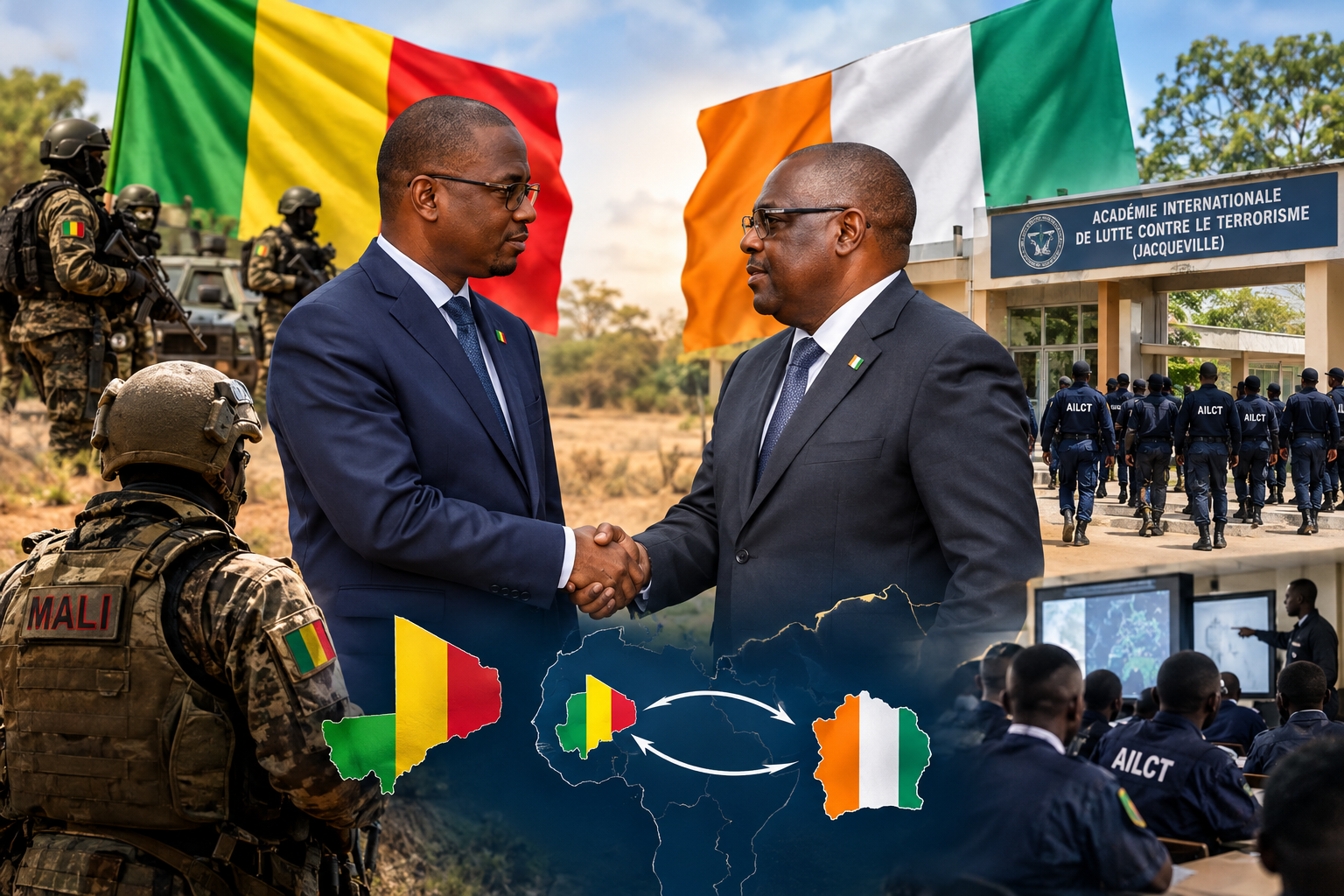
The head of Ivory Coast’s intelligence agency is set to arrive in Bamako on October 15, 2026, at the invitation of Mali’s State Security Agency (ANSE) director, Modibo Koné. This high-level exchange comes at a pivotal moment as regional security cooperation takes center stage in the fight against escalating terrorism across the Sahel.
As Mali grapples with persistent insecurity, the visit raises a critical question: Could Bamako benefit from Ivory Coast’s battle-tested strategies to strengthen its own counterterrorism efforts?
Why Ivory Coast’s counterterrorism model stands out in West Africa
Over the past decade, Ivory Coast has refined a multi-layered approach to terrorism, focusing not just on military response but on prevention, intelligence-sharing, and operational coordination. Its model emphasizes proactive measures such as targeted training programs, cross-agency collaboration, and threat anticipation to neutralize risks before they escalate.
This approach has yielded tangible results, particularly in urban centers and border regions where attacks were once frequent. For Mali, facing similar threats, Ivory Coast’s playbook offers a potential blueprint for adapting and enhancing its own security architecture.
The Jacqueville Anti-Terrorism Academy: A game-changer in regional security
At the heart of Ivory Coast’s strategy lies the Jacquesville International Counter-Terrorism Academy (AILCT), launched in 2021. Designed to train security personnel at strategic, operational, and tactical levels, the academy serves as a hub for knowledge exchange among West African nations.
For Malian forces, the AILCT presents an opportunity to:
Upgrade specialized unit training: Lessons in intelligence-led operations and rapid response tactics.
Enhance inter-agency coordination: Bridging gaps between military, police, and judicial bodies to streamline investigations and prosecutions.
Strengthen intelligence networks: Leveraging Ivory Coast’s experience in disrupting terror cells before attacks occur.
While the academy’s role is primarily educational, its real-world applications could redefine Mali’s counterterrorism readiness.
From diplomatic talks to actionable security gains
The upcoming visit is more than a symbolic gesture it signals a potential shift in Mali’s approach to regional security. After years of strained relations, both capitals appear ready to prioritize concrete cooperation over rhetoric.
Key areas of focus include:
Shared intelligence frameworks: Establishing real-time data exchanges to track cross-border threats.
Joint training exercises: Simulating attack scenarios to test Mali’s defensive and response protocols.
Resource optimization: Identifying gaps in Mali’s security infrastructure that Ivory Coast’s model could fill.
Yet the true test will lie in execution. Past exchanges between Sahel nations have often stalled at the discussion phase. For Bamako, the challenge is to translate this engagement into measurable improvements fewer attacks, swifter responses, and greater protection for civilian populations.
Sovereignty vs. security: Finding the right balance
Critics may argue that adopting foreign models risks compromising Mali’s autonomy. However, the goal isn’t to replicate Ivory Coast’s system verbatim but to integrate its most effective elements into Mali’s existing framework.
Terrorism knows no borders, and neither should counterterrorism efforts. By learning from neighboring successes while adapting them to local contexts Mali can bolster its defenses without sacrificing its sovereignty.
The October 15 meeting isn’t a guarantee of change, but it’s a vital step. The question now is whether Bamako will seize this moment to turn collaboration into capability and insecurity into resilience.
By Henri Nkeng — Journalist