
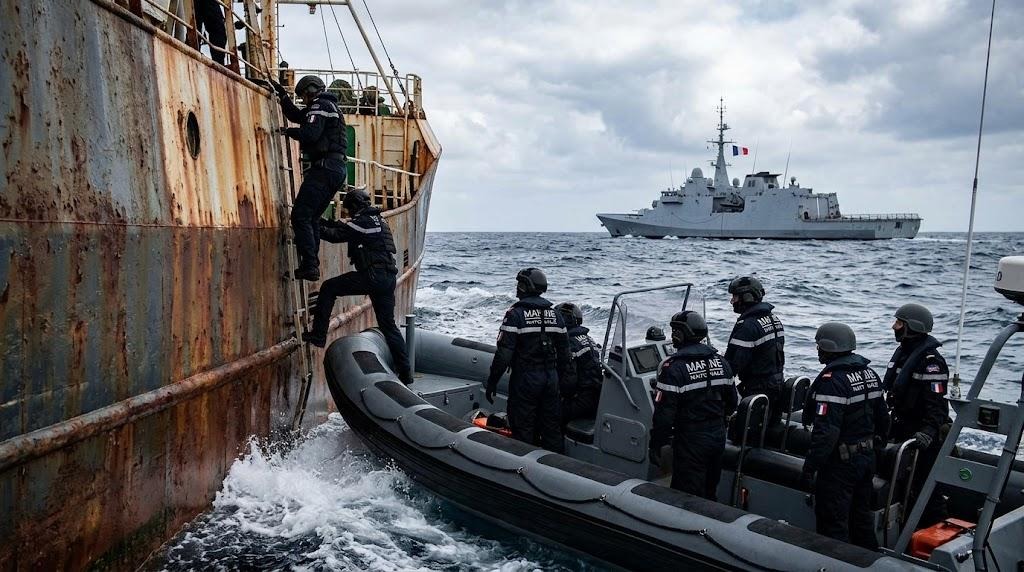
The interception of a 244-meter oil tanker by the French Navy in the Indian Ocean has ignited a critical debate: Could Benin’s national flag be the weak link enabling Russia’s sanctions evasion?
The High-seas Interception: France’s decisive strike against a suspected sanctions-busting vessel
On October 12, 2026, more than 830 kilometers south of Réunion Island, French naval forces boarded the oil tanker DF Peak, sparking a major international incident. The operation, later confirmed by Emmanuel Macron, targeted a vessel allegedly using a Bénin-flagged registration to illegally transport Russian oil past Western sanctions.
During the at-sea inspection, French authorities uncovered discrepancies in the vessel’s documentation. Under legal pressure from prosecutors, the DF Peak was escorted to a security anchorage near Réunion for judicial review, where investigators scrutinized its administrative status, cargo, and ownership structure. The findings could unravel a sophisticated network designed to obscure the true origins and destination of the crude oil onboard.
From Kaliningrad to Cotonou: A web of fake identities
The DF Peak is no ordinary tanker. Sanctioned by the European Union, United States, and United Kingdom since 2024, the 110,000 DWT vessel has a well-documented history of identity manipulation.
Originally registered as the NS Captain in 2023, it was reflagged to Kaliningrad under the Russian flag in April 2024. By 2025, it had adopted the name DF Peak and hoisted the Bénin flag—likely as part of an attempt to bypass international restrictions through a friendly registry. Recent satellite tracking data showed the ship returning from Venezuela near Madagascar before the French intervention.
How strong are Benin’s maritime regulations against flag abuse?
The case has thrust Cotonou into the spotlight, raising serious concerns about the integrity of Bénin’s maritime registry. National law requires that vessels registered under the Bénin flag demonstrate a genuine link with the country—such as resident ownership, local enterprise registration, or operational control by Bénin-based entities.
If investigators confirm that the DF Peak used a counterfeit Bénin flag, this would constitute a criminal violation of national sovereignty, undermining Bénin’s maritime credibility and exposing weaknesses in its flag state control system. Under the United Nations Convention on the Law of the Sea, Bénin is legally obligated to ensure rigorous oversight of vessels flying its flag. Failure to act could result in the vessel’s immediate deregistration and trigger sanctions under international maritime law.
From an international legal standpoint, France acted within its rights under Article 110 of the Montego Bay Convention, which permits the inspection of vessels suspected of flying a false or non-existent national flag. Bénin, as the flag state, may now request judicial assistance from France to investigate whether local intermediaries or shipping agents facilitated the fraudulent registration.
Shadow fleets: The global cost of maritime evasion
The DF Peak is part of a broader trend—Russia’s “shadow fleet”. These vessels operate outside regulated insurance schemes, use opaque corporate structures, and conduct ship-to-ship transfers in remote waters to obscure oil origin and ownership. By exploiting weak or complicit registries, these networks undermine the global sanctions regime, distort energy markets, and threaten financial stability.
This incident is not just a French operation—it’s a wake-up call for Bénin. The government must urgently audit its maritime registry, strengthen verification protocols, and collaborate with international partners to prevent its national flag from becoming a tool in global sanctions circumvention.
Key red flags in flag abuse cases
- Sudden flag changes: Vessels switching registries without clear operational ties to the new flag state
- Shell company registrations: Ownership obscured through front companies in offshore jurisdictions
- No insurer of record: Absence of valid maritime insurance compliant with international standards
- Frequent identity alterations: Repeated name or IMO number changes to avoid detection
What’s next for Cotonou and global sanctions enforcement?
The outcome of this case will set a precedent. If Bénin acts decisively—by deregistering the DF Peak and cooperating with international authorities—it can reaffirm its commitment to maritime law. Failure to do so risks enabling further abuse and tarnishing its reputation as a responsible maritime nation.
The DF Peak now stands as a symbol of a larger battle: Can the world’s shipping registries resist becoming pawns in geopolitical games?