
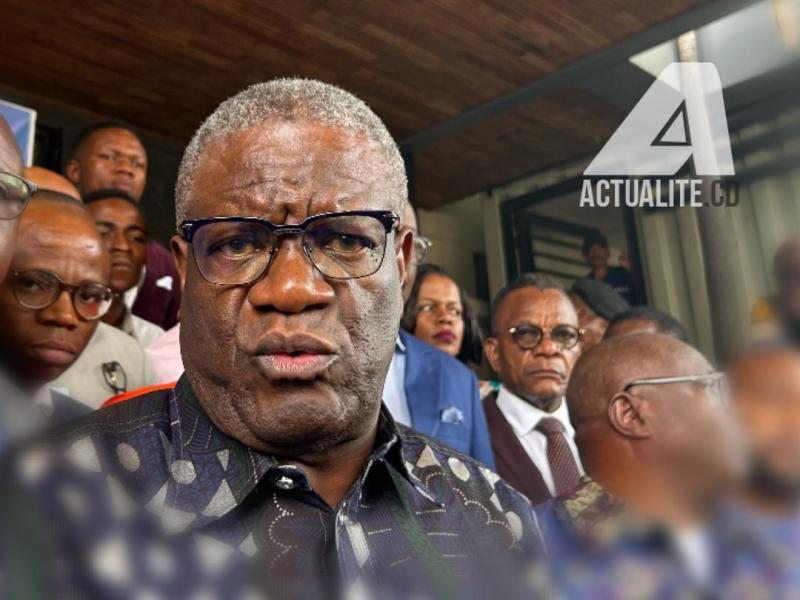
The Nobel Peace Prize laureate and former presidential contender, Denis Mukwege, has voiced his support for the Democratic Republic of the Congo‘s decision to file a lawsuit against Rwanda at the International Court of Justice (ICJ). This legal move is viewed as a vital step toward uncovering the truth and securing justice for those affected by the enduring violence in the eastern parts of the Congo.
Denis Mukwege praised the national authorities for initiating this judicial process, which aims to address alleged breaches of international law attributed to Rwanda. He highlighted that these violations have been carried out either directly or through various armed factions, including the AFDL, RCD, CNDP, and M23/AFC, over a period stretching from 1996 to the present.
A call for individual criminal accountability
While acknowledging the importance of the ICJ proceedings for state-level disputes, the doctor stressed the necessity of holding individuals accountable for their actions. He called upon the International Criminal Court (ICC) to maintain and expand its investigations into crimes falling under the Rome Statute, with a specific focus on the political and military command structures responsible for these atrocities.
Furthermore, Denis Mukwege suggested that the principle of universal jurisdiction should be utilized by other nations to prosecute those suspected of international crimes. He also recommended that the government in Kinshasa establish a national transitional justice framework. This would include the formation of a Special Criminal Tribunal for the Congo, a proposal originally outlined in the United Nations Mapping Report.
Justice as a foundation for peace
According to the Nobel laureate, legal accountability is a crucial element in preventing future violence and establishing a lasting peace within the Democratic Republic of the Congo. He argued that there is an urgent need to recognize the link between conflict prevention, transitional justice, and the stabilization of the region.
The formal request to the ICJ in The Hague was presented by Guillaume Ngefa Atondoko Andali, the Minister of Justice. The Congo has expressed its confidence in the court’s ability to uphold the law and provide a path toward reparations for victims, asserting that legal rights must prevail over the use of force.
This judicial offensive is part of a broader strategy supported by President Félix Tshisekedi. In response to the activities of the M23 and the security challenges in the east, the presidency has sought to complement military and diplomatic efforts with international legal action. This includes documenting war crimes, crimes against humanity, and the systematic exploitation of the country’s natural resources.