
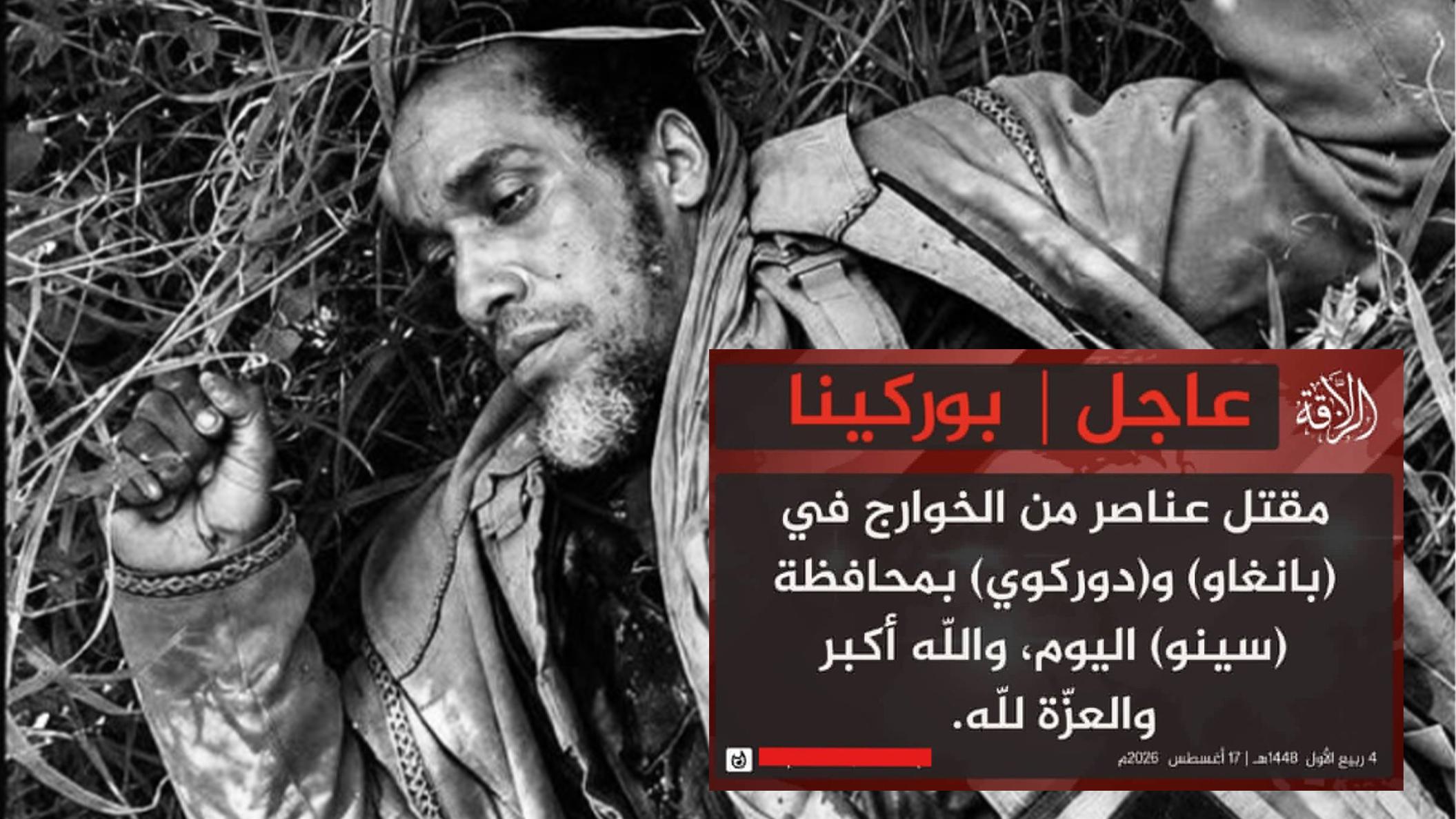
The violent turf war between rival jihadist factions in the Sahel has claimed another high-profile victim. On August 17, 2026, Abu Zeid al-Burkinabi, a senior leader of the Islamic State in the Greater Sahel (ISGS), was killed not by Burkina Faso’s armed forces, but in brutal clashes with members of the Jama’at Nusrat al-Islam wal-Muslimin (JNIM), Al-Qaeda’s Sahel affiliate.
The deadly confrontation unfolded in the villages of Bangao and Dorkoye, within Séno Province—a region along the Niger border notorious for its persistent insurgent activity. Initial reports circulating on social media falsely suggested that Burkina Faso’s defense and security forces had neutralized the extremist commander through a coordinated military operation. However, field investigations and corroborated accounts from multiple sources confirm that Abu Zeid al-Burkinabi fell in intra-jihadist violence, a grim reminder of the deepening schism tearing apart the Sahel’s militant landscape.
Who was Abu Zeid Al-Burkinabi?
Abu Zeid al-Burkinabi was far from a rank-and-file fighter. Hailing from Burkina Faso, he rose through the ranks to become one of the Islamic State in the Greater Sahel’s most influential operational and propaganda leaders. His influence stretched across the volatile tri-border zone—spanning Burkina Faso, Mali, and Niger—where he played a central role in orchestrating attacks on defense forces, intimidating local populations, and extorting resources under the guise of religious taxation.
As a zone commander, he oversaw a brutal campaign of ambushes, civilian abductions, and coercive fundraising, leveraging his deep local knowledge and extensive recruitment network. His death deals a significant blow to ISGS command structures, already strained by sustained military pressure and relentless competition from JNIM.
Propaganda vs. reality in the aftermath of his death
The announcement of his killing sparked an immediate narrative battle across pro-government and social media channels. Several influential accounts and state-aligned outlets were quick to credit Burkina Faso’s defense and security forces, bolstered by civilian auxiliaries, for eliminating the terrorist leader. This strategic misinformation reflects the growing emphasis placed by transitional authorities on showcasing military progress in the fight against terrorism.
Yet, field reports and verified communications from rival militant sources swiftly dismantled the official version. While Burkina Faso’s armed forces remain active in Séno Province, they were not directly involved in the August 17 confrontation. Abu Zeid al-Burkinabi’s death was the direct result of internecine warfare between two of the Sahel’s most lethal jihadist organizations.
JNIM vs. ISGS: a rivalry rooted in ideology and power
The clashes in Bangao and Dorkoye are not isolated incidents but the latest chapter in a bloody feud that has simmered since 2019 between JNIM and ISGS. Despite their shared goal of toppling regional governments and imposing hardline Islamic rule, the two groups diverge sharply on ideology, tactics, and strategy.
- Ideological divide: JNIM, aligned with Al-Qaeda’s global leadership, pursues a pragmatic approach, often negotiating with local leaders to embed itself within communities. In contrast, ISGS enforces an extreme takfiri doctrine, marked by mass killings of civilians deemed insufficiently devout.
- Resource competition: Control over artisanal gold mines, smuggling routes, and transhumance corridors is vital for financing. Both groups vie aggressively for dominance over these lucrative zones.
- Violence escalation: Since 2020, clashes have erupted with unprecedented ferocity in Mali’s Gourma and Liptako regions, followed by intense battles in Ménaka (2022–2023) and northern Burkina Faso—engagements involving hundreds of fighters, armored vehicles, and heavy weaponry.
The August 17 confrontation underscores that, despite relentless pressure from regional governments, the visceral enmity between these factions remains unabated.
What this means for civilians and regional security
The death of Abu Zeid al-Burkinabi may temporarily shift the balance of power in Séno Province. By eliminating a top ISGS commander, JNIM seeks to strengthen its territorial grip and push its rival out of strategically critical border areas. However, for civilians caught in the crossfire, this internal jihadist conflict offers little relief. While mutual weakening of terrorist groups increases operational vulnerabilities, it also exposes local populations to heightened reprisals and persistent insecurity.
The elimination of a high-value target by rival extremists highlights the complex, multi-layered nature of the Sahel’s security crisis. In this landscape, the downfall of one faction often paves the way for another—equally dangerous. For observers and regional stakeholders, monitoring these internal fractures is essential to understanding Burkina Faso’s evolving security trajectory.