
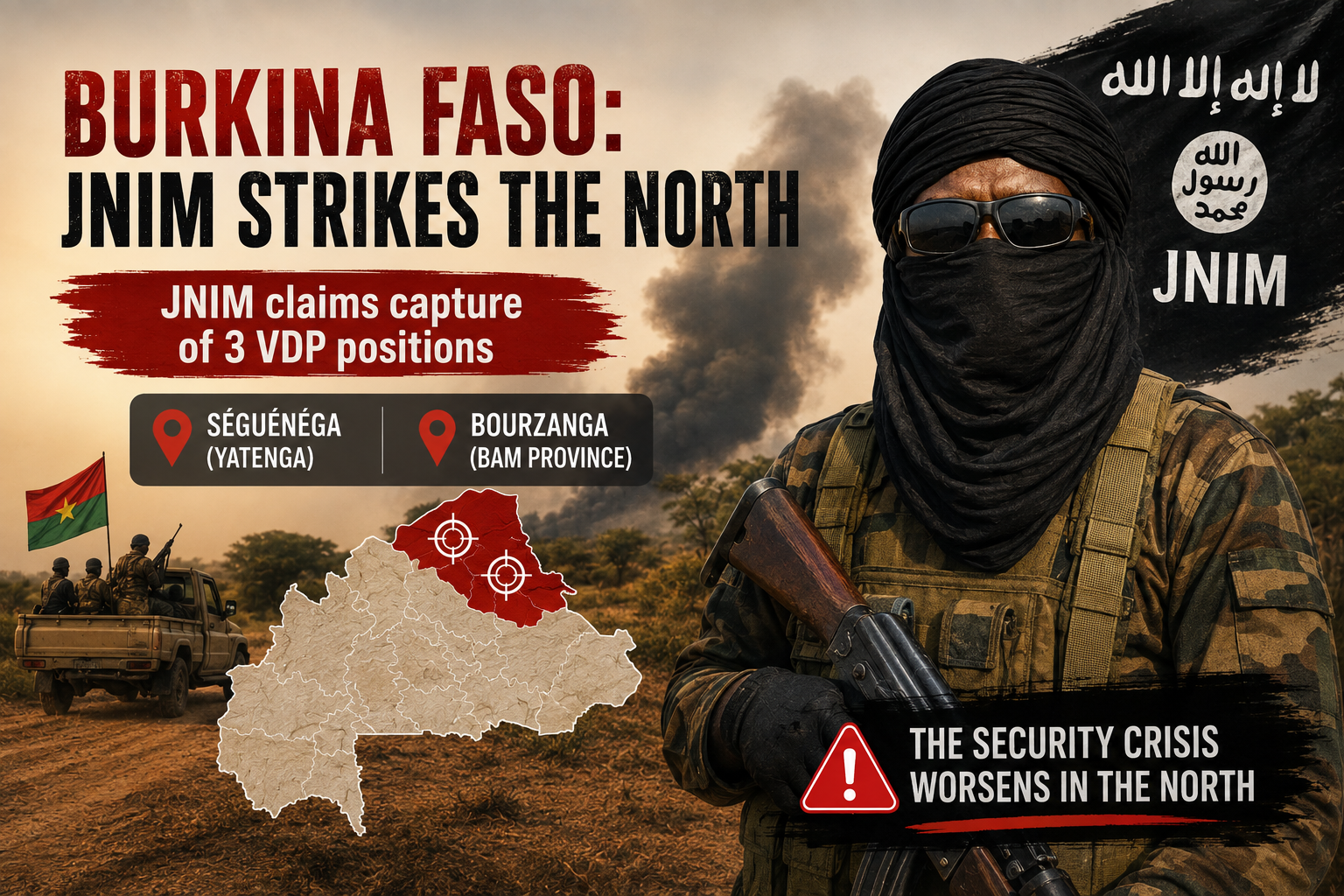
The persistent security crisis in Burkina Faso continues to cast a shadow over the nation, with the government’s communication strategy facing growing scrutiny. On August 19, the JNIM armed group claimed responsibility for seizing three strategic positions held by the Volunteers for the Defense of the Homeland (VDP) in the North. The attacks, marked by extreme violence, targeted Séguénéga in Yatenga and Bourzanga in Bam province. This latest setback underscores the challenges faced in maintaining control over recaptured or secured areas, as militant groups continue to expand their influence.
The recurring nature of these assaults, coupled with the relentless pressure on civilians and the persistent vulnerability of certain outposts, highlights a critical flaw in Burkina Faso’s counterterrorism strategy. Military reconquest alone is proving insufficient. A sustainable solution requires a robust state presence, effective intelligence, adequate supply chains, and, above all, genuine protection for local communities.
The situation is further exacerbated by the role of the VDP, who have been integral to the country’s security framework. These volunteers frequently find themselves on the front lines against armed groups that possess superior mobility and destructive capabilities. Each territorial loss does not merely represent a military setback; it also undermines public confidence, triggers civilian displacement, and complicates humanitarian access.
Political response falls short of addressing ground realities
Despite the escalating crisis, the response from Captain Ibrahim Traoré’s transitional leadership has raised concerns. Rather than delivering a candid assessment of security failures, the head of state has resorted to disjointed media appearances. These speeches, often laced with populist rhetoric, appear more as attempts to deflect attention than as coherent crisis management strategies. Such maneuvers risk exacerbating public frustration amid the daily deterioration of safety conditions.
In a crisis of this magnitude, political communication cannot substitute for tangible results on the ground. Rhetoric centered on sovereignty, resistance, or breaking past alliances may resonate with certain segments of the population, but it does little to safeguard villages, secure road networks, or prevent attacks on military and auxiliary positions. What citizens demand is concrete, measurable action.
The true measure of success is no longer confined to the narratives propagated by authorities but is reflected in the daily lives of Burkinabè people. When a locality remains exposed, when villagers are forced to abandon their homes, or when positions fall despite deployed resources, the problem transcends political discourse. It directly challenges the efficacy of the security strategy and the state’s ability to fulfill its commitments.
Media suppression deepens the crisis
The space for critical analysis has been severely restricted, with the Burkinabè press—once vibrant—now subjected to stringent controls. Journalists and dissenting voices attempting to investigate or report on ground realities face systematic repression. Silenced through arrests, forced conscription into so-called ‘re-education camps,’ or dispatched to frontline duties under the guise of patriotism, these professionals are penalized for their commitment to truth.
This suppression of independent media presents an additional challenge. In times of war, accurate information is a vital tool for evaluating successes, identifying weaknesses, and alerting authorities to civilian hardships. Stifling those who document the situation does not erase the problems; it risks widening the gap between official narratives and lived realities.
While tighter control over national discourse may create an illusion of crisis management, it does not alter the underlying realities. Attacks, civilian displacements, and loss of life remain unaddressed by institutional communication.
The paradox of transparency in crisis management
The paradox is stark: as the security situation demands greater transparency, evaluation, and debate, the space for criticism narrows. Yet, an effective strategy hinges on the ability to acknowledge setbacks, understand their causes, and swiftly correct errors. Refusing dissent may offer short-term political relief, but it deprives decision-makers of essential insights for strategy refinement.
By denying citizens access to free and independent information, the government entrenches itself in a cycle of denial that does nothing to resolve the urgent security challenges. Combating terrorism demands resolve and mobilization, yes, but it also requires transparency, accountability, and the courage to confront difficulties.
Ultimately, the litmus test remains the safety of the population. As long as armed groups continue to strike, expand their control, or maintain relentless pressure on certain regions, the government must be held accountable for the outcomes of its strategy. Political messaging may win battles of perception, but it cannot, in isolation, secure victory in the war against terrorism.