
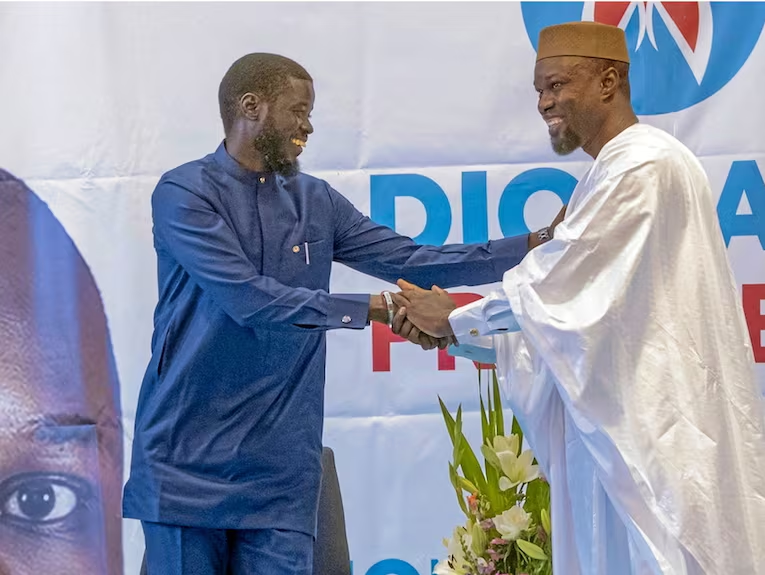
In a dramatic move that has sent shockwaves through Senegal’s political landscape, President Bassirou Diomaye Faye abruptly terminated the mandate of Prime Minister Ousmane Sonko late on Friday evening. The decision, announced via national television by presidential secretary-general Oumar Samba Ba, marks the abrupt end of a fragile alliance that once united the two leaders in their ascent to power following the February 2024 presidential election. The outgoing executive, now stripped of its authority, has been instructed to handle «routine matters» until a new government is formed.
The dismissal closes a chapter that began in opposition to former President Macky Sall, whose final years in office were marked by fierce clashes with Ousmane Sonko’s camp. Barred from running in the election after a defamation conviction stripped him of civic rights, Sonko ultimately backed Bassirou Diomaye Faye as the presidential candidate for their political movement—a decision that played a pivotal role in securing Faye’s victory.
a growing rivalry reaches boiling point
Tensions between the two figures had been simmering since the new administration took office in Dakar. Clashes of influence and disagreements over governance deepened the rift, particularly as Sonko’s political clout—rooted in a youth movement drawn to his sovereignist and pan-Africanist rhetoric—continued to shape national discourse. For many in the activist base, Sonko remained the true architect of the political shift, placing President Faye in an increasingly delicate position.
Frictions intensified further after the November 2024 parliamentary elections, which saw the president’s party secure a landslide victory closely tied to Sonko’s enduring popularity. Recent incidents in Dakar had laid bare widening divisions between the presidency and the prime minister’s office, fueling speculation that a breakup was imminent.
Within minutes of the announcement, Ousmane Sonko took to social media with a cryptic post: «Alhamdoulillah. Tonight, I will sleep soundly in Keur Gorgui», a nod to the Dakar neighborhood where he resides. Shortly after, videos emerged showing scores of supporters gathering outside his home, chanting his name in defiance.
parliamentary majority faces uncharted waters
The president’s decision plunges Senegal into a period of profound political uncertainty. Despite the shake-up at the top, Sonko’s faction retains significant sway within the National Assembly, raising the prospect that a personal rift could escalate into a full-blown institutional standoff. The former prime minister remains one of the country’s most influential political figures.
The meteoric rise of Bassirou Diomaye Faye and Ousmane Sonko was built on a shared platform of fierce criticism against entrenched elites, a rejection of ties with France, and a pledge to overhaul the political system. For months, their movement energized urban youth, galvanized by Sonko’s uncompromising rhetoric of change.
By sidelining the man who once served as his political mentor, President Faye risks alienating a militant base whose loyalty remains anchored in Sonko. Already, Dakar’s political circles buzz with anticipation over a potential realignment of power at the highest levels—a scenario that could test Senegal’s long-standing institutional resilience in the face of recurring crises.