
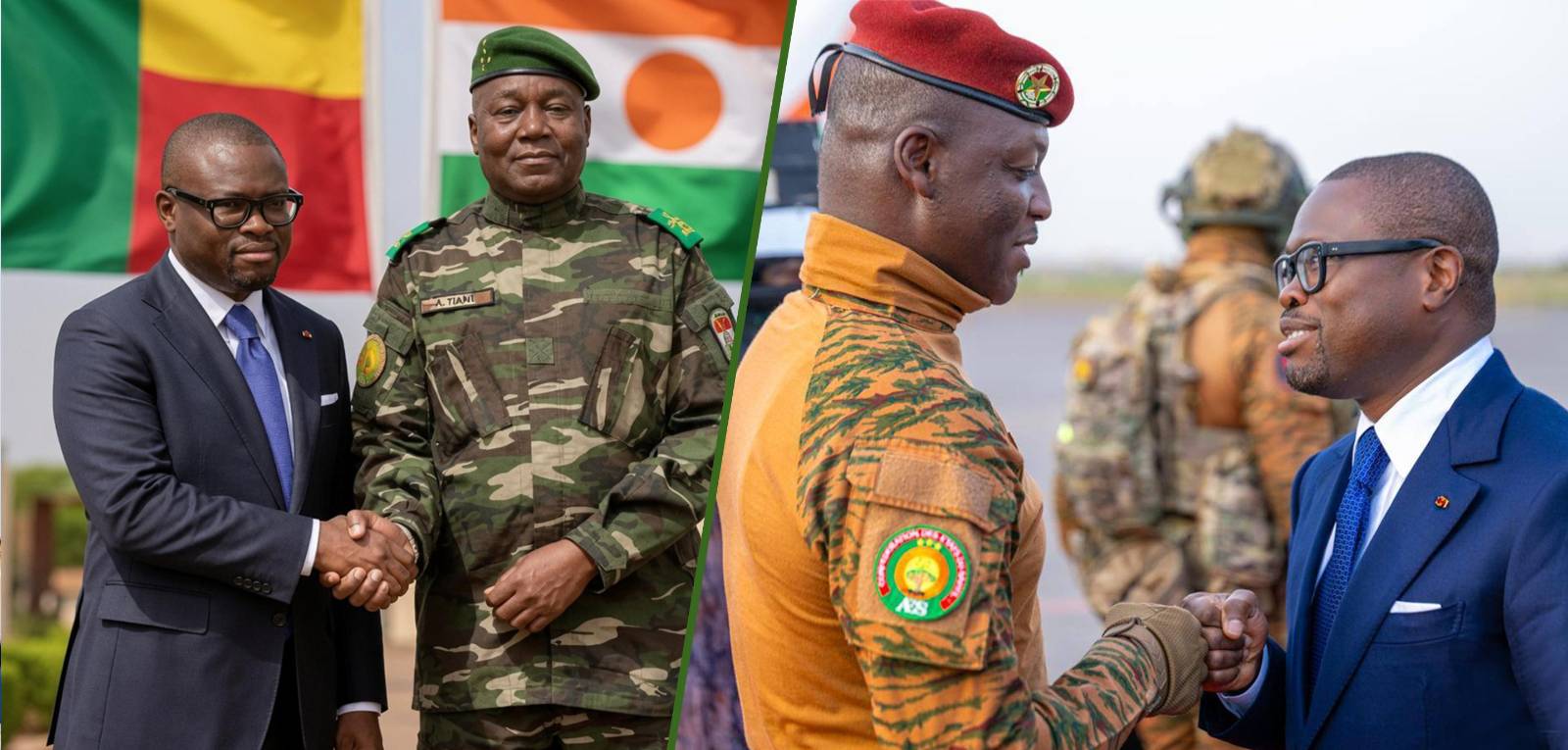
The recent official visits by Bénin’s President Romuald Wadagni to Abuja (Nigeria), Niamey (Niger), and Ouagadougou (Burkina Faso) signal a decisive shift toward renewed regional cooperation. This strategic realignment underscores the pressing economic and security imperatives driving direct diplomatic engagement across the Sahel.
Following prolonged tensions rooted in political transitions and regional policy shifts, Bénin has taken proactive steps to reopen and strengthen dialogue with its key neighbors. The mission reflects a clear commitment to rebuilding trust and restoring functional cross-border partnerships.
Economic and logistical interdependence
The economies of Bénin, Niger, and Burkina Faso are deeply interconnected, with each nation relying on shared infrastructure to sustain trade and supply chains. For landlocked Niger and Burkina Faso, access to global markets hinges on transit routes through coastal nations—most critically through Bénin’s Cotonou-Niamey corridor and its connections to Ouagadougou. Meanwhile, Bénin’s economic vitality, particularly its Port Autonome de Cotonou and logistics sector, depends heavily on the volume of goods transiting to and from Sahelian markets.
This mutual reliance extends to energy infrastructure, including the pipeline linking Agadem’s oil fields to the Sèmè-Kpodji terminal. The arrangement ensures Niger can export crude while Bénin benefits from transit revenues. A newly formed expert committee has been tasked with identifying and removing barriers to free movement within 15 days, highlighting the urgent need to safeguard these shared economic lifelines.
Strengthening border security and transnational threats
Security challenges posed by armed groups and cross-border crime demand coordinated responses. Burkina Faso, Niger, and Bénin share the W National Park, a highly strategic yet vulnerable region. The renewed diplomatic push with Ouagadougou and Niamey aims to enhance collective security by pooling intelligence, clarifying military protocols, and reinstating joint operations such as synchronized patrols and information exchanges.
These measures are not optional—they are essential to national security, particularly for Bénin, where stability is intrinsically tied to the Sahel’s broader peace. No single country can address these threats alone; collaboration is the only viable path forward.
Balancing regional commitments with bilateral priorities
The sequence of visits—beginning in Abuja, the institutional hub of ECOWAS, followed by stops in Niamey and Ouagadougou—demonstrates a deliberate strategy to serve as a bridge between evolving regional dynamics. This approach seeks to reconcile operational communication channels with member states of the Alliance of Sahel States (AES) while upholding West Africa’s broader macro-regional commitments.
In a landscape marked by shifting geopolitical alliances, maintaining direct bilateral negotiation channels is critical. It reduces systemic risk, revitalizes economic flows, and protects local communities from the fallout of instability. The recent diplomatic offensive is not merely symbolic—it is a pragmatic response to the realities of shared geography, collective security, and interdependent economies.