
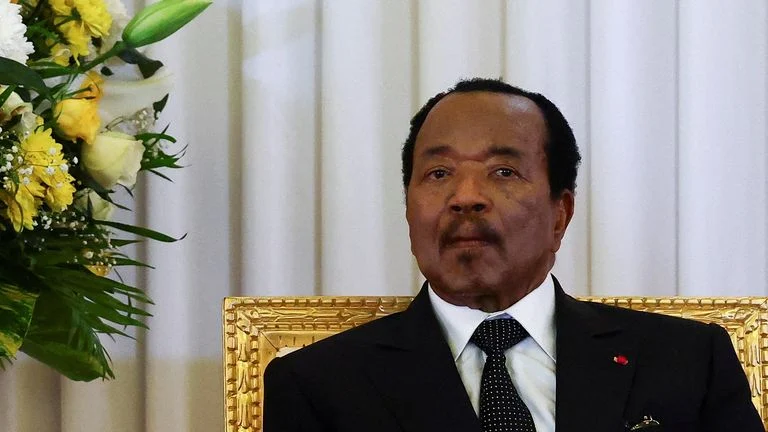
When President Paul Biya of Cameroon departed the country on June 7, 2026, accompanied by his wife, it was initially described as a routine private trip to Europe. Yet, over 40 days later, he has yet to return. This prolonged absence has sparked growing unease among Cameroonians, who remain without any official statement from their leader—despite having re-elected him just seven months earlier for another seven-year term.
The president’s extended stays abroad, particularly in Switzerland, are not uncommon. For decades, Biya has spent significant time in luxury hotels, often returning only briefly to the Etoudi Palace in Yaoundé. While his advanced age—now 93—and fragile health may explain these trips, the lack of transparency fuels speculation. Unlike many of his African counterparts, Biya has never sought medical care in Cameroon, reinforcing doubts about the state of his health. Yet, in a country where such matters are treated as state secrets, citizens are left in the dark, and rumors spread unchecked.
Who really governs Cameroon?
The absence of a sitting president naturally raises a fundamental question: who is truly in control in Cameroon? Critics argue that the country operates almost on autopilot, with Biya’s frequent absences leaving governance in limbo. How can a leader fulfill presidential duties when more time is spent abroad than engaging with citizens? At his age, with health visibly declining, concerns grow over his ability to govern effectively. His latest re-election, after sidelining credible opponents, may well be his final mandate—but Biya appears determined to cling to power until his last breath.
Frustration is palpable. Opposition figures, including lawmaker Jean Michel Nintcheu, have gone so far as to urge the Constitutional Council to declare a power vacuum. The response from the ruling party was swift and dismissive: “Power is not vacant. The Lion has not left.”
A government frozen in time
Cameroon under Biya is a study in political stasis. The same administration, led by Prime Minister Joseph Dion Ngute since January 2019, remains unchanged—a tenure equivalent to a full presidential term. Despite a constitutional revision in April 2026 reintroducing the vice-presidency, Biya has yet to appoint one. The message is clear: opposition voices demanding presidential presence and accountability can move along—there’s nothing to see here.
This is the Cameroon of Paul Biya: a nation where leadership defies convention. It holds the unenviable record of Africa’s oldest serving president—and, coincidentally, the world’s oldest police chief. Martin Mbarga Nguélé, Cameroon’s national security delegate, recently celebrated his 90th birthday, a symbol of an institution that, like the presidency, shows no signs of renewal.
From Etoudi Palace to the streets of Yaoundé, the question lingers: in a country where power is personalized to this extreme, what happens when the man at the helm is no longer physically present?