
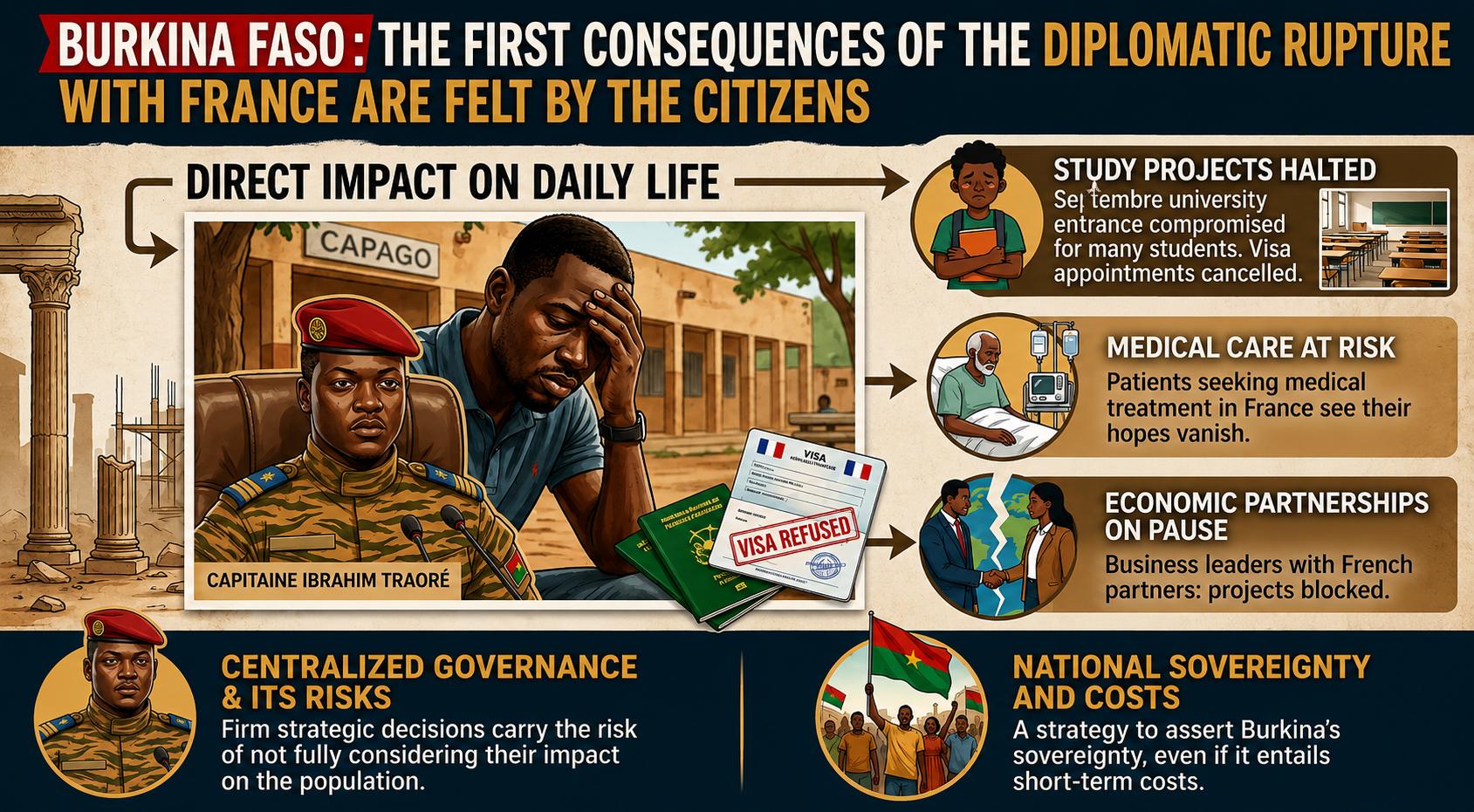
The recent severance of diplomatic ties between Burkina Faso and France is now manifesting in tangible ways, moving beyond high-level state relations to directly affect the daily lives of many Burkinabè nationals.
In recent days, nearly 200 visa applicants, whose files were already under consideration, were summoned to the CAPAGO offices. Upon arrival, they were instructed to retrieve their passports, which were accompanied by formal notifications of visa refusal. This development has caught many applicants off guard, as they had maintained hope that their requests would be processed successfully.
Diverse groups affected by visa restrictions
The impact of these decisions is far-reaching. Among those facing denials are patients requiring specialized medical care in France, entrepreneurs engaged in international economic partnerships, and students who were finalizing arrangements for the September academic intake. Furthermore, appointments previously scheduled for student visa submissions have been abruptly cancelled, leaving numerous families in a state of profound uncertainty regarding their children’s educational future.
This evolving situation underscores a stark reality: executive decisions made at the highest levels of government can have immediate and severe repercussions for the general population. While citizens do not participate directly in the formulation of diplomatic strategy, they are the ones forced to navigate the practical consequences of these geopolitical shifts.
Governance and sovereignty at the heart of the debate
For some observers, these events highlight a governance style that is heavily centralized around Captain Ibrahim Traoré. Critics argue that strategic choices are being implemented with a level of firmness that may not fully account for the hardships imposed on the populace. They contend that the current administration of state affairs sometimes mirrors a personal management style, where political priorities are elevated above the daily struggles and mobility of the people.
On the other hand, supporters of the administration maintain that these actions are essential components of a broader strategy to assert the sovereignty of Burkina Faso. From their perspective, such a direction is necessary for national dignity, even if it entails significant short-term costs for the population.
Regardless of the political interpretation of this diplomatic rupture, the immediate outcome remains unchanged: hundreds of Burkinabè citizens have seen their academic, health, and professional projects suddenly halted. Beyond the diplomatic friction, numerous lives and family aspirations are now facing an increasingly precarious future.