
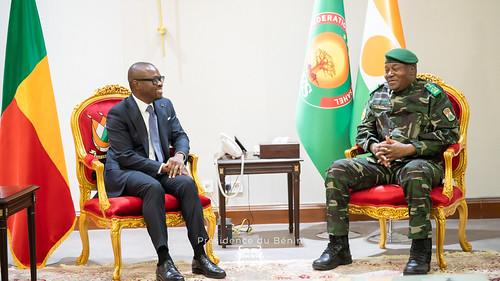
The tarmac of Cotonou International Airport bore witness to a pivotal moment in West African diplomacy on Friday, June 19, 2026. As a Nigerian official delegation landed under full protocol honors, the resumption of high-level bilateral talks between Bénin and Niger transitioned from rhetoric to tangible action. For regional observers, the event signaled far more than diplomatic choreography—it marked the revival of a dialogue that had appeared irreparably severed.
The breakthrough did not emerge overnight. It stemmed directly from the historic meeting in Niamey between Bénin’s President, Romuald Wadagni, and Niger’s transitional leader, General Abdourahamane Tiani, where both sides acknowledged the urgency of breaking the impasse. Since then, a dedicated team of technical experts, seasoned diplomats, and military strategists from both nations worked tirelessly behind closed doors for two weeks, ironing out disputes, cataloging mutual grievances, and preparing the groundwork for their leaders’ renewed engagement. Their goal remains clear: securing a comprehensive, long-term agreement to reopen the shared border, closed in the aftermath of Niger’s political upheaval.
Diplomatic observers describe the current negotiations in Cotonou as a delicate balance between gravity and constructive momentum. The weight of expectations rests heavily on the negotiators, not only from political circles but also from local communities and economic actors who have endured months of hardship due to the border closure.
Economic chokehold fuels urgency for resolution
The urgency driving these talks is most visible in the stark economic toll inflicted on both nations. The once-thriving trade corridor between Cotonou and Niamey has been choked off, revealing how deeply interconnected the two economies have become over decades. For Niger, a landlocked nation, the closure of the Port of Cotonou—a lifeline for imports and exports—has triggered a logistical nightmare. Transport companies and traders in Niamey have been forced to reroute goods through distant, hazardous ports, driving transportation costs to unsustainable levels. The result: a sharp rise in consumer prices across Niamey, eroding already fragile purchasing power amid broader international sanctions.
Bénin’s economy has not escaped unscathed. The transit route to Niamey represents the backbone of the country’s port economy, contributing significantly to customs revenue and national development budgets. The sudden halt in cargo flow has slashed state income and crippled a vast ecosystem of informal workers—truck drivers, roadside vendors, small logistics firms—whose livelihoods depend entirely on cross-border exchange. What began as a diplomatic dispute has evolved into a humanitarian crisis, with families on both sides of the border facing economic ruin.
Security concerns remain the core hurdle
While economic desperation pushes both sides toward compromise, the central sticking point remains national security. Since the establishment of Niger’s transitional military leadership, Niamey has maintained an uncompromising stance: no economic concession will be made at the expense of territorial integrity or institutional stability. This doctrine has shaped the current negotiations in Cotonou, where sensitive security files dominate the agenda.
Key among these is the management of the Niger River, a natural boundary that has occasionally served as a conduit for complex infiltration attempts. Equally critical is the establishment of joint surveillance protocols along the land border to prevent incursions by armed groups terrorizing the Sahel. Niger has repeatedly warned that a porous border could be exploited by hostile elements to destabilize its territory. To address these concerns, Bénin’s delegation is expected to propose robust measures, including real-time military intelligence-sharing mechanisms.
The challenge facing negotiators is monumental: designing a border management model that is impermeable to asymmetric threats and illicit trafficking while maintaining the fluidity essential for legitimate trade. Striking this balance—between state sovereignty and economic necessity—may well determine whether these talks succeed or fail.
What lies ahead for regional relations
The prolonged negotiations in Cotonou underscore a hard truth: geography and economic interdependence ultimately override ideological posturing in West Africa. The crisis stemmed from stringent sanctions imposed after Niger’s regime change, yet the prolonged blockade has exposed the fundamental interdependence of the two nations. Yet, as regional analysts note, a return to the status quo ante is unlikely. Trust has eroded, and any future accord will likely be built on stricter controls, heightened vigilance, and lingering caution.
Beyond the Bénin-Niger dynamic, the outcome of these talks is being watched closely by international partners, financial institutions, and neighboring states. The Cotonou-Niamey corridor is a linchpin of regional economic integration, and its resolution could serve as a litmus test for the ability of Sahel and ECOWAS member states to prioritize stability and social cohesion over political divisions. For the millions of citizens exhausted by months of uncertainty, the real test will come not from diplomatic smiles, but from the swift, concrete lifting of barriers that have strangled their daily lives.