
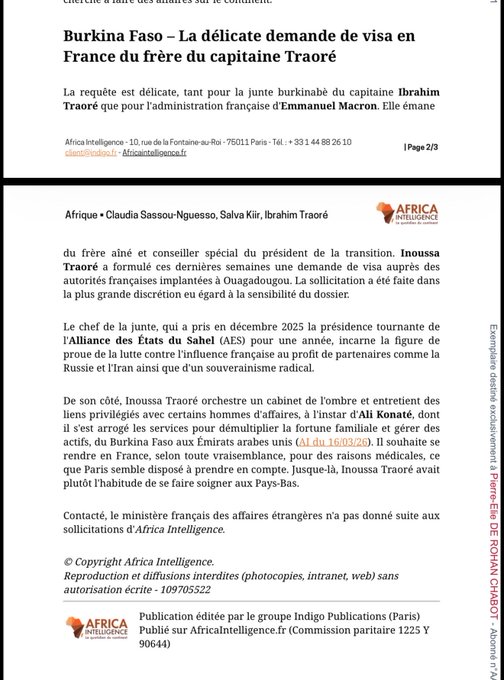
For more than two years, the political atmosphere in Burkina Faso has been defined by a sharp pivot away from traditional alliances. Under the leadership of Captain Ibrahim Traoré, the transitional government has consistently framed Paris as a remnant of a colonial era that must be left behind. This shift has manifested in the expulsion of French forces, a vocal rejection of Western influence, and a strategic realignment toward partners like Russia and Iran.
A quiet request amidst loud rhetoric
While the public discourse remains centered on total sovereignty and confrontation, a recent development has introduced a layer of complexity to this narrative. Inoussa Traoré, the elder brother of the Head of State and a special advisor to the presidency, has initiated a confidential process to obtain a visa from French authorities in Ouagadougou.
This move was handled with significant discretion, reflecting the sensitive nature of such a request in the current climate. It appears that Inoussa Traoré is seeking to travel to France for medical reasons. Historically, he has sought specialized care in the Netherlands, but this latest turn toward Paris suggests a pragmatic choice that contrasts sharply with the administration’s official stance.
The friction between policy and personal needs
This situation highlights a profound paradox. Since taking the helm, Ibrahim Traoré has built his political identity on a foundation of resistance against French influence. Official speeches frequently target Paris, blaming the former colonial power for various national challenges while calling for a definitive break from the West.
The decision by a member of the President’s inner circle to seek entry into a country publicly designated as a strategic adversary raises significant political questions. It provides a focal point for critics who argue there is a growing disconnect between the government’s sovereignist communication and the private decisions of its high-ranking officials.
Sovereignty versus reality
The authorities in Burkina Faso continue to assert their total independence, claiming to have closed the chapter on French dependency. However, the reality of specialized medical requirements or administrative needs often complicates these political declarations. It is a recurring theme in regional politics: while the rhetoric may be hostile, the practicalities of governance and personal well-being sometimes lead back to European institutions.
In the case of the Traoré family, this visa application suggests a policy where firm public stances are maintained for the benefit of national opinion, while France remains a destination of necessity when circumstances demand it. Ultimately, this development tests the credibility of the sovereignist discourse currently echoing through the halls of power in Ouagadougou, showing that institutional realities can sometimes override public criticism.