
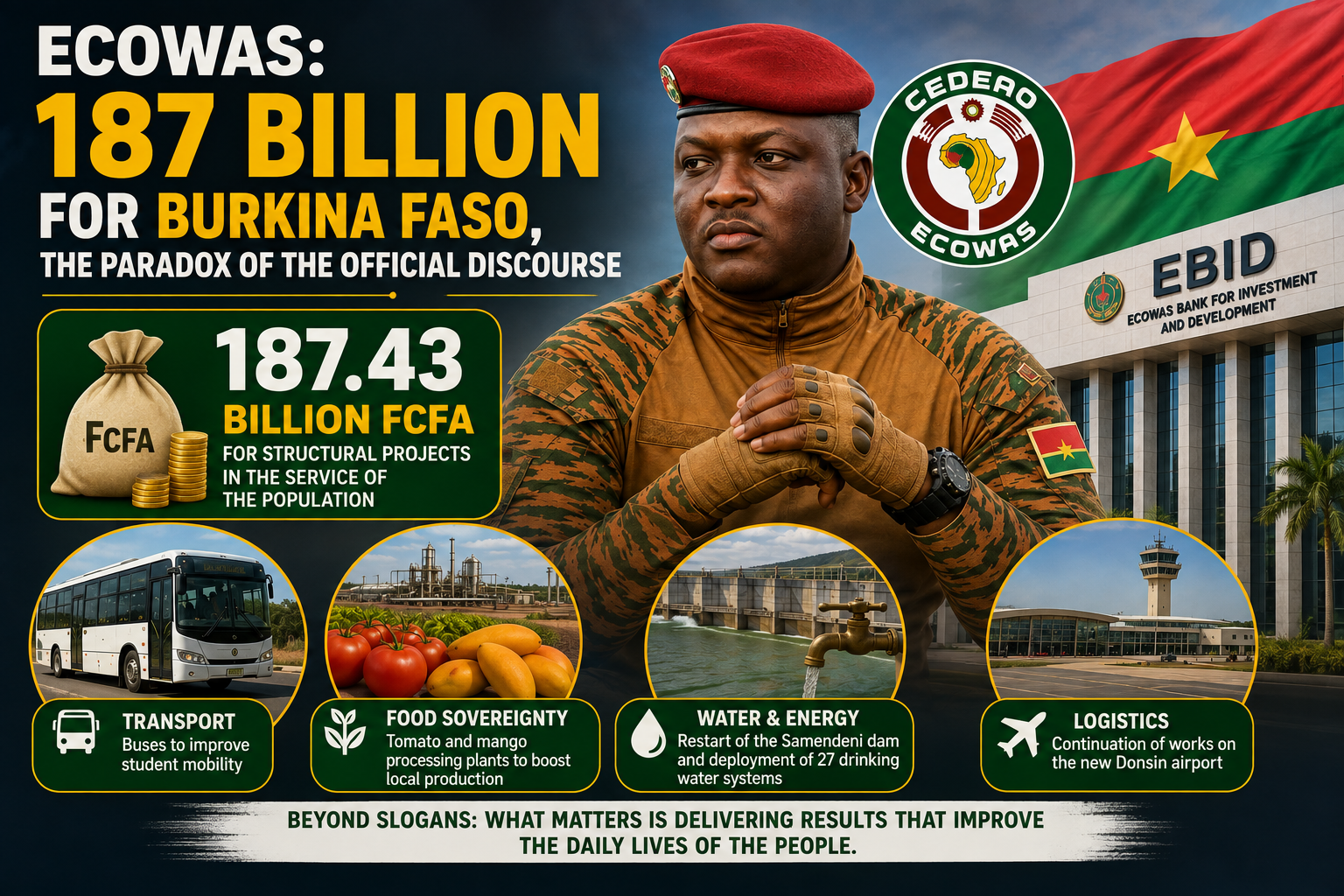
The official rhetoric from Captain Ibrahim Traoré has repeatedly condemned the Economic Community of West African States (ECOWAS), portraying the regional bloc as a puppet of Western powers. Yet, beneath the political posturing lies a stark contradiction: Burkina Faso continues to actively engage with and benefit from ECOWAS’s financial mechanisms.
This paradox underscores a critical divide between political declarations and economic imperatives. While rhetoric may shape public perception, financial realities often dictate the necessity of cooperation, even with institutions whose policies may be criticized. The relationship between Burkina Faso and ECOWAS exemplifies this tension, where ideological opposition coexists with pragmatic financial reliance.
Massive investments to bolster key sectors
The ECOWAS Bank for Investment and Development (EBID) has recently committed a substantial financial package of 187.43 billion West African CFA francs to Burkina Faso. These funds are earmarked for transformative projects across critical sectors:
Transport and education: Acquisition of buses to alleviate student transportation challenges, directly enhancing access to education and easing daily burdens on students and their families.
Agricultural transformation: Establishment of tomato and mango processing plants to boost local production value. This initiative aims not only to increase output but also to create employment, reduce post-harvest losses, and strengthen market opportunities for farmers.
Water and energy: Revival of the Samendeni dam project and deployment of 27 potable water systems in high-demand areas. Access to clean water remains a cornerstone of development, particularly in regions grappling with economic and security challenges.
Logistics and infrastructure: Continued progress on the Donsin International Airport project. A facility of this scale could enhance trade, improve national connectivity, and stimulate economic activity provided the project is executed efficiently and resources are managed effectively.
These investments demonstrate that regional integration extends beyond diplomatic declarations. ECOWAS’s financial instruments provide tangible support to member states, addressing pressing developmental needs.
The disconnect between political rhetoric and economic necessity
The disparity between Burkina Faso’s public criticism of ECOWAS and its reliance on the bloc’s financial resources highlights an uncomfortable truth: the country cannot afford to sever ties with regional financial mechanisms, regardless of political disagreements. The contradiction lies in the fact that while ECOWAS may be framed as an adversary in political discourse, its financial contributions remain indispensable for national development.
This situation reflects a broader reality in modern governance: national interests often transcend political alliances. Economic imperatives, financing needs, and regional infrastructure demands frequently necessitate cooperation, even when ideological differences persist. It raises an essential question: If ECOWAS’s financial instruments are deemed detrimental to Burkina Faso’s interests, why continue leveraging them for critical national projects?
The answer does not lie in abandoning criticism or defending regional institutions blindly. Instead, it calls for a balanced approach where national interests are pursued without undermining the very tools that enable development. A sovereign state can challenge regional policies while simultaneously utilizing available resources to benefit its people.
Sovereignty redefined: beyond ideological posturing
The discourse on sovereignty in Burkina Faso emphasizes independence from external influences. However, sovereignty should not be conflated with isolation. A truly sovereign nation can assert its interests, reject unfavorable policies, and yet capitalize on cooperative frameworks that advance its development goals.
The focus must shift from whether Burkina Faso should engage with ECOWAS to how these funds can be utilized most effectively. With 187.43 billion CFA francs at stake, the emphasis should be on execution, transparency, and alignment with national priorities. The true measure of success will lie in the tangible outcomes for citizens: functional infrastructure, reliable public services, and economic opportunities.
Accountability and transparency as pillars of development
For citizens, the critical issue is not the political narrative surrounding ECOWAS but the tangible benefits these investments bring to their daily lives. They deserve clarity on how funds are allocated, the conditions attached to their use, project timelines, and oversight mechanisms. Sovereignty, in its truest sense, demands accountability not just in words, but in action.
From commitments to results: what matters most to the people
The debate over ECOWAS should ultimately be pragmatic, not ideological. For students relying on improved transportation, farmers seeking market access, families in need of clean water, and entrepreneurs requiring modern infrastructure, the central question remains unchanged: What will these investments deliver?
The success of this financial package will be determined by its implementation. Will the processing plants operate at full capacity? Will the water systems function reliably? Will the airport enhance economic connectivity? Or will these funds be mired in bureaucratic delays and mismanagement?
The people of Burkina Faso are not concerned with political slogans or regional tensions. They demand results infrastructure that works, services that deliver, and opportunities that materialize. The true test of this partnership with ECOWAS will be measured not in rhetoric, but in the tangible improvements to their quality of life.