
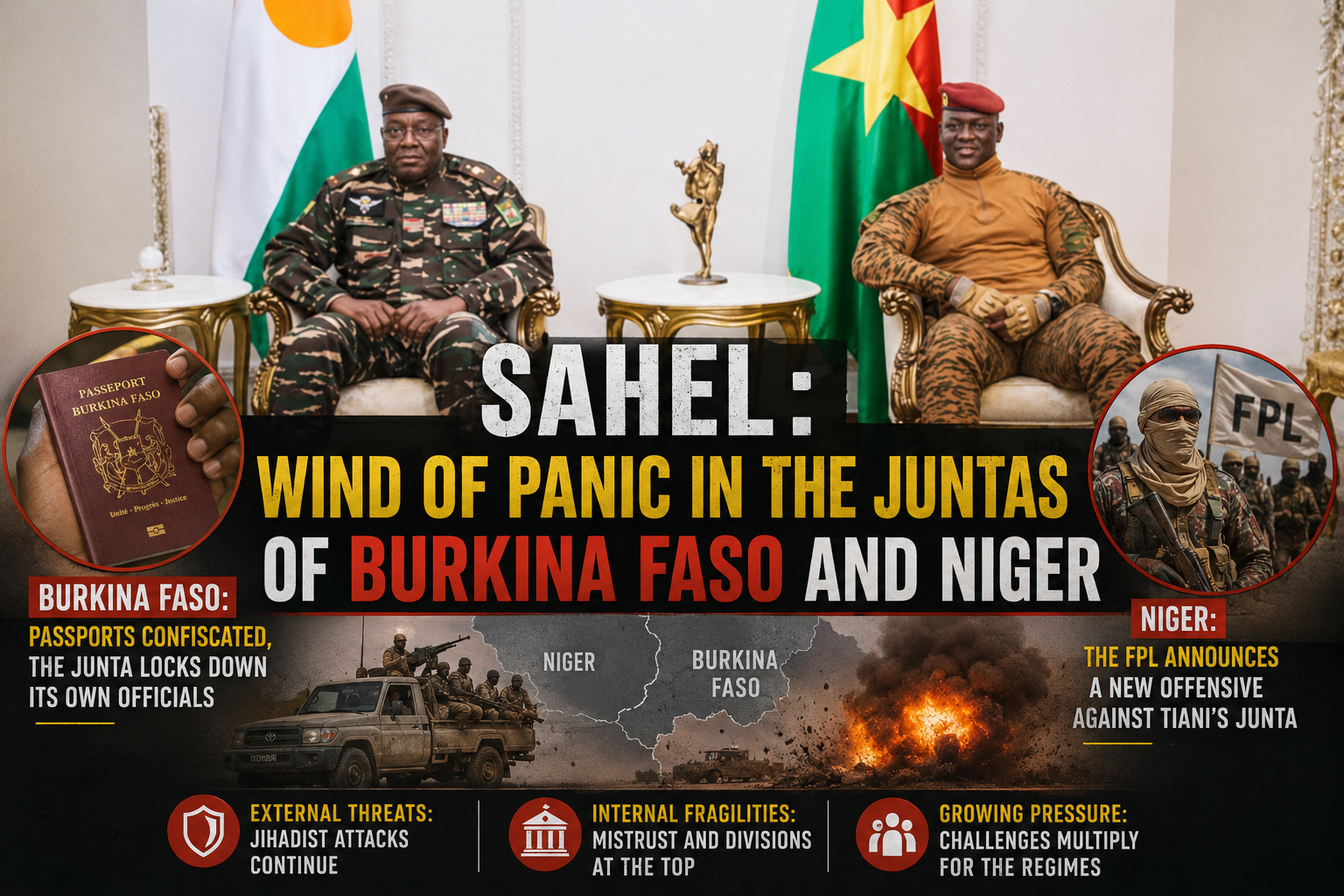
Military regimes in Burkina Faso and Niger face mounting internal and external pressures
The security and political landscape in the Sahel region continues to deteriorate, with Burkina Faso and Niger—key members of the Alliance of Sahel States (AES)—now confronting compounded challenges. While the juntas in Ouagadougou and Niamey grapple with persistent insurgencies, internal fissures within their own ranks have emerged as a critical concern, further complicating their efforts to maintain authority.
Burkina Faso tightens control over state apparatus
In Ouagadougou, a climate of heightened suspicion has taken root. Reports indicate that the military-led government has implemented an unprecedented measure: the confiscation of travel documents for key government officials and senior military officers. This sweeping restriction extends beyond ministers to encompass high-ranking members of the armed forces, signaling an unprecedented level of scrutiny within the upper echelons of power.
The rationale behind this decision appears twofold. First, it seeks to prevent potential defections or unauthorized exits from the country, particularly of officials who may harbor discontent or possess sensitive information. Second, it underscores the regime’s determination to consolidate control over its own institutions at a time when trust within the leadership is eroding. Such measures are typically deployed in contexts where internal cohesion is fragile, and the risk of internal rivalries or betrayals looms large.
This crackdown coincides with an ongoing security crisis marked by relentless jihadist attacks across Burkina Faso. Despite extensive military operations and the mobilization of Volunteers for the Defense of the Homeland (VDP), the insurgency shows no signs of abating. The persistent violence has not only strained security forces but has also intensified pressure on the government to demonstrate decisive leadership, further exacerbating tensions within the state apparatus.
Niger’s FPL intensifies campaign against the ruling junta
In Niger, the opposition to the military regime has escalated from political dissent to an overt military challenge. Following his release in June 2026—secured through a contentious prisoner exchange involving a Libyan militia leader—the secretary-general of the Patriotic Front for Liberation (FPL), Mohamed Salah, has returned with a renewed offensive agenda.
Salah’s liberation, facilitated by forces loyal to Libyan Field Marshal Khalifa Haftar in exchange for the release of a Libyan militant, has emboldened the FPL to escalate its rhetoric. The group now vows to launch a “major operation” aimed at toppling the regime led by General Abdourahamane Tiani. The FPL frames its campaign as a crusade to restore constitutional order, demanding the immediate release of former President Mohamed Bazoum, whom it recognizes as the country’s legitimate leader.
This development marks a significant shift in Niger’s crisis dynamics. While the junta has prioritized combating jihadist threats, the emergence of an armed opposition movement explicitly challenging its legitimacy introduces a new layer of complexity. The dual burden of counterinsurgency and internal dissent risks overstretching the country’s already strained security resources.
Dual crises highlight fragility of Sahel’s military regimes
The unfolding situations in Burkina Faso and Niger reveal a troubling pattern: the juntas, which came to power through coups, now face a convergence of internal and external threats that threaten their stability. In Ouagadougou, the focus has shifted from external threats to the precarious state of internal governance. In Niamey, the challenge is no longer confined to jihadist groups but now includes a determined armed opposition.
As the crises deepen, the ability of these regimes to govern effectively is increasingly in question. The twin pressures of security threats, economic hardship, public discontent, and internal power struggles create a volatile environment. With no immediate resolution in sight, the Sahel region remains on a precarious trajectory, where the risks of further destabilization loom large.