
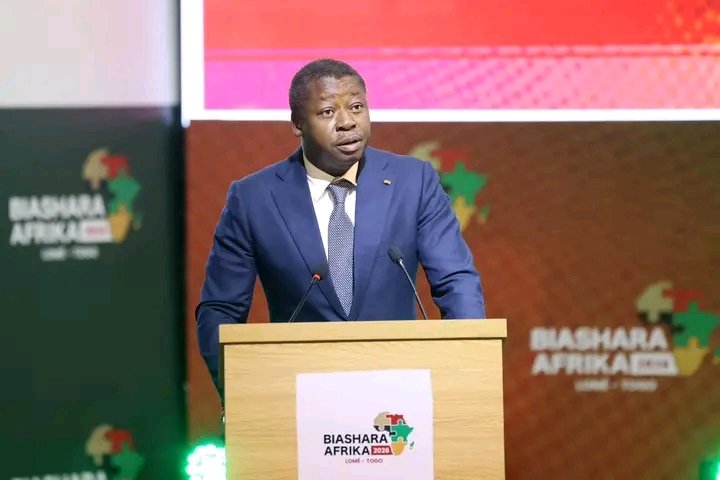
Lomé is currently hosting the third annual Biashara Africa forum, an important continental gathering focused on trade, investment, and fostering African economic partnerships, which commenced on May 18, 2026.
During the opening ceremony, Faure Essozimna Gnassingbé, President of the Council, delivered a keynote address emphasizing the critical importance of the African Continental Free Trade Area (AfCFTA). He underscored the urgent need for Africa to translate its ambitious political visions into demonstrable economic achievements.
Addressing an audience of numerous African leaders, government ministers, investors, and private sector representatives, the Togolese head of state asserted that “the era of vision must now transition into an era of results.”
honoring issoufou mahamadou and pushing for afcfta operationalization
In his speech, President Gnassingbé paid tribute to Issoufou Mahamadou, a prominent champion of the AfCFTA, acknowledging his unwavering dedication to advancing African economic integration.

The President of the Council stressed that mere agreements and legislative frameworks are no longer sufficient. He emphasized that African integration must now manifest through efficient infrastructure, high-performing logistical corridors, modern payment systems, and streamlined trade interactions among African businesses.
He specifically highlighted ongoing challenges such as persistent non-tariff barriers, bureaucratic delays at borders, and prohibitively high logistical costs, all of which continue to impede intra-African trade.
“biashara africa must be a platform for solutions”
For the Togolese head of government, the Biashara Africa forum should transcend simple discussions. He declared, “This event must serve as a platform for solutions, a platform for partnerships, and a platform for operationalizing African integration.”
The Togolese leader further underscored the AfCFTA’s pivotal role within a global landscape characterized by geopolitical tensions, escalating protectionism, and the reconfiguration of international supply chains.
a more economically sovereign africa
Faure Gnassingbé argued that in an increasingly fragmented world, no single African economy can effectively safeguard its interests in isolation.

He views the AfCFTA as far more than a mere trade agreement; it is a vital instrument for achieving continental economic sovereignty. According to him, the ultimate goal is to empower Africa to boost local production, strengthen its industrial capabilities, and enhance its negotiating power on the global economic stage.
advocating for major african corporate groups
The President of the Council also underscored the imperative for the continent to cultivate robust regional value chains and foster the emergence of a more formidable African private sector.
Despite Africa’s abundant natural and human resources, Faure Gnassingbé expressed concern that the continent predominantly exports raw materials while importing high-value-added processed goods. He believes the AfCFTA must enable Africa to overcome the limitations of fragmented national markets to establish competitive African industries. He specifically advocated for the rise of African-owned enterprises capable of operating across the entire continent.
youth and smes at the heart of african integration
In the concluding segment of his address, Faure Gnassingbé placed particular emphasis on African youth, women entrepreneurs, and Small and Medium-sized Enterprises (SMEs). He maintained that African integration can only be sustainable if it genuinely benefits African populations, particularly through job creation, entrepreneurship, and access to regional markets. He affirmed, “African integration cannot succeed if it remains perceived as a project exclusively for large corporations or institutions.”
Togo reaffirms its continental commitment
In his closing remarks, Faure Essozimna Gnassingbé reiterated Togo’s steadfast commitment to African integration. Leveraging its strategic geographical location, advanced logistical infrastructure, and dedication to regional connectivity, Togo aims to play a proactive role in shaping Africa’s future market. The Togolese leader concluded by expressing his hope that this edition of Biashara Africa will catalyze new partnerships and ignite a fresh economic dynamism for the African continent.