
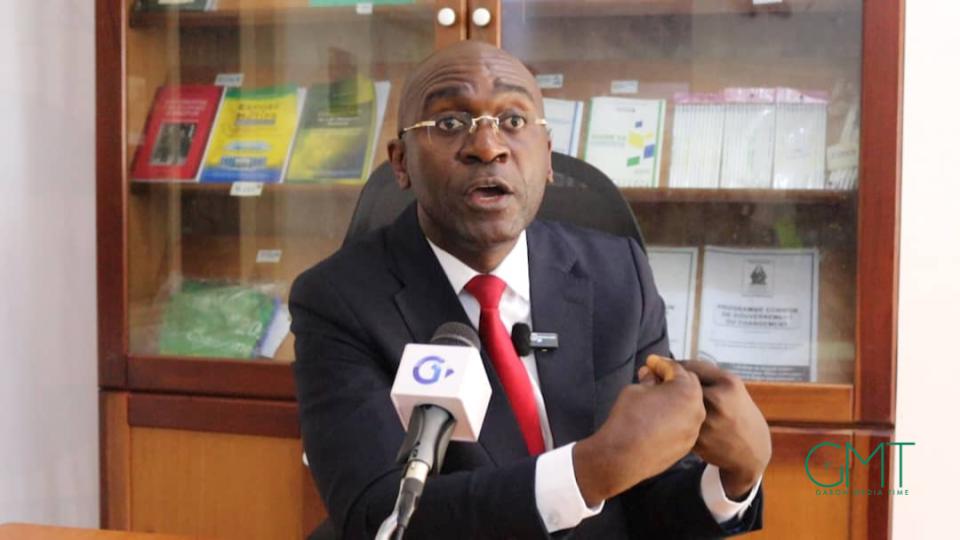
In a bold stance against escalating inflammatory rhetoric from certain Gabonese activists abroad, prominent civil society leader Geoffroy Foumboula Libeka Makosso has drawn a clear line between free speech and harmful verbal abuse. Speaking at a press conference in Libreville, he forcefully condemned recent attacks targeting President Brice Clotaire Oligui Nguema, his wife, and his mother, while also urging authorities to take legal action rather than merely express outrage when infractions occur.
Freedom of expression, Makosso argued, must not be exploited to cross into personal attacks. He highlighted the case of an activist operating under the pseudonym Lanlaire, whose recent statements he deemed to have crossed a critical threshold by shifting from political dissent to direct insults against the Head of State and his family.
Free speech has boundaries
Makosso emphasized that civic engagement should never descend into invective. Drawing from his own experience, he stressed that constructive advocacy—through petitions, public statements, and when necessary, legal proceedings—remains the foundation of meaningful activism. “Disagreement does not imply insulting one’s opponent,” he stated, underscoring that while political criticism is vital, it must never violate the law.
He further warned that the constitutional transition period could not be used as justification for tolerating unchecked verbal aggression. “Insults, defamation, and contempt are crimes—not exercises of free speech,” he declared, calling for judicial accountability when such offenses are committed. Makosso condemned without reservation the statements attributed to Lanlaire, labeling them as unacceptable attacks on the dignity of the presidency and its family.
Questioning the power-activist nexus
Beyond naming the culprits, Makosso scrutinized the relationship between authorities and certain diaspora activists whose notoriety stems from relentless hostility toward the government. He cited instances of invitations to Gabon, appearances on state media, and alleged outreach during presidential visits—claims that, while unverified, demand scrutiny.
He also referenced an unverified claim by an activist who alleged receiving €150,000 (nearly FCFA 100 million) from a member of the presidential delegation to target the Head of State verbally. While these accusations remain unproven, they raise serious questions about the motivations behind such alliances.
Ending the culture of impunity
The civil society leader called on the presidency and state institutions to distance themselves from activists whose only “achievements” are outrage and insults. “The President and his team must end this troubling proximity,” he insisted, warning that unchecked verbal abuse risks normalizing a culture of impunity. Such tolerance, he argued, could embolden others to believe that inflammatory rhetoric is a viable path to influence or even access to power.
Makosso’s message extends to both the perpetrators and the institutions tasked with upholding the law. Condemning misconduct without enforcing legal consequences, he warned, only serves to trivialise the very behaviors being denounced.
Legal action, not tolerance, is the answer
He urged judicial authorities to pursue legal action against those spreading harmful rhetoric, cautioning that inaction could foster the perception that certain activists operate under protection. He also called on the public to reject the viral spread of abusive content by disengaging from offending accounts, refusing to share such material, and reporting it through available platforms.
At its core, Makosso’s intervention raises a fundamental question about Gabon’s public discourse: while free speech is the lifeblood of democracy, it must never devolve into personal humiliation. Political opposition is a cornerstone of governance, but infractions belong in court—not in the court of public opinion.