
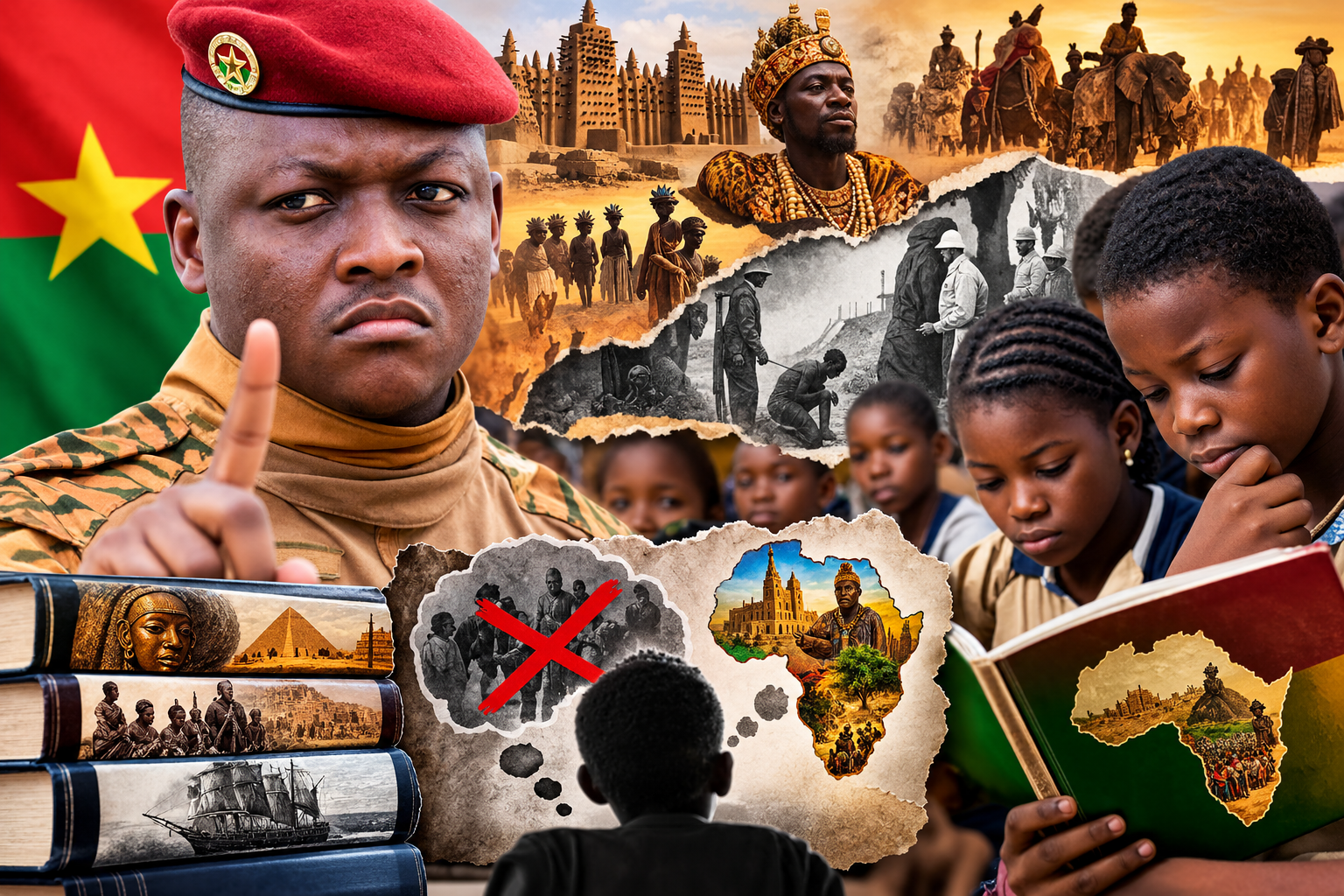
The Burkina Faso government has launched a sweeping reform of its history and geography curricula, aiming to ‘decolonize’ school textbooks. While this effort rightly seeks to elevate African historical narratives, it raises a critical question: should rewriting educational materials confine future generations to a skewed interpretation of their own past?
Beyond the colonial lens: recognizing history’s full spectrum
History is not confined to the era of colonization, the suffering it caused, or the conflicts between African societies and Western powers. It encompasses vibrant civilizations, powerful empires, thriving kingdoms, dynamic trade networks, intellectual exchanges, and societal transformations. To teach history effectively means presenting a robust and multidimensional narrative not one reduced to a single narrative of oppression.
The challenge lies in crafting a curriculum that acknowledges historical injustices without collapsing the entire collective memory into them. School programs have a vital role to play: they can highlight the atrocities of colonialism, celebrate African resistance movements, and restore the legacies of figures long marginalized by dominant historical accounts. Yet, they cannot, in isolation, undo centuries of systemic violence or retroactively repair historical wounds.
Can Burkina Faso steer clear of a new ideological trap?
The danger is real. A reform intended to liberate young minds could, if poorly executed, impose a new form of ideological bias one that replaces an outdated Eurocentric lens with a singular, oversimplified African-centric perspective. Such an approach risks fostering a generation ill-equipped to engage with the complexity of world history.
Take the example of Côte d’Ivoire, where educational reforms have emphasized national identity and African civilizations. A balanced history curriculum must integrate local achievements while embedding them within a global context. Understanding one’s own nation does not mean ignoring the broader world; on the contrary, it requires viewing national history through the lens of international dynamics, power structures, and cross-cultural exchanges that have shaped today’s societies.
The purpose of history education: illumination, not indoctrination
Befriending the past does not mean forgetting its injustices. It means equipping students with the tools to examine those injustices critically: to understand how they occurred, who was responsible, and what lessons they hold for the future. An effective history curriculum doesn’t just list grievances it teaches students to analyze the mechanisms behind historical events and to contextualize them within broader societal frameworks.
A truly decolonized curriculum should not replace one monolithic narrative with another. Students deserve access to the full spectrum of historical truth: the crimes of colonialism, the richness of African civilizations, and the complexities of both African and European societies, including their contradictions and conflicts. This comprehensive approach empowers learners to move beyond resentment or idealization and instead cultivate informed, nuanced perspectives.
What kind of legacy will Burkina Faso leave its children?
The ultimate test of this educational reform is not how well it corrects past imbalances, but how effectively it prepares young people to engage with their world. Will the curriculum foster a narrative of perpetual confrontation with the past? Or will it empower students with the intellectual tools to understand history, debate its lessons, and build a more informed future?
History is not healed by concealing its pages from future generations. It is healed meaningfully and constructively by teaching them to read those pages wisely, interpret them honestly, and learn from them courageously. That is the only way Burkina Faso’s school reform can truly serve its young citizens: not as an ideological tool, but as a foundation for enlightened citizenship.
By Henri Nkeng — Journalist