
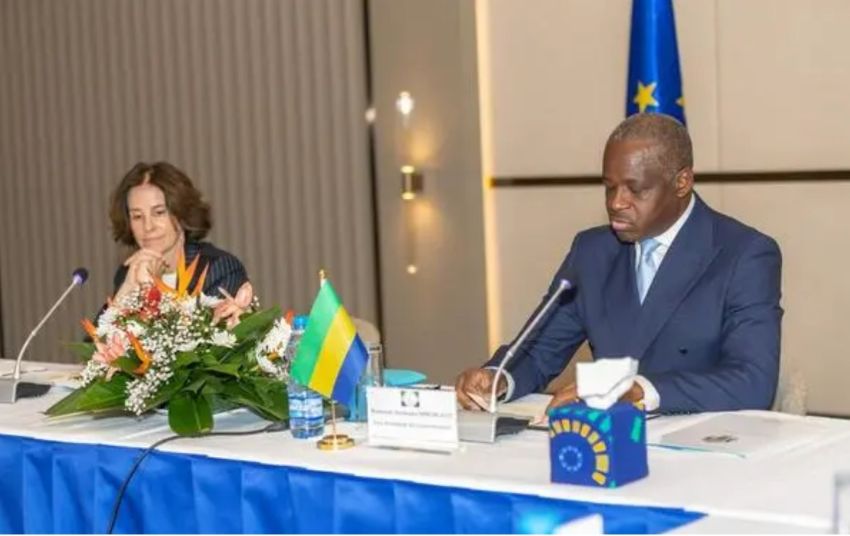
Libreville — The strategic talks recently held in Libreville between Gabon and the European Union represent much more than a routine diplomatic gathering. This session marks a profound evolution in the bond between the two entities.
Within the framework of the 5th Republic, established following the April 2025 presidential elections, these discussions serve as a barometer for a new era. Gabon no longer views itself as a simple recipient of international aid but as a significant economic, political, and environmental ally on the global stage.
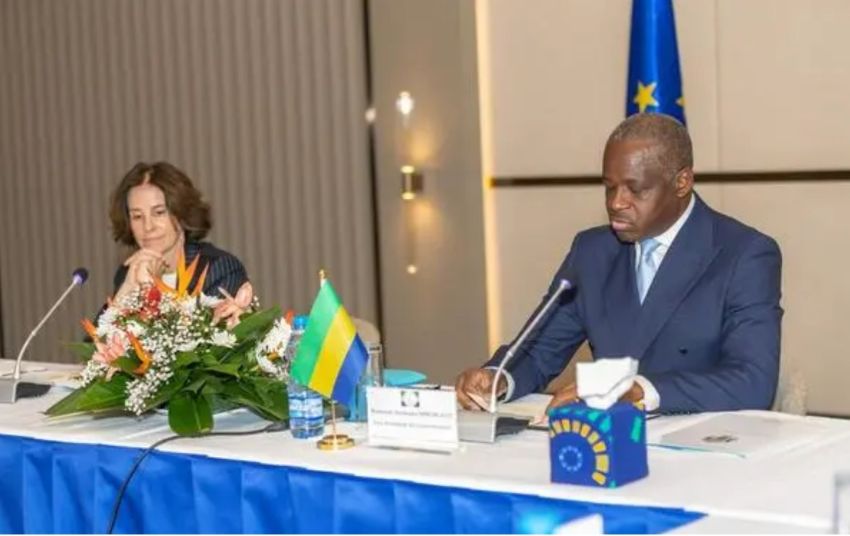
Hosted at the Palais des Congrès Omar Bongo Ondimba, the meeting was led by Hermann Immongault, Vice-President of the Government, and Cécile Abadie, the European Union Ambassador to Gabon. Together, they outlined a cooperation doctrine centered on investment, local value creation, skill transfers, and Gabon’s pivotal role in regional stability.
The 5th Republic under international review
This second session of the Gabon–European Union political dialogue was highly anticipated, serving as the first major international assessment of the country’s institutional cycle following its political transition. Governance and political reforms were at the heart of the agenda.
François Ndong Obiang, Minister of Reform and Relations with Institutions, elaborated on the foundations of the new Constitution. This text is designed to bolster national unity, encourage civic engagement, and promote sustainable development. Key highlights included the institutional recognition of indigenous peoples and the inclusion of the diaspora within national institutions, reflecting a commitment to a more inclusive governance model.
The 2025 elections were also a focal point. Officials in Libreville emphasized the success of a process described as transparent and peaceful, noting a voter turnout exceeding 70%. For the administration, this high participation rate confirms public support for the current institutional order, which is essential for bolstering Gabon’s democratic credibility and attracting foreign investment.
Transitioning from aid to co-investment
A central theme of the discussions was the transition toward a more balanced economic relationship. Hermann Immongault advocated for a paradigm shift, urging a move away from traditional aid toward a structured economic partnership. This new approach prioritizes productive investment, local wealth generation, and human capital development.
Aligned with the Samoa Agreement, which governs relations between the European Union and African, Caribbean, and Pacific states, Gabon aims to attract European capital into vital sectors. These include industrialization, infrastructure, natural resource processing, renewable energy, and the digital economy.
This strategy mirrors the economic vision of President Brice Clotaire Oligui Nguema, who seeks to diversify the economy and reduce reliance on raw material exports. In response, Cécile Abadie noted the importance of evolving cooperation tools to focus on mutual interests and tangible economic outcomes.
Gabon’s leadership in green diplomacy
Environmental preservation remains a cornerstone of Gabon’s international identity. With nearly 88% of its territory covered by forests, the nation is a vital part of the Congo Basin—the world’s second-largest ecological lung. Gabonese authorities argue that this contribution to global climate stability warrants greater financial recognition.
Vice-President Immongault highlighted the significant efforts required to protect these ecosystems. Consequently, Libreville is calling for stronger international financing mechanisms for the ecological transition, ensuring that environmental conservation does not hinder economic progress. This demand for a fair valuation of ecological services is gaining traction in global climate debates.
Beyond ecology, the dialogue addressed regional security in Central Africa, the role of the CEEAC, and stability in the Gulf of Guinea. Ultimately, the Libreville meetings demonstrate Gabon’s ambition to redefine its place in the world. By building a relationship with the European Union based on reciprocity and shared challenges, Gabon is positioning itself as a stable, ambitious, and sovereign partner in the pursuit of sustainable growth and regional peace.