
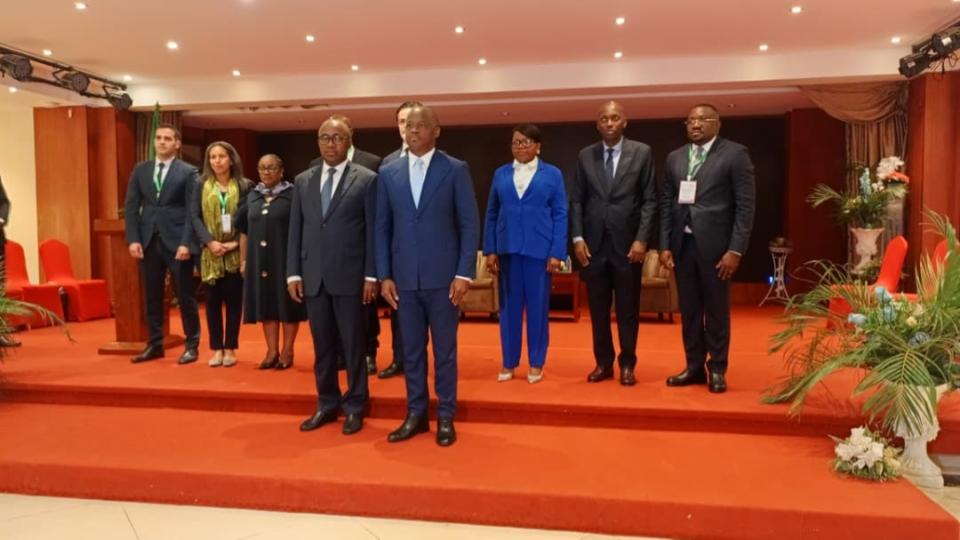
Libreville has become the focal point for a strategic international assessment as Gabon hosts a review mission for the United Nations Convention against Corruption (UNCAC). Starting June 29, this three-day evaluation brings together global experts and national authorities to scrutinize the country’s progress in preventing financial malpractice and recovering illicit assets. This high-level review, involving representatives from the United Nations Office on Drugs and Crime (UNODC) and experts from Tchad and Libye, marks a decisive step in the institutional reforms of the Fifth Republic.
During the opening session, Vice-President of the Government Hermann Immongault emphasized that the quality of national governance is now a primary driver for stability, development, and public trust. For the Gabonese authorities, this international audit is essential for establishing global credibility and ensuring the state remains accountable to its citizens.
Integrity at the heart of the Fifth Republic’s agenda
The fight against financial misconduct is no longer just a legal obligation but a cornerstone of the profound public transformation currently underway. Hermann Immongault noted that since the dawn of the Fifth Republic, Gabon has focused on restoring the bond between the state and the people through transparent and results-oriented institutions. He argued that corruption does more than drain public funds; it erodes the social contract, discourages foreign investment, and fuels social inequality.
In this new era, transparency is viewed as a competitive economic asset. The Vice-President remarked that sound governance provides a strategic edge for nations seeking sustainable growth and shared wealth, moving beyond a simple democratic ideal to become a necessity for national prosperity.
Institutional transformation under the leadership of Nestor Mbou
Nestor Mbou, President of the National Commission for the Fight Against Corruption and Illicit Enrichment (CNLCEI), highlighted the importance of this mission within the current political climate. Nestor Mbou stated that the evaluation coincides with a period of deep institutional shifts aimed at increasing accountability in the management of public resources.
Referencing the vision set by the President of the Republic, Brice Clotaire Oligui Nguema, during his June 15 address to Parliament, Nestor Mbou recalled the commitment to move past the era of endemic corruption and patronage that preceded the transition of August 30, 2023. The goal is to build robust, credible institutions that align with international standards regarding human rights, the rule of law, and democratic principles. These directives now serve as the framework for all public bodies dedicated to preventing and penalizing corrupt practices.
A collaborative effort for truth and progress
Séraphin Ondoumba, acting as the national focal point for the UNODC, welcomed the visiting experts and praised the spirit of international cooperation. He indicated that this exercise demonstrates Gabon’s unwavering commitment to its obligations under the United Nations Convention against Corruption. The focus remains on two critical pillars: preventive measures and the effective recovery of stolen assets, both of which are vital for protecting public wealth.
This “direct dialogue” is intended to be a moment of transparency and renewed dedication to the general interest. Beyond reviewing legal texts, the objective is to refine public policy by identifying successful practices and addressing remaining hurdles with concrete, actionable recommendations.
Three days of rigorous evaluation
Over the course of the mission, international experts will engage with a wide array of stakeholders, including administrative bodies, the judiciary, independent oversight agencies, and civil society organizations. This comprehensive approach ensures a thorough understanding of how the UNCAC is being implemented on the ground.
By opening its doors to this evaluation, Gabon aims to prove that its anti-corruption strategy is a vital part of state modernization. Enhancing the country’s attractiveness to international investors and partners depends heavily on this commitment to integrity and the rule of law.