
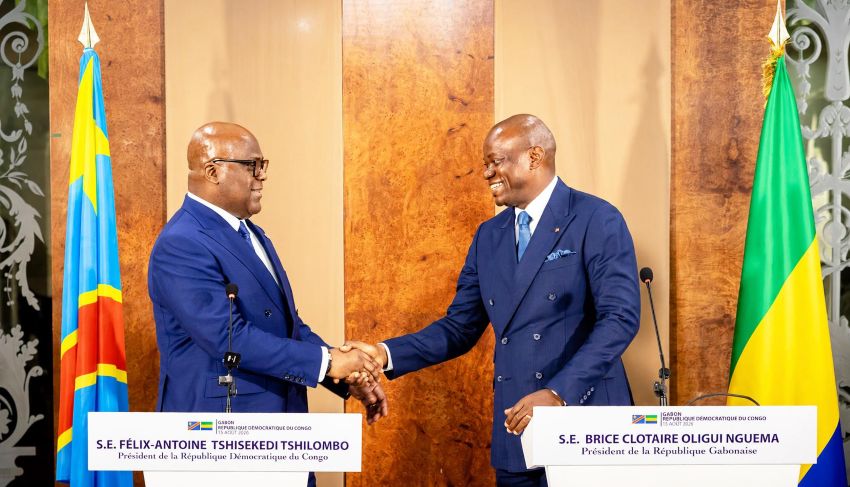
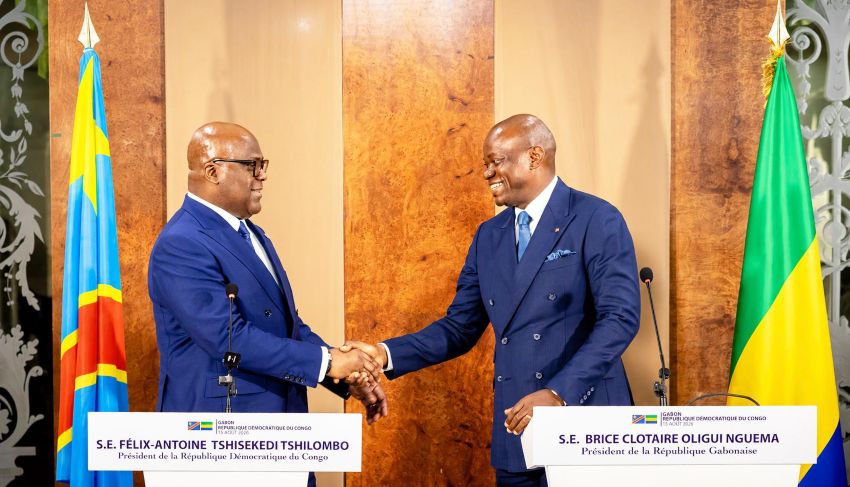
Libreville — The recent visit of President Félix-Antoine Tshisekedi Tshilombo of the Democratic Republic of Congo (RDC) to Libreville transcended the typical formalities of a friendly exchange. During his high-level discussions with Gabonese counterpart Brice Clotaire Oligui Nguema, a more profound political ambition emerged: to position the relationship between Gabon and the RDC as a pivotal instrument for economic transformation, regional stability, and deeper African solidarity.
These ambitious intentions were solidified through the signing of three concrete agreements at the conclusion of their talks.
President Tshisekedi’s presence in Libreville, coinciding with Gabon’s 66th independence anniversary, carried significant weight. It served as a testament to the enduring bond between their respective peoples and underscored the commitment of both leaders to cultivate a robust and lasting cooperative framework. Discussions encompassed a broad spectrum of sectors, including agriculture, infrastructure development, transportation, energy, mining, healthcare, education, vocational training, digital technology, and culture.
Underlying this comprehensive agenda is a shared conviction. Both Gabon and the RDC are endowed with vast natural resources, yet their true strength, as articulated by the leaders, will hinge on their collective capacity to process these resources locally, generate employment, and foster a greater exchange of African skills, capital, and expertise.
Transforming historical proximity into economic power
The two heads of state placed particular emphasis on accelerating the local transformation of natural resources. This strategic direction is crucial for both economies as they endeavor to reduce their dependence on raw material exports and to build greater value chains within their own borders.
Brice Clotaire Oligui Nguema detailed Gabon’s ongoing reform initiatives, specifically highlighting progress in digitalization, women’s empowerment, youth employment strategies, improvements in living conditions, and the strategic valorization of natural assets. Félix Tshisekedi lauded these efforts and conveyed Kinshasa’s strong desire to strengthen its ties with Libreville.
However, the scope of this envisioned cooperation extends beyond purely economic matters. The presidents also addressed critical issues such as transnational organized crime, regional integration, and the indispensable conditions of peace and stability required for development. Their shared vision also encompasses the vital Congo Basin, a major ecological region whose protection now necessitates collaborative, cross-border solutions.
Climate finance, particularly initiatives related to the carbon tax, could also unlock new avenues for collaboration. In a global context where African nations seek to enhance the recognition of their contributions to climate protection, a harmonized approach from Gabon and the RDC could significantly bolster their negotiating power.
This convergence of interests extends to the continental stage. Libreville actively seeks Kinshasa’s support for its bid to join the Council of the International Telecommunication Union (UIT) during the elections scheduled for Doha in November 2026, as well as for its aspiration to host the African Union Summit in 2027. For Gabon, this prospect would represent a significant return to hosting a major continental event, almost half a century after Libreville last welcomed such a summit in 1977.
Three agreements: from discourse to tangible action
The true impact of this meeting is most evident in the formal commitments formalized between the two states. The first agreement covers broad areas of cooperation, including justice, environmental protection, health, and the mining sector, with a specific focus on the local processing of resources. The second accord grants visa exemption for holders of diplomatic and service passports, simplifying travel for officials. The third establishes a framework for regular diplomatic and political consultations between Gabon and the RDC.
A Joint Commission has been established to ensure the diligent follow-up of these commitments. This commission will undoubtedly serve as the ultimate test of this renewed diplomatic phase. While African agreements are numerous, their effectiveness often falters due to the lack of identifiable, funded, monitored, and evaluated projects.
Gabon and the RDC now possess a solid framework to move forward. The imperative is to transform these signatures into active projects, declarations into investments, intentions into job creation, and diplomatic relations into tangible benefits for both populations.
The visit concluded with both presidents observing a moment of reflection at Sainte-Marie Cathedral. This stop at Libreville’s prominent religious site also resonated with a particular Congolese memory, recalling a mass held there in February 2018 in homage to Étienne Tshisekedi.
Beyond this symbolic gesture, the core message remains clear. Today, Gabonese and Congolese citizens have the opportunity to transform their historical closeness into a powerful collective force. The two presidents have paved the way, the three signed agreements provide the structure, and the Joint Commission is now poised to set the pace for implementation.
Africa must move beyond merely proclaiming its solidarity; it must actively organize, finance, and translate it into concrete results. Between Libreville and Kinshasa, the time for decisive action has definitively arrived.