
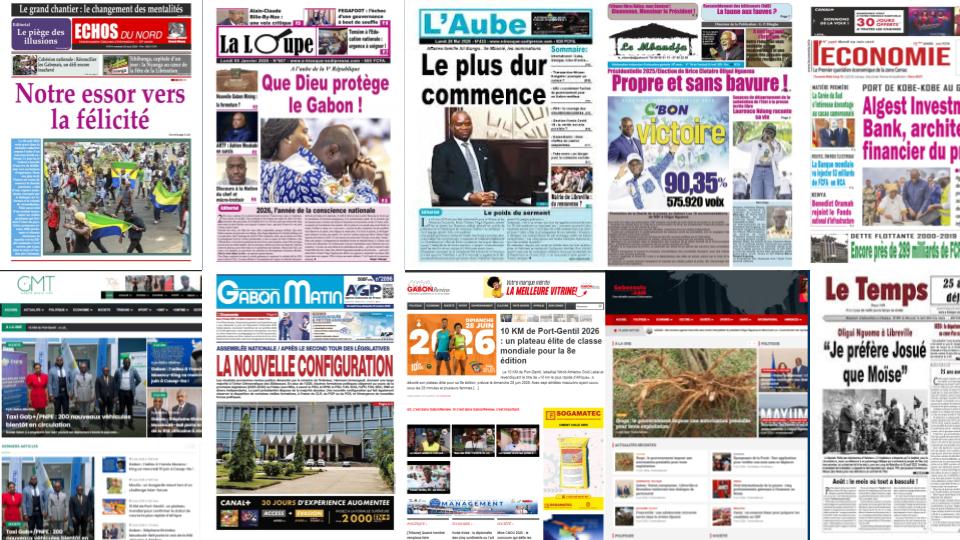
As Gabon works toward establishing its Fifth Republic, the national media landscape is facing an unprecedented existential threat. The erosion of print newspapers, the instability of digital platforms, and a shrinking advertising market are not just economic hurdles; they represent a direct challenge to the health of our democratic system.
While national discourse focuses on infrastructure and political transitions, the quiet collapse of the press sector is being met with a troubling lack of urgency. A democracy that lacks a robust media environment eventually becomes a monologue, where the leadership risks losing touch with the people’s reality.
The fading presence of newspapers
The decline of print media serves as a stark indicator of this crisis. There was a time when newsstands were the heart of public debate, where citizens eagerly awaited the latest editions to discuss the nation’s affairs.
Iconic titles such as La Loupe, L’Aube, and Échos du Nord once served as the heartbeat of public discourse, weathering political storms to provide critical analysis. Despite being labeled as hostile by some officials in the past, these journals continued to publish and nourish the national conversation. Today, these publications have become rare finds, leaving a void where national debate once thrived. This disappearance is not merely an economic statistic; it is the silencing of a vital political voice.
The symbolic shift of state media
The trajectory of Gabon Matin serves as a cautionary tale for the entire industry. Once a daily pillar of the state media, it transitioned to a bi-weekly and then a weekly format before moving almost entirely to digital distribution. While some claim this is a strategic move toward modernization, the reality is far more practical: the severe financial pressures affecting the sector do not spare even those outlets historically supported by the state.
The missing reforms for the sector
For several years, there has been talk of restructuring programs and financial support mechanisms intended to stabilize the media. Significant figures have been mentioned and expectations raised, yet on the ground, publishers are still fighting for their very existence. The effectiveness of public policy is measured by its impact, and currently, the visible results for media houses are deeply concerning.
Digital media under pressure
The digital sector is similarly precarious. Although news websites are proliferating across the Gabonese internet, very few possess formal newsrooms, physical offices, or transparent leadership structures. Even the platforms that maintain high professional standards are being choked by an impossible economic equation: private advertising is scarce, digital revenue remains low, and access to major institutional campaigns is often restricted to a small circle of actors.
Democracy requires a resilient press
This issue has moved beyond economics and now threatens the core of democratic life. Pluralism cannot exist if media organizations cannot afford to operate. When newsrooms live in permanent precariousness, the quality of information suffers, and the diversity of opinions vanishes.
A weakened press is a vulnerable press, susceptible to external pressures and compromises. For a democracy to remain resilient, it requires independent voices that are solid, credible, and capable of working without the constant fear of financial collapse.
A collective failure in the making
There is a cruel irony in the current situation: the authorities tasked with regulating the media may soon find themselves overseeing an empty landscape. A regulatory framework is useless if there are no actors left to follow it. The loss of independent voices would be a failure for the entire nation, depriving Gabon of the vibrant public space necessary for a functioning democracy.
Protecting the media to save public debate
The media crisis is a societal issue, not just a professional one. A country that allows its press to wither away inevitably impoverishes its own public discourse. Gabon now faces a choice: continue to watch the industry decline or implement deep reforms based on transparency, equity, and economic viability. Democracy is threatened not only when newspapers are silenced, but when they are allowed to perish through neglect.