
As tensions in the Western Pacific reach new heights, a critical question looms over the Taiwan Strait: Is China probing the boundaries of regional stability with an unprecedented naval display, and is Washington responding with covert nuclear surveillance?
China’s massive naval exercise: A calculated show of force or a rehearsal for isolation?
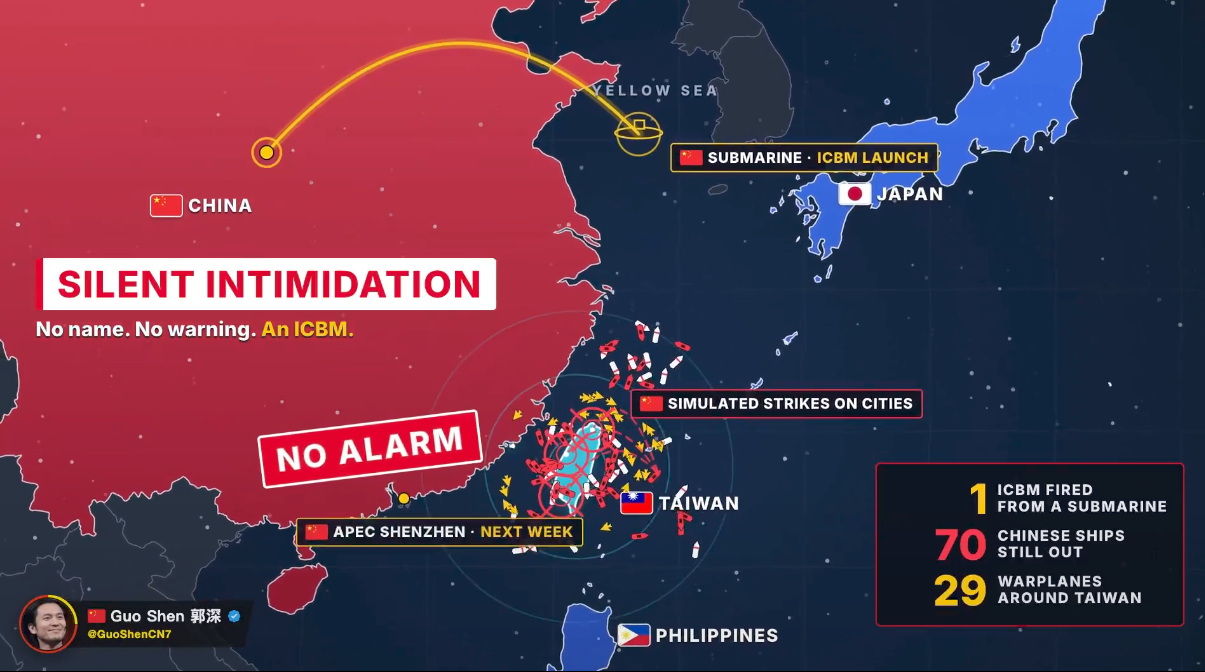
In early November 2026, a coordinated naval operation unlike any other unfolded in the waters surrounding Taiwan. Over 100 Chinese warships and coast guard vessels, drawn from the Eastern, Northern, and Southern fleets, were deployed in a sweeping maneuver that stretched far beyond the confines of the Taiwan Strait. According to Taiwanese security officials, the exercise included simulated attacks on military targets and urban areas, raising eyebrows among regional analysts.
The sheer scale of the deployment—with around 70 ships still active near the First Island Chain as of November 13—signals more than routine drills. Observers suggest this could be a dry run for a potential blockade or denial-of-access strategy, designed to isolate Taiwan in a crisis. Such a move would allow Beijing to disrupt the island’s maritime and air traffic while exerting economic pressure without launching a full-scale invasion.
The Institute for the Study of War (ISW) highlighted in its November 13 assessment that these maneuvers align with scenarios Beijing might use to enforce a maritime blockade, a tactic that would severely test Taipei’s resilience and international support.
Taiwan’s strategic vulnerability: A tinderbox in the making?
For Taiwan, the implications are stark. The island’s economic and military lifelines—its shipping lanes and air corridors—are now under the shadow of China’s naval surge. A successful blockade could cripple Taipei’s ability to import essential goods, from energy to semiconductors, while complicating any foreign intervention. The stakes are global: Taiwan produces over 60% of the world’s advanced microchips, making it a linchpin in the tech industry’s supply chain.
Japan, geographically close and a key US ally, would also feel the ripple effects. A disruption in the Taiwan Strait could threaten maritime trade routes critical to Tokyo’s economy, from energy imports to manufactured goods. The region’s security architecture, already fragile, now faces an even greater test of endurance.
The WC-135R ‘Nuclear Sniffer’: What was its mission near Taiwan?
Amid the naval tensions, another player entered the fray on November 15—a WC-135R Constant Phoenix, the US Air Force’s airborne nuclear detection aircraft, codenamed ‘Nuclear Sniffer.’ According to military aviation trackers, the plane took off from Okinawa, Japan, and flew a route south of Taiwan before heading toward the southwestern approaches of the Taiwan Strait.
Equipped with advanced atmospheric sampling technology, the WC-135R is designed to detect traces of radioactive particles, a capability typically used to monitor nuclear tests or radiological incidents. Its presence in the region, coinciding with China’s naval exercises, has fueled speculation. Is Washington gathering intelligence on potential nuclear developments in Beijing’s military operations? Or is this a routine surveillance flight unrelated to the ongoing tensions?
Without official confirmation, the answers remain speculative. The WC-135R’s mission could range from monitoring China’s nuclear-capable assets to assessing environmental conditions after a hypothetical conflict. What is clear, however, is that its deployment adds another layer of uncertainty to an already volatile situation.
Washington’s hidden hand: Is the US watching Beijing’s every move?
The US has long maintained a robust surveillance network in the Western Pacific, with Kadena Air Base in Okinawa serving as a critical hub. The WC-135R’s flight near Taiwan suggests that Washington is leveraging every available tool to stay ahead of Beijing’s strategic maneuvers. But is this a defensive response to China’s naval surge, or a proactive attempt to deter escalation?
The ambiguity of the WC-135R’s mission underscores a broader challenge: deciphering intent in a region where miscalculation could spiral into conflict. The US-China rivalry over Taiwan is not just about control of an island—it’s about dominance in a high-stakes geopolitical chess game where economic, technological, and military interests collide.
A global domino effect: Why Taiwan’s stability matters to everyone
The Taiwan Strait is no longer just a regional flashpoint—it’s a global pressure point. A military confrontation here would send shockwaves through the world economy, disrupting supply chains for everything from smartphones to electric vehicles. Semiconductor shortages, already a concern in 2020-2023, could become a permanent crisis, crippling industries worldwide.
Moreover, the risk of unintended escalation looms large. A misstep in the waters or skies around Taiwan could drag the US and China into direct conflict, with unpredictable consequences for global security. The stakes are simply too high for complacency.
What’s next? The delicate balance of deterrence and diplomacy
For now, neither Beijing nor Washington has signaled an imminent move toward open conflict. China’s naval surge appears to be a test of resolve, while the US response—including the WC-135R’s flight—hints at vigilance rather than provocation. Yet, in a region where trust is scarce and brinkmanship is common, the margin for error is razor-thin.
The coming weeks will reveal whether these maneuvers are part of a broader strategy or merely a temporary spike in tensions. One thing is certain: the Western Pacific is now the epicenter of a new Cold War, where every ship, plane, and satellite move is scrutinized for clues about the future of global order.