
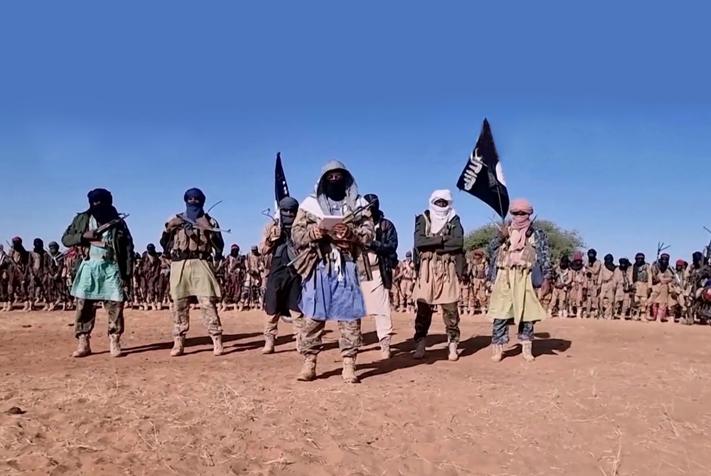
The Islamic State in the Sahel continues to exert influence in northeastern Mali despite growing attention on the JNIM.
The Islamic State’s Sahel Province (ISSP), formerly known as EIGS, maintains a strong foothold in key areas of Mali, particularly in the Gao and Ménaka regions. Localities like Talataye, Tin-Hama, Tessit, and Labbezanga—often referred to as the “3 T” zones—remain critical operational hubs where the group enforces territorial control and exerts pressure on nearby communities.
Leadership and Strategy
The ISSP operates under the command of Abou Al-Bara, who took over after Adnan Abu Al-Walid Sahraoui was killed in 2021. While the group’s exact command structure remains unclear, it has shifted tactics since 2020. Instead of relying on high-profile executions and mass terror, the ISSP now focuses on local governance, territorial dominance, and strategic pressure, aiming to embed itself within communities while minimizing media exposure.
Recent military operations by Malian forces have disrupted the group’s activities. In a nighttime airstrike on May 14–15, 2026, near Bara in the Ansongo district, Malian troops neutralized a key ISSP operative alongside several affiliated fighters. Despite these setbacks, the group has shown resilience, regrouping in border regions and maintaining its logistical networks.
Ongoing Operations and Rivalries
The ISSP continues to target strategic locations along the Mali-Niger border, including Talataye, Tin-Hama, Tessit, Labbezanga, and Ménaka. By controlling movement corridors, the group secures its dominance over trade routes and exerts influence over local armed factions. This strategy reinforces its presence while avoiding direct confrontations that could draw military or media attention.
A notable aspect of the current security landscape is the persistent rivalry between the ISSP and the JNIM. While the JNIM has gained visibility through high-profile attacks, including coordinated strikes near Bamako in April 2026, the ISSP operates with a more subtle approach. Unlike the JNIM’s focus on spectacular violence, the ISSP prioritizes quiet territorial control, economic pressure, and community influence.
Although tensions between the two groups have eased at times—such as during periods of military offensives—the underlying competition persists. The ISSP’s ability to adapt and maintain its networks suggests that its threat remains deeply entrenched in northeastern Mali.
Escalating Threats and Regional Impact
According to recent assessments, the ISSP accounted for 86% of Islamic State activity in Africa during the first quarter of 2026. The group has expanded its methods, incorporating armed drones, motorized attacks, and economic blockades to weaken local resilience. Key targets include infrastructure along the Ménaka-Ansongo-Tessit axis and near Labbezanga, where the group imposes de facto governance.
A February 2026 attack on a civilian convoy near Gao, at Kobé, highlighted the ISSP’s willingness to disrupt supply lines and intimidate populations. While international cooperation has led to the neutralization of high-ranking figures—such as Abu-Bilal Al-Minuki, killed in a joint operation near Lake Chad on May 16, 2026—the group’s core presence in the “3 T” zones and Labbezanga remains intact.
The ISSP’s strategy hinges on exploiting gaps in security and media focus. As attention shifts toward the JNIM and other factions, the group strengthens its territorial grip, undermines local stability, and challenges Malian forces. Strengthening security efforts along the Niger-Mali border is essential to countering this persistent threat.