
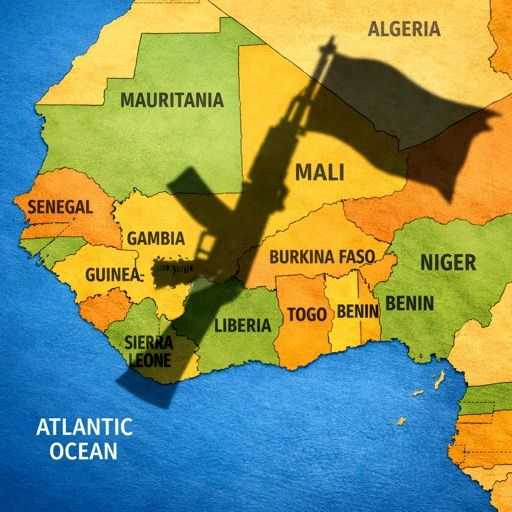
Understanding the JNIM’s Expansion Strategy in West Africa
The Jama’at Nusrat al-Islam wal-Muslimin (JNIM), an Al-Qaeda affiliate established in 2017, has emerged as one of the most influential armed groups in the Sahel. With a growing presence across Mali, Niger, and Burkina Faso, the group’s various katibas (military units) now compete with state authorities for territorial control and governance in key regions.
However, since 2019, the JNIM’s expansion has taken a new direction—moving southward beyond the Sahel into the Gulf of Guinea. This shift has particularly targeted northern Bénin, Togo, and Côte d’Ivoire, where the group has claimed responsibility for several high-profile attacks in recent years. Yet this expansion is not uniform: while Ghana remains largely untouched, Côte d’Ivoire saw significant violence between 2020 and 2022 before a sudden lull in armed activity. Meanwhile, Bénin has experienced a sharp deterioration in security, particularly in 2025.
International Crisis Group’s latest report delves into the geography of this expansion, examining how the JNIM’s leadership conceptualizes and executes its strategy. Far from being a straightforward or inevitable move, territorial expansion presents the group with a strategic dilemma. Expanding too slowly risks ceding ground to rival factions or failing to meet the expectations of its own fighters. But expanding too rapidly could stretch the organization’s resources thin, leading to internal tensions and potential fragmentation.
Key Challenges in the JNIM’s Expansion
- Resource allocation: Spreading forces across new territories demands significant manpower and funding, which may not always be available.
- Internal cohesion: Rapid expansion can create logistical and operational strains, risking disorganization or dissent among commanders.
- Geopolitical shifts: The formation of the Alliance des États du Sahel (AES) and its withdrawal from the CEDEAO add further complexity to regional security dynamics.
- Strategic unpredictability: The JNIM’s inconsistent pattern of attacks—sudden escalations followed by lulls—suggests a decision-making process that is not always linear or predictable.
Why This Matters for Regional Security
In a context where Burkina Faso and its neighbors are grappling with rising insecurity, understanding the internal workings of the JNIM is critical. A clearer picture of its expansion strategy could help policymakers and security forces in Ouagadougou and beyond develop more effective counterterrorism policies—ones that account for the group’s evolving tactics and the broader geopolitical landscape of West Africa.
Expert Insights on Jihadist Expansion in the Sahel
This analysis is informed by discussions with leading researchers and analysts, including:
- Jean-Hervé Jézéquel (International Crisis Group) – Director of the Sahel Project, specializing in political and security issues across the region.
- Marte Beldé (Sciences Po Bordeaux) – Postdoctoral researcher studying the political economy and spatial expansion of jihadist movements in West Africa.
- Beatriz de León Cobo (GEMASS – Sorbonne Université) – Doctoral candidate researching radicalization, with a focus on dialogue initiatives between Europe and the Sahel.
- Dan Sanaren (CERI–Sciences Po / CNRS) – Moderator and expert on Sahelian geopolitics.
As the JNIM continues to reshape the security landscape of West Africa, its strategic choices—whether deliberate or constrained—will have lasting implications for countries on its periphery.