
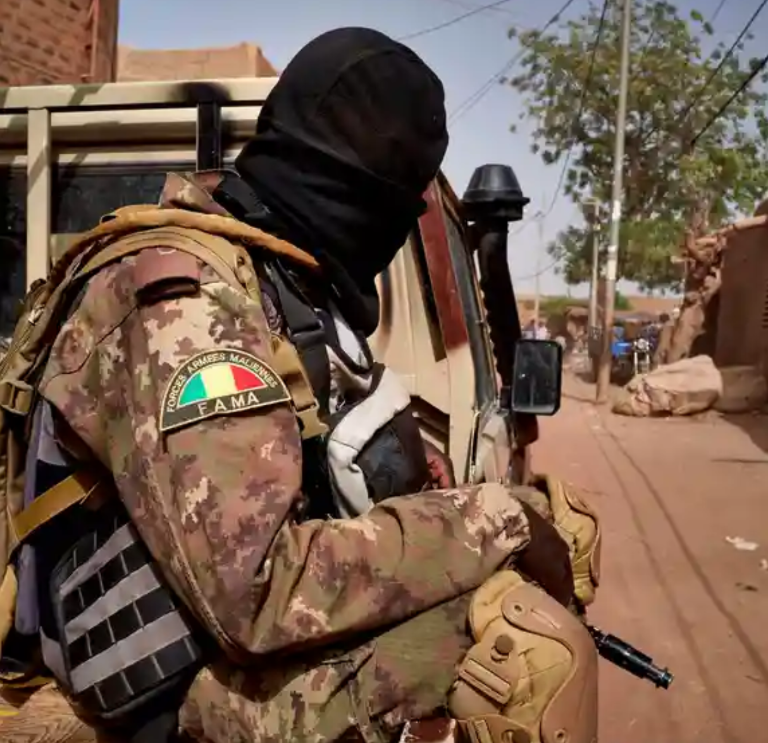
The Group for the Support of Islam and Muslims (JNIM), an Al-Qaeda-affiliated militant coalition, has leveled serious allegations against the Malian Armed Forces (FAMa) and their Russian allies, Africa Corps, accusing them of executing civilians from the Fulani community in the Niono district of the Ségou region.
Unverified claims fuel tensions in central Mali
The accusations, released via the group’s propaganda channels, claim that a joint military operation involving Malian troops and Russian paramilitaries targeted Fulani civilians in a punitive raid. While independent verification remains nearly impossible due to the information blackout in the area, reports suggest multiple civilian casualties and property damage. The Niono district, a historically volatile area, has once again become a flashpoint in the broader crisis gripping central Mali.
The escalation follows a pattern of recurring violence where military operations and militant propaganda intertwine, leaving civilians caught in the crossfire. The JNIM’s accusations come at a time when the region’s security situation is increasingly precarious, with civilian protection slipping further out of reach.
Fulani community: a recurring victim in the conflict narrative
For years, the Fulani people—primarily pastoralists—have been trapped between conflicting narratives. The Malian government and its allies have often viewed them with suspicion, associating them with militant groups due to their ethnic ties. Meanwhile, jihadist factions like JNIM exploit this distrust, positioning themselves as the sole protectors of the Fulani against perceived state violence.
By framing its accusations around ethnic identity, the JNIM seeks to deepen divisions and rally support. The group’s messaging taps into real grievances of marginalization, portraying itself as the only entity capable of shielding the Fulani from harm. This strategy not only bolsters its local legitimacy but also serves as a recruitment tool, attracting disillusioned members of the community.
The war of narratives has become as pivotal as the military campaign. For the JNIM, weaponizing the suffering of Fulani civilians weakens national cohesion and undermines trust in Bamako’s governance.
Military operations under scrutiny amid civilian toll concerns
Bamako maintains that its military operations—conducted with support from Africa Corps—target terrorist networks without ethnic bias. The transitional authorities insist that human rights are respected, though critics argue that the tactics employed, particularly those involving Russian forces, raise serious concerns about collateral damage.
Human rights organizations have repeatedly highlighted the risks of indiscriminate violence, but the Malian military dismisses such reports as fabrications, labeling them “Western propaganda” or “fake news.” The lack of transparency and restricted access for independent journalists and international investigators make it difficult to corroborate or refute these claims, leaving the public reliant on competing narratives.
The opacity surrounding these operations only fuels the adversary’s propaganda, allowing militant groups to fill information gaps with their own versions of events. This dynamic further complicates efforts to restore peace and stability in central Mali.
Civilian protection and truth must take precedence
The latest JNIM allegations underscore the urgent need to prioritize civilian safety in the conflict’s most volatile regions. As military pressure intensifies, the risk of interethnic retaliation grows, threatening to plunge central Mali into an irreversible cycle of vengeance.
For independent observers and media outlets, the challenge lies in reporting with precision and neutrality—avoiding amplification of militant propaganda while exposing ground realities without bias. True peace in Mali cannot be achieved through force alone; it demands justice, accountability, and the restoration of trust among traumatized communities.