
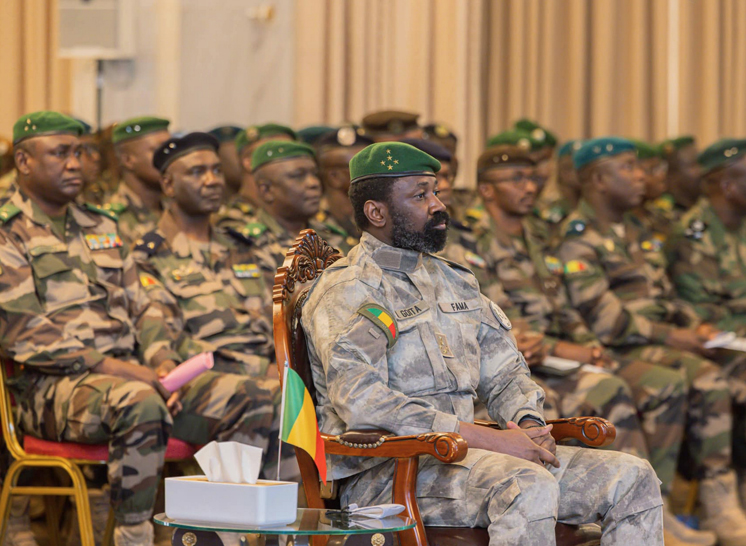
The Mali government has rolled out a sweeping overhaul of its defense and security architecture, marking the first major revision in over two decades. The new framework, approved by the National Transitional Council, expands the scope of national security to include internal threats, cyber defense, and comprehensive crisis management. This legislative shift aims to replace the outdated 2004 National Defense Law, which had become ill-equipped to address the country’s evolving security landscape.
In a session before the 125 Council members, General Daoud Aly Mohammedine, Minister of Security and Civil Protection, emphasized that two decades of security challenges—both domestic and regional—made this reform long overdue. He highlighted the inclusive nature of the drafting process, noting that security stakeholders from across sectors contributed to shaping the new policy to ensure practical and balanced implementation.
The 2004 framework, while originally focused on military defense, already included provisions for internal security, civil defense, and the involvement of local governments, civil society, and communities. Under the old system, the Chief of the General Staff led military operations and, during territorial defense scenarios, could exercise authority over select security forces. However, the new law refines and clarifies these roles to meet today’s threats.
Strengthening national security in a digital age
The reform consolidates strategic decision-making and operational command under unified structures. The National Security Council and the National Defense Committee now replace older bodies, reinforcing centralized leadership under the President. This restructuring aims to streamline crisis response, particularly in cases of cross-border threats or major incidents requiring multi-force coordination.
One of the most significant updates is the explicit inclusion of cybersecurity and cyberdefense as core pillars of national security. In June, the government formalized the creation of the National Agency for Information System Security (ANSSI), tasked with protecting critical infrastructure and coordinating responses to cyberattacks. This agency will operate within the broader National Cybersecurity Strategy (2026–2030), distinguishing between cyberdefense—reserved for state-level threats—and general cybersecurity, which covers government systems, networks, and communications.
Unified operational command remains centered on the Chief of the General Staff, particularly for territorial defense. This ensures rapid decision-making when multiple security forces—including the Police, Gendarmerie, National Guard, and Civil Protection—must respond simultaneously to an attack or crisis. However, these forces will not be permanently placed under military command, preserving their distinct roles in public safety and emergency response.
Notably, since 2022, the National Police and Civil Protection services have been militarized, a change that enhances their integration into broader security operations while maintaining their core functions. This shift facilitates smoother collaboration across agencies during joint missions.
Local governance and community engagement
The reform places renewed emphasis on strengthening territorial administration and leveraging traditional authorities in counter-terrorism efforts. Recruitment and equipment upgrades for security forces remain a priority, as does the role of the Ministry of Territorial Administration and Decentralization. This ministry is now tasked with coordinating civil defense, managing decentralized services, engaging local governments, and mobilizing communities—all aimed at improving early warning systems and situational awareness without overburdening civilians.
General Daoud Aly Mohammedine underscored three critical priorities during the Council session: bolstering local administrative capacity, integrating traditional leaders into security strategies, and continuing to recruit and equip forces. The goal is to create a more responsive and adaptive security ecosystem that bridges the gap between national policy and ground-level realities.
Testing coordination: disarmament and reintegration
While not directly tied to the new law, the ongoing Disarmament, Demobilization, and Reintegration (DDR) initiative serves as a real-world test of inter-agency coordination. On August 4, 254 former combatants from various armed groups completed training in Soufouroulaye and officially joined the Armed Forces. The broader DDR program aims to integrate 2,000 ex-fighters and support the socio-economic reintegration of another 1,000. This effort demands close collaboration between defense, security, reconciliation, and local authorities, reinforcing the practical application of the reform’s principles.
The success of this new security framework will hinge not on the names of new institutions, but on the effectiveness of their implementation. Key factors include the clarity of operational procedures, the efficiency of intelligence sharing, the resources available to local governments, cyber capabilities, and the monitoring of reintegrated personnel. The reform establishes a chain of command and accountability—its true test will be the speed of decision-making, the synergy on the ground, and the trust among institutions, forces, and citizens.