
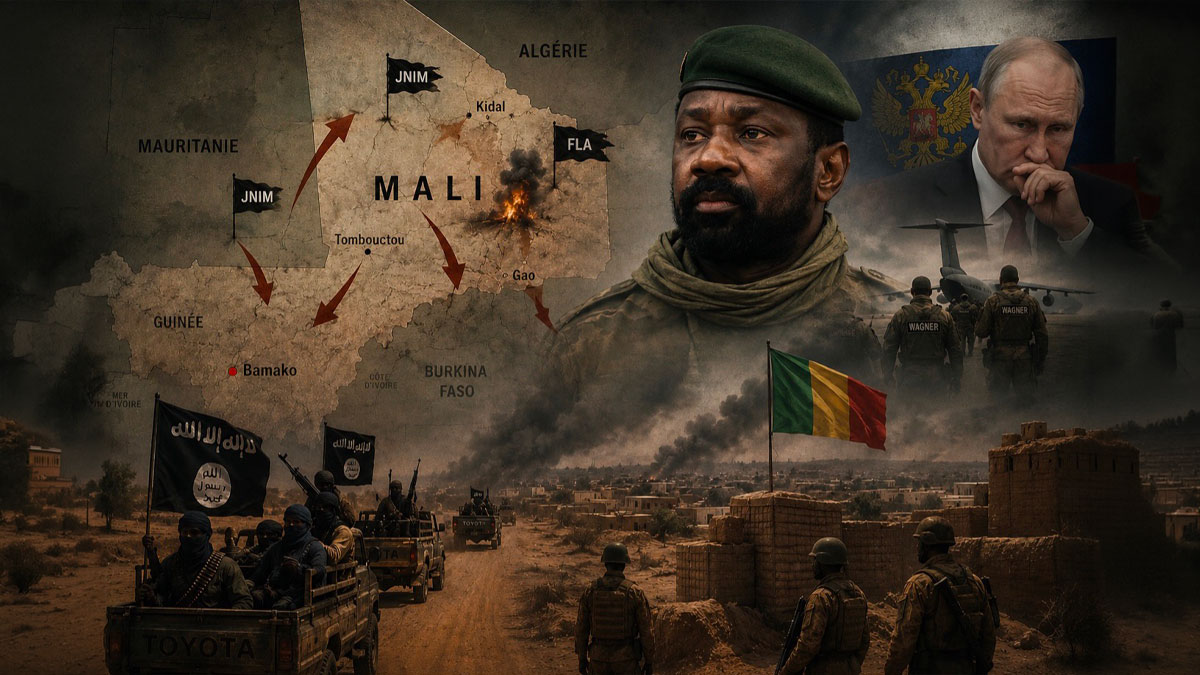
The Bamako junta’s strategic vacuum
The Republic of Mali is no longer merely a nation in crisis—it has become a critical fault line across the entire Sahel region. A toxic cocktail of relentless jihadist offensives, Tuareg separatist militancy, deep-seated ethnic rivalries, economic collapse, and heavy reliance on Moscow’s security support has transformed Mali’s fragility into a full-blown regional emergency.
Since launching a major offensive on April 25, 2026—attributed to a tactical merger between the JNIM (an Al-Qaeda affiliate) and the FLA (a front advancing northern separatist claims)—the dynamic has shifted dramatically. No longer confined to the desert periphery, the insurgency now targets urban hubs, military bases, supply corridors, and key power centers. What emerges is an image of a state reduced to scattered fortified enclaves, struggling to maintain coherence and increasingly dependent on ad-hoc defense of the remaining strongholds.
The military leadership under Assimi Goïta had vowed full territorial reconquest, the eviction of French influence, the restoration of national sovereignty, and the forging of a new strategic axis with Russia. Yet today, these ambitions appear increasingly hollow. While ejecting French forces was achievable, replacing their intelligence networks, logistical backbone, air support, regional partnerships, and ground-level expertise proved far more difficult than anticipated.
Strategic miscalculation: abandoning accords without the means to prevail
January 2024 marked a turning point when Bamako declared the 2015 Algiers Accords obsolete. Although flawed and inconsistently implemented, those agreements had at least served as a fragile political barrier against renewed all-out war in the north. By discarding them, the junta chose a path of force over diplomacy, and military reconquest over political accommodation.
Military reconquest, however, demands a disciplined army, robust intelligence, air power, logistics, sustained presence, local buy-in, and administrative continuity—none of which Bamako possesses in sufficient measure. What it does have is a militarized regime, a potent sovereignist narrative, a repressive domestic apparatus, and a Russian ally useful for regime protection but ill-equipped to stabilize a vast, fragmented country riven by trafficking, insurgencies, and historical grievances.
This is the heart of the misunderstanding: sovereignty is not merely declaring external actors unwelcome; it is the concrete capacity to govern territory, people, borders, economy, and security. When a state claims sovereignty but cannot control roads, schools, markets, mines, customs, or barracks, that sovereignty becomes a hollow emblem.
Jihadists and separatists: a tactical alliance, not a shared vision
Current operational cooperation between the JNIM and the FLA should not be mistaken for ideological alignment. The jihadists seek to impose an armed, transnational Islamic order premised on delegitimizing the national state. The Tuareg separatists of Azawad, by contrast, pursue a territorial, identity-based agenda rooted in autonomy or independence claims for northern regions.
In war, however, shared short-term objectives can outweigh long-term differences. Both factions now share Bamako—and the Russian-backed security apparatus—as their immediate enemy. Synchronized strikes saturate Malian defenses, forcing them to thin out units, divert reinforcements, split helicopters, ration fuel, guard convoys, and scramble intelligence. When a weakened army is stretched across multiple fronts, the crisis becomes psychological as much as military: each garrison fears becoming the next target; local officials wonder whether the capital can truly intervene; allies recalculate their stakes.
This is the decisive insight: victory in Mali is not won by capturing a single city, but by shattering residual trust in the state. When civil servants flee, soldiers hesitate, local chiefs negotiate with armed groups, traders pay protection, and citizens view Bamako as distant and impotent, the state retreats even where its flags still fly.
Military assessment: Mali’s army stuck between garrison duty and attrition
The Malian Armed Forces face a structural dilemma: defending an enormous territory with limited resources, insufficient manpower, vulnerable supply lines, and a highly mobile adversary. Insurgent groups do not need to hold cities permanently; they strike, withdraw, block roads, encircle convoys, isolate outposts, disrupt commerce, intimidate officials, tax villages, and impose intermittent sovereignty.
The regular army, by contrast, must garrison positions, protect civilians, maintain supply chains, and project continuity. This is the classic counterinsurgency paradox: the state must be everywhere, while the insurgency can be anywhere. When the state fails to guarantee security, populations do not necessarily embrace rebels out of ideological conviction; they often endure them out of proximity and survival instinct.
Any credible strike on a sensitive base such as Kati, or confirmed casualties among top security figures, would carry immense significance—signaling that the crisis has ceased to be peripheral and is now threatening the very heart of power. In such cases, the capital does not fall overnight, but it begins to suffocate under suspicion.
Russia’s limitations: regime protection is not state building
Moscow’s entry into Mali was marketed as an alternative to France and the West. Yet the results remain equivocal. Russia has delivered political protection, training, advisors, armed personnel, coercive capacity, and an effective anti-Western narrative. It has equipped Bamako with a new lexicon: sovereignty, order, counterterrorism, and the end of French neocolonialism.
On the ground, however, stabilization demands far more: local intelligence, tribal agreements, development, administration, justice, border control, communal conflict mediation, and political reconciliation. Paramilitaries can win firefights; they cannot rebuild a state. They can intimidate; they cannot govern. They can shield palaces; they cannot integrate hostile peripheries.
Russia, moreover, is already mired in a long, costly war in Ukraine. Its military, logistical, and financial resources are finite. Moscow’s African gambit was initially framed as a low-cost operation—political influence, resource access, security contracts, and global propaganda. But once the theater becomes a war of attrition, costs escalate—and Moscow must choose where to allocate scarce resources.
Mali may thus shift from a showcase of Russian penetration in Africa to a strategic quagmire. Hoisting a Russian flag over public squares is one thing; preventing jihadists, separatists, and criminal networks from hollow out the state from within is quite another.
Economic scenarios: gold, trafficking, and state survival
Mali’s economy is brittle, anchored in gold, agriculture, external aid, informal flows, and the state’s ability to control at least its primary revenue streams. When security collapses, the public order is not the only thing that crumbles; so too does the fiscal base of the state.
Gold mines—both industrial and artisanal—become contested zones. Control over a mine translates into money, weapons, labor, protection, and loyalty. Armed groups tax, extort, traffic, protect, or plunder. The state loses income and must spend more on war. It is a perfect vicious cycle: less security yields fewer resources; fewer resources yield less security.
The trans-Saharan trade routes also carry decisive weight. They are not merely smuggling corridors; they are economic arteries for communities dependent on exchanges, livestock, fuel, food, and both legal and illegal commerce. When Bamako loses control of these routes, it loses the ability to shape daily life. Where the state disappears, others step in: the jihadist, the trafficker, the local warlord, the rebel commander.
Geoeconomically, Mali is not an island. Instability can ripple across Niger, Burkina Faso, Mauritania, Algeria, Senegal, Guinea, and Côte d’Ivoire. The Sahel is a strategic depth, not a collection of isolated crises. Borders are porous, communities span official lines, and trafficking ignores cartography. A collapse in Bamako would send shockwaves far beyond Mali’s frontiers.
The Sahel States Alliance: sovereignty without substance
The Alliance of Sahel States—comprising Mali, Niger, and Burkina Faso—has crafted a bold political narrative: severing ties with the West, repudiating French influence, challenging the regional status quo, seeking new partners, and reclaiming sovereignty. Yet the paradox is stark: this proclaimed sovereignty is born in weak states with overstretched armies, fragile economies, militarized institutions, and expanding jihadist threats.
The alliance can function as a political bloc and symbolic force. It can coordinate statements, foster solidarity among juntas, and amplify anti-Western rhetoric. Can it, however, deliver tangible mutual assistance when all members are vulnerable? Can it stabilize Mali if Niger and Burkina Faso must also defend their capitals, mines, borders, and convoys? A structural threshold appears: an alliance of fragilities does not automatically produce strength; it may multiply isolation and propaganda, but without resources, training, legitimacy, intelligence, and administrative capacity, the result risks being a confederation of emergencies.
Geopolitical dimensions: France departs, the void remains
France’s exit from Mali symbolized the end of an era. Paris paid the price for strategic missteps, political misjudgments, operational limits, and a growing perception across the Sahel that it embodied neocolonial arrogance unable to defeat jihadism or shed its ties to local elites.
Yet anti-French sentiment does not equal Russian success. This is the error repeated by many juntas and pundits alike. While the anti-Western narrative can help seize public squares and secure temporary consensus, it is not a stabilization strategy. Russia has filled the space left by France, but it has not resolved the core challenge: how to govern the Sahel, with what institutions, what social compact between center and periphery, what economic model, what ethnic and clan balance, what relationship between security and development?
If these questions go unanswered, every external power eventually sinks. France learned this lesson; Russia may now be discovering it.
Three plausible futures for Mali
Scenario one: A three-way civil war. Bamako retains the capital and a few cities, the JNIM dominates or influences vast rural zones, and the FLA consolidates a presence in the North and the Azawad heartland. The country remains formally united but substantively fragmented. This is the most probable outcome if no actor gains decisive momentum and the war continues to wear everyone down.
Scenario two: Internal collapse of the junta. Military setbacks, leadership losses, army discontent, and the perception of Russian inefficacy could fracture the security apparatus. In a system born of coups, coups remain a constant risk. A new faction may attempt to salvage the regime by sacrificing key figures of the old order.
Scenario three: De facto secession. Not necessarily declared or internationally recognized, but practiced on the ground. The North could become a zone permanently detached from Bamako, governed by an unstable mix of Tuareg forces, local militias, jihadists, traffickers, and external patrons. It would resemble a Sahelian Somalia—residual institutions and shattered sovereignty.
Risks for Europe
Europe often views Mali through a distant lens, a mistake that overlooks the Sahel’s direct impact on migration, terrorism, raw materials, trafficking, Russian influence, Mediterranean security, West African stability, and global competition with China, Russia, Turkey, and the Gulf monarchies.
A fractured Mali expands space for jihadist groups, opens new criminal routes, increases pressure on coastal West African states, and destabilizes the Mediterranean flank. It also weakens Europe’s political, moral, and military credibility in a region from which it has been steadily expelled.
Europe has made two errors: first, treating the Sahel primarily as an external security problem; second, losing credibility without offering a true political alternative. Countless discussions have focused on terrorism, migration, military missions, and training. Too little attention has been paid to statehood, justice, corruption, rural economies, communal conflicts, demography, water, schools, employment, and legitimacy.
Mali as a global lesson
The Malian crisis delivers a stark verdict: switching external protectors does not, by itself, rescue a failing state. The French could not stabilize Mali; the Russians appear unable to do so either. The junta has wielded sovereignty as a slogan, but real sovereignty demands capabilities that propaganda cannot purchase.
A state does not always die with the fall of its capital. It dies earlier, when it can no longer protect roads, when schools close, when villages pay taxes to armed groups, when convoys move only under armed escort, when soldiers stop believing in orders, when external allies withdraw or extract too much, when citizens stop expecting anything from the state.
Mali is perilously close to that threshold. That does not mean collapse is imminent or Bamako will fall tomorrow. But the process of disintegration is now visible. The crisis is no longer peripheral; it is central. It no longer concerns only the North; it strikes at the very idea of the Malian state.
Here, the circle closes. The junta sought to prove that military force, backed by Russia and freed from Western constraints, would restore national unity. Instead, it demonstrates that without politics, force consumes itself; without legitimacy, sovereignty is mere rhetoric; without administrative capacity, military victory is fleeting; without a compact with the periphery, the center becomes a besieged fortress.
Mali is not just a Sahel front. It is a mirror of global disorder: competing external powers, fragile states, hybrid wars, criminal economies, jihadism, sovereignist propaganda, mineral wealth, and abandoned populations. In that mirror, the failures of many actors are reflected—France, Russia, military juntas, regional organizations, Europe, and an international order far more adept at commenting on crises than preventing them.