
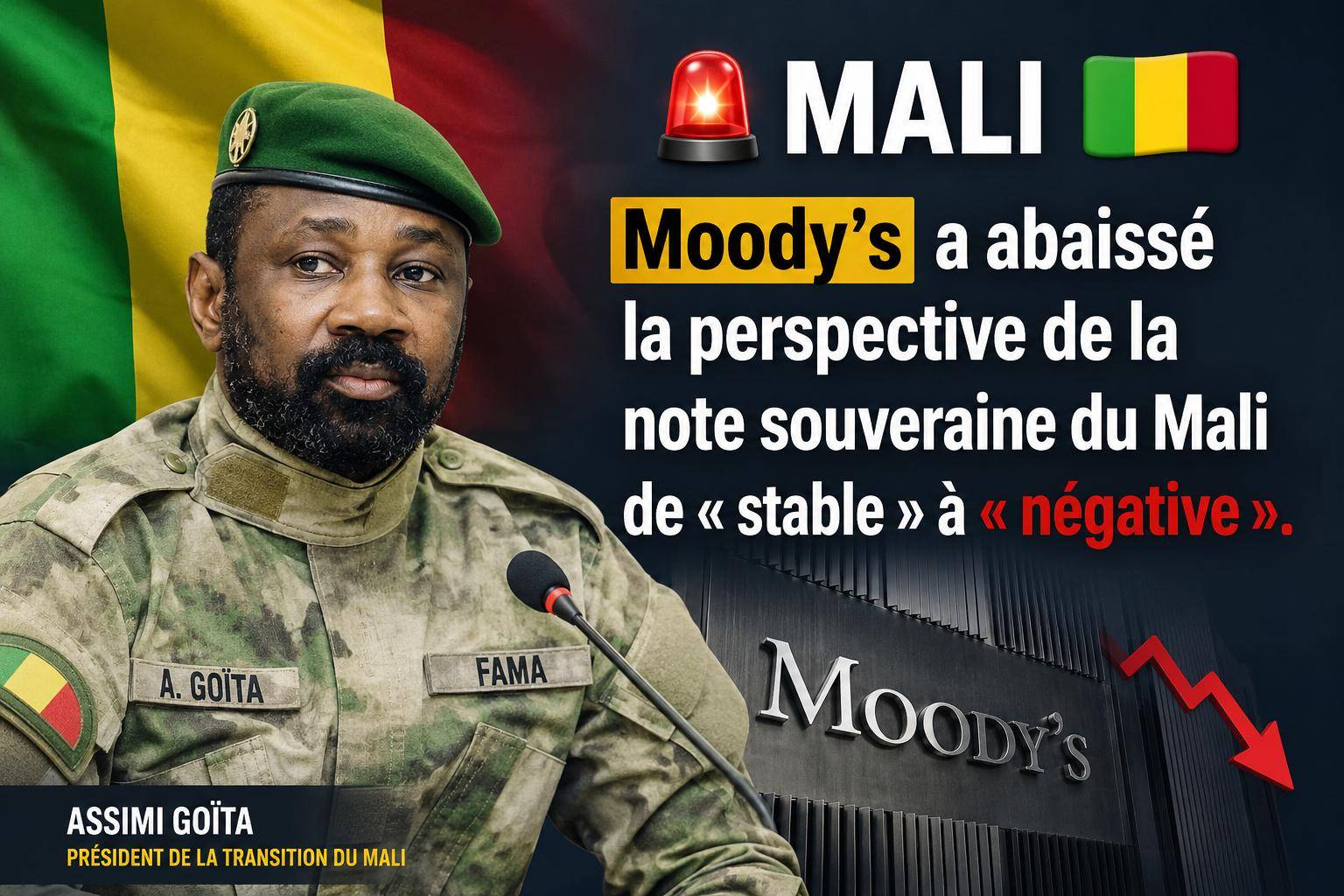
International credit rating agency Moody’s has downgraded Mali’s sovereign credit outlook from stable to negative, while retaining the Caa2 credit rating. This move underscores escalating risks in security, financing constraints in the regional market, and lingering political uncertainties, sending a cautionary signal to both domestic and international investors about the country’s economic trajectory.
Financial downgrade reflects harsh realities
The shift in Moody’s assessment serves as a barometer of market sentiment. By changing the outlook to negative, the agency signals a heightened likelihood of a further rating downgrade in the near to medium term. The current Caa2 rating places Mali’s sovereign debt squarely in the high-risk, speculative category—an assessment that has not changed, but whose implications have now grown more severe.
The primary driver behind this decision is the ongoing deterioration in security conditions. Despite efforts to restructure the national defense apparatus and ongoing military operations, instability continues to hamper economic activity. Persistent attacks and shifting conflict zones disrupt supply chains, undermine agricultural output, and hinder the government’s ability to collect tax revenue across multiple regions.
Regional financing becomes a costly challenge
Beyond security concerns, Moody’s highlights a critical financial bottleneck. Mali has increasingly relied on the regional debt market of the West African Economic and Monetary Union (WAEMU) following the loss of access to traditional external financing due to diplomatic and institutional disruptions.
However, this regional market has tightened significantly. Interest rates set by the Central Bank of West African States (BCEAO) to curb inflation have driven up borrowing costs. For Mali’s Treasury, accessing funds has become substantially more expensive. Recent treasury bond issuances have shown mixed subscription rates, reflecting growing caution among regional investors—particularly commercial banks—toward Mali’s creditworthiness. This tightening of credit conditions restricts the government’s fiscal flexibility, making it harder to fund critical infrastructure projects and essential public services.
Political uncertainty casts a long shadow
The third major factor in Moody’s assessment is governance and the political transition timeline. Mali remains in a prolonged period of uncertainty, with repeated delays in electoral processes and ambiguity surrounding the restoration of constitutional order. This instability has eroded the confidence of multilateral partners and development financiers.
Adding to the uncertainty is Mali’s withdrawal from the Economic Community of West African States (ECOWAS), formalized through its alliance with Niger and Burkina Faso in the Alliance of Sahel States (AES). While authorities frame this move as an assertion of sovereignty and a shift toward new strategic partnerships, global financial markets view it as a source of legal and commercial unpredictability. Investors fear potential future trade barriers or disruptions to the free movement of capital across the subregion.
Real-world consequences for Mali’s citizens
While financial ratings may seem abstract, their impact on daily life is tangible. Higher borrowing costs for the state mean less public funding for essential services such as healthcare, education, and subsidies for basic goods. For local businesses, the ripple effects are immediate. Banks, heavily exposed to government debt, have become more reluctant to extend credit to the private sector. Small and medium-sized enterprises—key drivers of national employment—are now struggling with tighter liquidity, curtailing investment and job creation.
Mali’s economy, though resilient in certain sectors like gold mining and cotton production, remains deeply embedded in the global financial system. Reversing Moody’s negative outlook will require a delicate balance: restoring security, clarifying the political roadmap, and demonstrating disciplined fiscal management to rebuild investor confidence—both regionally and internationally.