
Togo’s education ministry exposes and dismantles a decades-old sms-based results scheme
For nearly two decades, Togo’s education system operated a covert revenue stream siphoning funds from vulnerable households through a deceptive SMS-based examination results system. The abrupt announcement by Education Minister Mama Omorou to terminate this practice has exposed what officials describe as a state-sanctioned financial scheme draining billions of West African francs from families across the country.
The mechanics of deception: stress turned into profit
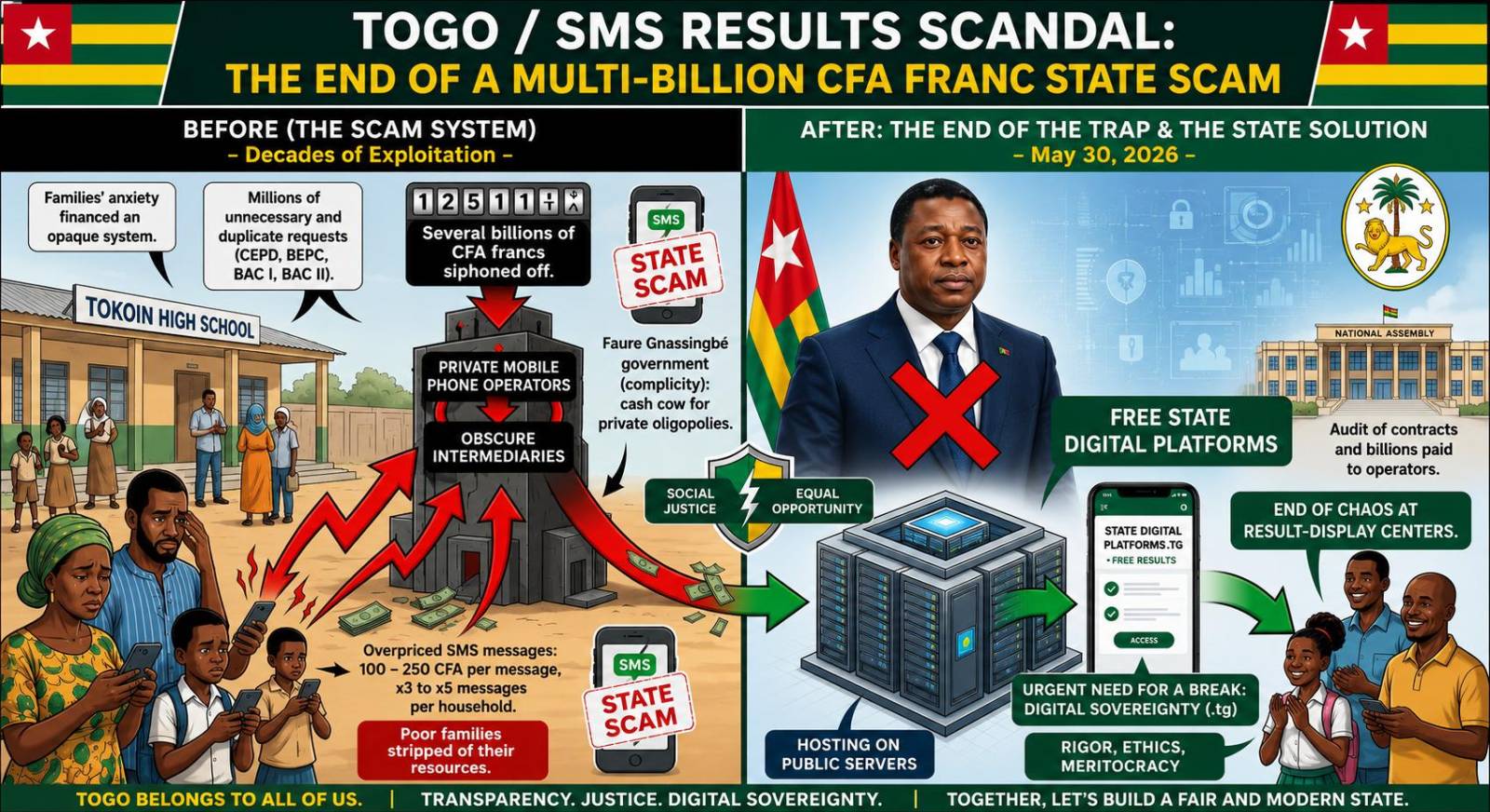
During a May 2026 inspection at BAC I examination correction centers in Tokoin and Agoè-centre, Minister Omorou revealed the true cost of this system. The process, he stated, was not merely inefficient but a deliberate financial trap. Families, gripped by anxiety over exam outcomes, repeatedly sent premium-rate SMS messages—each costing between 100 and 250 francs CFA—hoping to retrieve identical results. Each candidate’s household sent multiple identical queries, generating millions of redundant, overcharged messages that enriched private operators and intermediaries.
Financial scale: a billion-franc hemorrhage over time
While formal audits remain pending, preliminary analysis reveals staggering cumulative losses. With hundreds of thousands of candidates sitting national exams annually—including CEPD, BEPC, and Baccalaureate levels—and each family sending an average of three to five messages per session, the total volume of messages ran into the tens of millions per year. Extending this over the past two decades under the current administration, the financial toll exceeds several billion West African francs.
Rather than funding public education, these funds flowed into private telecom operators and shadowy intermediaries, beneficiaries of state concessions that operated unchecked for years. This amounted to a systemic transfer of wealth from impoverished families to private oligopolies, facilitated by tacit or active complicity of prior authorities.
Building a fair and transparent alternative
Minister Omorou’s decision to end the SMS system is a necessary first step, yet it demands urgent follow-through. Eliminating premium-rate messaging must not reintroduce the chaos of physical result displays—crowded, disorderly, and anxiety-inducing spaces where families gather for days in uncertain conditions.
Togo, which has promoted digital integration through its Ministry of Digital Economy, now faces a critical obligation: deploying a state-run, free, and secure digital platform for results publication. This system must adhere to three core principles:
- Digital sovereignty: Results must be hosted on public servers under the .tg domain, fully managed by the state.
- Full transparency: Access must be entirely free, funded from the national education budget to ensure equitable access across socioeconomic backgrounds.
- Modern delivery: Results should be disseminated via email waves or lightweight web portals optimized for mobile phones—technologies that are both affordable and widely accessible.
Restoring trust through ethics and merit
Beyond the financial scandal, the minister used the inspection to re-engage examiners, emphasizing that rigor, ethical conduct, and meritocracy must once again guide Togo’s education system. The announcement signals a profound ideological shift—one that prioritizes social justice by protecting families from institutionalized exploitation.
The question now is whether the government will follow through by auditing past telecom contracts to uncover the full extent of the financial embezzlement that has diverted billions from the future of Togo’s youth.